

The sign in the square changes the algebra
The books discuss a split-complex unit for a hyperbolic temporal pairing, while the phase-selection papers use an operator whose square is minus the identity. These are mathematically different structures. A shared use of the word “complex” does not make their scalar products or invariant forms interchangeable. [B10] [B18] [P03]
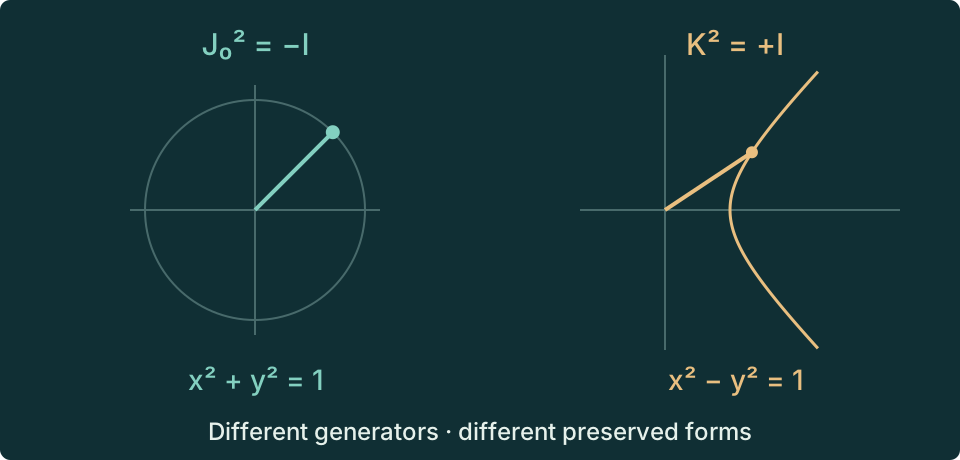
On a real plane, the ordinary phase generator J₀ exchanges the two coordinates with one minus sign. The split generator K exchanges them with no minus sign. Consequently J₀²=−I, whereas K²=+I. Their exponentials use circular and hyperbolic functions, respectively.
The animation compares the two transformations on explicit unit vectors. It is a mathematical illustration. Neither panel, by itself, reconstructs physical Lorentz symmetry or identifies an internal variable with a second laboratory clock.
Inspect the two invariants
Change the circular angle θ and the hyperbolic parameter η independently. The first point stays on a circle; the second stays on the right branch of a hyperbola. Play scans both supplied parameters so their distinct trajectories are easy to compare.
Explore · Exact finite illustration
Change the inputs and compare the numerical readout. Playback begins only when you press Play.
The interactive values require JavaScript. The diagram and worked equations provide the same mathematical construction.
The numerical readout checks x²+y² for the rotation and x²−y² for the hyperbolic transformation. Both equal one for these initial conditions. The apparent length of the hyperbolic vector in the Euclidean drawing changes, which is exactly why its invariant must be stated.
Compare the generators and their exponentials
| Structure | Preserved expression | Behaviour |
|---|---|---|
| Ordinary complex phase | x²+y² | Periodic rotation |
| Split-complex transformation | x²−y² | Hyperbolic transformation; not periodic |
The hyperbolic identity cosh²η−sinh²η=1 proves the second invariant. The split algebra also has nonzero zero divisors: (1+j)(1−j)=0 for j²=1. Ordinary complex numbers do not share that property.
A further, distinct bridge appears in Hermitian two-by-two matrices: their determinant has a Lorentzian algebraic form. This identity does not identify the ordinary complex unit i with a split unit j. It is a statement about a quadratic form on the real vector space of Hermitian matrices.
From an invariant to a physical interpretation
To use such structures as spacetime geometry, a reconstruction must specify its observables, admissible transformations, length and duration calibration, and physical clocks. A preserved difference of squares is mathematically useful, but an empirical spacetime interpretation requires more than the sign pattern. [P01] [P02] [B16]
The phase and temporal-geometry questions can therefore be connected without being collapsed into one. Circular phase describes a compatible recurrent scalar action. Hyperbolic pairing concerns a different invariant. The broader programme must identify the physical mechanism and measurement structure that relates them.
Continue to tests and predictions to see how a phase model can make a reserved numerical prediction and where an additional SMM/DTT claim would need independent evidence.