

Keep three controls distinct
A phase scan is more informative than a single bright or dark output. It separates the position of a fringe from its contrast. In the model used here, φ controls phase, p controls path balance, and ν controls the magnitude of retained coherence. These are three different inputs.
The nonnegative weights used in Emergence did not carry a phase-sensitive cross term. Here we explicitly supply complex amplitudes, a positive density matrix, a recombination operation, and the standard measurement rule. This added structure is what makes the comparison sensitive to phase. [B19] [B24]
The coherence parameter lies between zero and one. It represents a reduced description of an ensemble or a system whose path information may be correlated with other degrees of freedom. The slider is a model parameter, not a microscopic mechanism that explains why a particular apparatus loses coherence.
Scan a two-path fringe
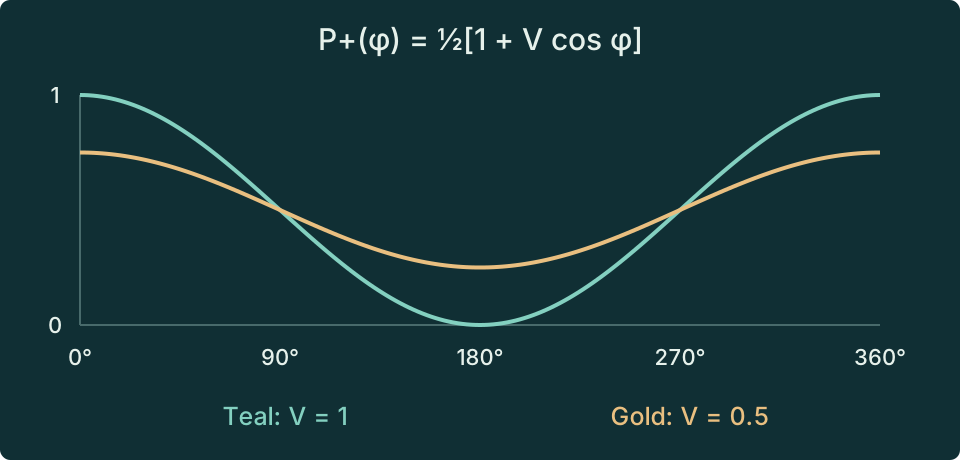
Change p and ν, then scan φ. Balanced paths with full coherence reach both zero and one. With ν=0, both recombined outputs remain at one half for every phase. If one path is absent, there is likewise no cross term to scan.
Explore · Standard quantum baseline
Change the inputs and compare the numerical readout. Playback begins only when you press Play.
The interactive values require JavaScript. The diagram and worked equations provide the same mathematical construction.
The plot shows expected probabilities. It does not display experimental data or randomly generated detector clicks. A single quantum detection gives one outcome; repeated preparations estimate the probabilities. A one-particle-at-a-time experiment can still build a phase-dependent distribution.
A positive two-path record
The matrix is Hermitian and has trace one. Its determinant is p(1−p)(1−ν²), so the allowed ranges 0≤p≤1 and 0≤ν≤1 make it positive semidefinite. Positivity is needed for every allowed measurement to return nonnegative probabilities.
The two probabilities sum to one. Their largest and smallest values give the fringe visibility (Pmax−Pmin)/(Pmax+Pmin)=V. Since 2√[p(1−p)]≤1, visibility never exceeds one.
Here D is the prior path predictability determined solely by the populations. The inequality follows directly from ν≤1; equality holds for full coherence. This D is not a complete measure of path information available in an arbitrary external detector, so the simple formula should not be extended to a different experiment without checking its definitions.
How coherence can be reduced
Suppose the two paths are correlated with marker states |e₁⟩ and |e₂⟩. Tracing out the marker multiplies the off-diagonal term by their overlap, with its magnitude contributing to ν and its phase absorbed into φ. Orthogonal markers remove the cross term in this reduced description. Identical markers preserve it. [B11]
Alternatively, averaging a fluctuating phase multiplies coherence by an average phase factor. The same reduced visibility can therefore have different physical explanations. A visibility measurement alone does not identify which mechanism is present, or demonstrate a unique SMM/DTT deviation from ordinary quantum theory.
Continue to detector records to see which extra comparisons recover phase information that a path-only measurement misses.