

Eight steps from structure to observation
Real rotations
Start with two real coordinates and a quarter-turn operator. Complex notation becomes a description of a structure we can already inspect.
↗02 / EXPLORESelecting phase
An oriented real flow selects a quarter-turn structure on its moving sector. Stationary modes reveal exactly where that selection stops.
↗03 / EXPLORERelative phase
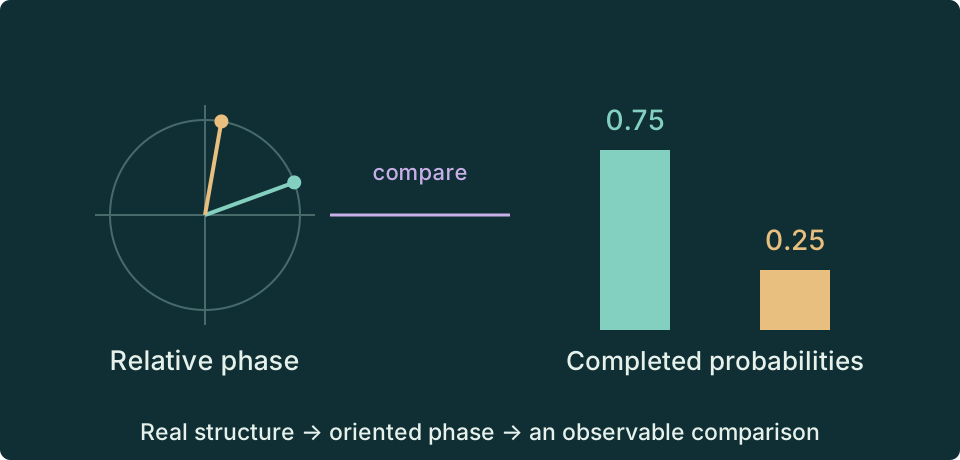
Rotate both alternatives together, then rotate one relative to the other. Only the second change affects the two-path comparison used here.
↗04 / EXPLOREInterference
Relative phase moves the fringe. Path balance and retained coherence set how far its probabilities can vary.
↗05 / EXPLOREDetector records
Equal path populations can hide different relative phases. Change the readout basis to expose the difference.
↗06 / EXPLOREShared phase
Selecting a complex structure locally is only part of the problem. Composite systems also need a rule for identifying their scalar actions.
↗07 / EXPLORETwo geometries
Ordinary complex phase preserves a positive norm. Split-complex transformations preserve a difference of squares.
↗08 / EXPLORETests & predictions
Fit a standard fringe using two synthetic calibration points. Reserve another angle for a prediction, and keep incompatible inputs visible.
↗Continue the Duality and Emergence journeys
Duality introduces inner generation and outer observation. Emergence follows a finite construction from generation addresses to completed records. Phase now asks what extra structure is needed when a later comparison can reveal interference.
A sequence of classical weights does not supply the phase-sensitive cross term automatically. This guide begins with a real rotation operator, explains oriented polar selection, and then supplies the standard quantum state and measurement rules for explicit two-path experiments. The distinction between those stages makes the dependency of each result visible. [B19] [P03] [B24]
| Stage | What is supplied | What can be inspected |
|---|---|---|
| Real structure | An inner product, operators, and a flow | Rotation, compatibility, polar orientation, and zero modes |
| Quantum baseline | Positive density matrices and a measurement rule | Relative phase, interference, and basis-dependent records |
| Physical test | A source mechanism, calibration, and reserved observations | Whether an additional proposal differs from the baseline |
The mathematical examples are reproducible. The experimental comparison is explicitly synthetic. Published results, standard quantum assumptions, and open physical questions are identified where they enter.
Change what the detector can see
Explore · Standard quantum baseline
Change the inputs and compare the numerical readout. Playback begins only when you press Play.
The interactive values require JavaScript. The diagram and worked equations provide the same mathematical construction.
A common phase turns both arrows together. A relative phase changes their comparison and the resulting probabilities. Continue to Which phase can a record reveal? for the derivation and the role of an external reference.
Choose a route through the argument
| Interest | Suggested route |
|---|---|
| Visual intuition | Real rotations → Relative phase → Interference |
| Mathematical reconstruction | Selecting phase → Shared phase → Two geometries |
| Observable consequences | Detector records → Tests & predictions → Sources & model |
Every chapter includes an original downloadable SVG, an interactive laboratory, mathematical detail, and source links. Use the shared reading controls to enlarge the text. Animations have explicit controls, pause when out of view, and respond to reduced-motion preferences.
The source page includes the full model specification, JavaScript source, and BibTeX/RIS references. The guide cites published papers and online book sections; it does not rely on unpublished manuscripts.