
A single source can generate many distinguishable histories. A physical SMM model must explain which distinctions persist, how they are observed, and why their relations acquire the structure of a spatial world.
1. A source before spatial location
The Single Monad Model begins with the proposal that the many structures encountered in experience have a common generative source. The source is “single” at the level of origin, while multiplicity concerns the distinguishable relations and records that arise through its activity. This is an ontological starting point: it asks what is fundamental, rather than assuming that every observed object is an independently existing primitive.
The description “pre-spatial” is essential. A point with coordinates already belongs to a space and inherits its topology, distances, and neighbouring points. Such a point cannot explain those structures merely by being called their origin. In a constructive account, the source is first described through allowed states and operations; spatial interpretation is assigned to appropriate relations among the resulting records.
Pre-spatial also need not mean an event located earlier on the ordinary cosmic clock. It can express an explanatory dependence: spatial records depend on generation, while the inner-generative description is not assumed to require the same completed spatial arena. A cosmological model would need additional arguments to connect this dependence with a beginning, expansion history, or specific early-universe state.
2. How one source can support many distinctions
A single rule can act repeatedly without producing identical records. Its output may depend on retained information, the state reached by earlier operations, or the allowed order of compositions. Thus unity of source does not imply that every event has the same observable content. The relevant question is what structured activity the source is permitted to carry out.
A simple finite example separates three counts: the number of active source operations, the number of possible histories, and the number of completed observable records. Suppose the source can perform two allowed operations, A and B. Histories of length three include AAA, AAB, ABA, and so on. There are eight formal words before constraints are imposed. A completion rule might distinguish all eight, identify some, or retain only a parity bit. None of those record counts follows from the number of active sources alone.
The example does not introduce eight fundamental substances. It introduces eight possible histories of one specified operational system. Conversely, saying there is one active operation at a time does not eliminate the resources needed to store the sequence. A physically explicit model must account for the memory that allows earlier activity to influence later behaviour.
3. Histories and the observable quotient
Let H be a collection of allowed histories. A completion map C assigns a retained result to a history, and an observation map O selects what the available tests can read. Their composition Π = O ∘ C is the accessible record. Two histories can then be identified when their accessible records agree.
A predictive identification must survive the operations that the model allows later. If U is one such operation, a well-defined update on record classes requires Π(h) = Π(k) to imply Π(Uh) = Π(Uk). Under that condition, V(Π(h)) = Π(Uh) gives the same answer whichever representative history is used. This is the elementary reason that a quotient can support its own dynamics.
If the implication fails, the present record is an incomplete state for that prediction. The model can retain more information, restrict the permitted operations, or use a reduced description with memory. These are different modelling choices. Discarding a distinction and then silently using it in a future prediction is inconsistent.
Open the full-size diagram →
4. A hidden sign makes the issue concrete
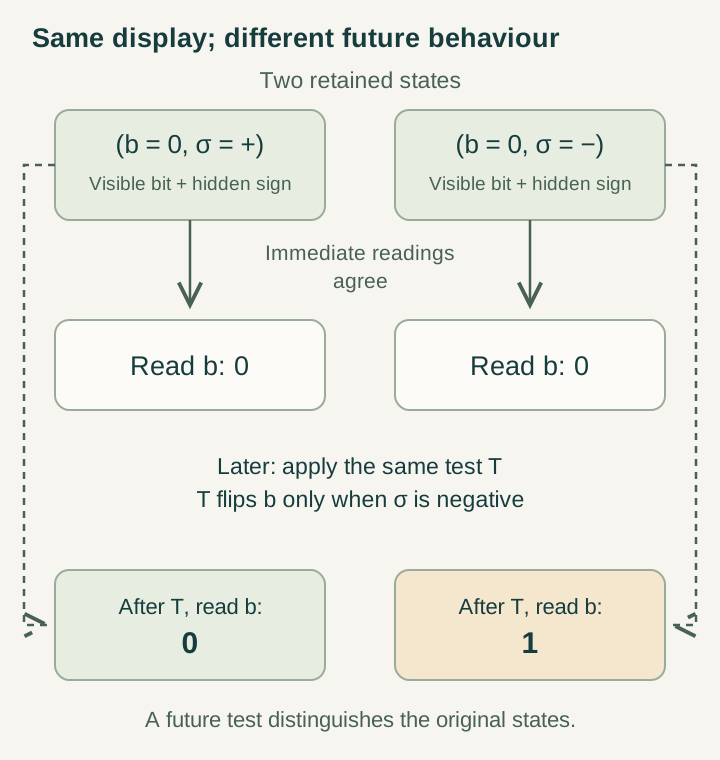
Take a completed record with a visible bit b and an internal sign σ. The states (0,+) and (0,−) both display b = 0. If the admitted tests can never convert σ into a visible distinction, the two records may consistently be treated as observationally equivalent.
Now allow a control T that flips the bit only when σ is negative. The same control produces visible outputs 0 and 1 from the two preparations. Once T followed by a bit measurement belongs to the test language, the initial records must be distinguished. The source has not changed; the family of accessible questions has changed.
This supplies an operational meaning for multiplicity. Distinctness is assessed through a specified family of comparisons, including future processing. It does not mean that arbitrary hidden differences are physical observables, nor that the observer creates those differences by looking. The measurement interface tells us which distinctions the model predicts can be accessed.
5. What an explicit source model must contain
| Ingredient | What must be specified |
|---|---|
| State | The degrees of freedom carried by the source, memory, controller, and relevant environment. |
| Update | One law acting on that state; any internal scheduling mechanism belongs to the law’s physical realization. |
| Memory | What persists between operations, how much can be retained, and when it may be overwritten. |
| Completion | A criterion and physical procedure for making a record available, including incomplete outcomes. |
| Readout | The observations used to define events, spatial relations, clock readings, and matter behaviour. |
| Resources | The capacity, energy scales, locality constraints, and preparation conditions required by the construction. |
An autonomous model can include a controller, but the controller is then part of the system. Replacing an external operator by an internal schedule does not by itself explain why the schedule has its particular geometry, clock coupling, or interaction strength. The stronger SMM aim is to constrain several of these features through the same selected dynamics.
A useful mathematical notation is zₙ₊₁ = U(zₙ), where z includes everything needed for the next update. The integer n labels iterations in the description. A physical clock is a separately specified readout T(z), whose relation to that iteration count must be established. The distinction becomes important when different preparations complete after different amounts of internal work.
6. Persistence through renewed generation
The idea of renewed creation motivates a question about identity: how can an object remain recognizably the same while its physical state changes? In a record-based model, persistence can be expressed through stable relations among successive completed configurations. An object need not correspond to an unchanged microscopic label if the properties that identify it are reliably transported and retained.
For example, a pattern may occupy different register entries at successive updates while preserving a conserved charge and a repeatable set of correlations. The model must provide a rule that identifies those patterns across records. A translation of a pattern, a deformation of it, and its destruction should lead to distinguishable operational consequences.
This is a route to describing matter as organized activity, but stability has to be demonstrated. A repeated pattern is not automatically a bound particle. One needs a dynamical reason that the pattern survives perturbations, a spectrum or effective evolution describing its excitations, and a consistent coupling to the clocks and geometry produced by the same framework.
7. From relations to local space
Begin with labels that have no assigned positions. Declare an adjacency relation when an allowed completed operation connects two record states. This produces a graph. If a cost is assigned to each edge, the least total cost over connecting paths gives a candidate distance. The construction derives a graph distance from a stated operational rule; it has not yet established that the resulting graph resembles three-dimensional space.
A graph can have long-range shortcuts, irregular branching, or disconnected sectors. A cubic lattice requires particular relations. Even on that lattice, counting nearest-neighbour steps gives a Manhattan-type distance, while an isotropic Euclidean distance requires another comparison or a justified limiting procedure. Dimensional growth, distance, diffusion, and signal propagation should therefore be examined separately.
The central selection question is why the source produces and maintains a local relational structure rather than any of the many alternatives it can formally encode. A constructed lattice establishes possibility. A source law that robustly favours suitable locality would establish something stronger. The locality article explains this distinction in a particular relational ensemble.
8. Why unity alone does not select geometry
A short mathematical argument shows the importance of additional structure. Suppose a nonzero real vector space is supplied with no distinguished metric or operations, and a proposed bilinear form B must be invariant under every active linear automorphism. In particular it must be invariant under multiplication by 2. Bilinearity then gives B(2v,2w) = 4B(v,w), while invariance requires this to equal B(v,w). Therefore B must vanish.
The result does not rule out emergent geometry. It identifies what is missing from an overly sparse starting point. Operations, a state, a norm, a completion mechanism, or a selected family of observations can reduce the symmetry and make nontrivial structures distinguishable. A rigorous reconstruction should state which of those additions does the selecting.
For SMM, the productive objective is therefore a structured common-source principle: a source together with justified dynamical and operational properties. A proof then shows what those properties require. The role of the original unity premise is to organize the search for a shared explanation across sectors, while the detailed laws carry the mathematical work.
9. Historical motivation and the modern programme
The book series develops the source proposal in conversation with Ibn al-Arabi’s account of time and renewed creation. That historical setting gives the project its distinctive questions about unity, manifestation, and temporal dependence. Reading those ideas in their textual and philosophical setting is worthwhile in its own right.
The later mathematical programme asks additional questions that require explicit definitions and proofs. A philosophical analogy can motivate a construction, but a physical conclusion depends on the construction’s actual assumptions and its connection to observation. Keeping the connection explicit allows the historical work and the formal research to strengthen one another without treating them as the same kind of evidence.
Continue with the guide to Volume I for the book’s place in the programme, or move to the DTT guide to see how the generation–completion distinction organizes the next stage of the mathematical account.
Further reading
Continue with the individual articles and their source references.
- The Single Monad Model of the Cosmos
The Single Monad Model proposes one generative source for the many events of experience. Its central concepts lead to a precise question: how can common dynamics produce geometry, clocks and matter together?
- The Principle of Ever-renewed Creation
Ever-renewed creation motivates an account of persistence through changing states. Update rules, invariants and retained memory show what SMM/DTT must specify for renewed records to support recognizable objects and continuous histories.
- The Three Hypotheses of the Single Monad Model
The three SMM hypotheses concern a common source, lawful renewal and the relation between generative order and observed time. Their combined physical content depends on a shared dynamics that constrains geometry, clocks and propagation together.
- The Structure of the Monad
Indivisibility does not necessarily mean an absence of mathematical structure. State-space and operational examples distinguish a monad’s conceptual organization from separable physical parts and measurable constituents.
- One action, two temporal roles
Inner generation and outer record order can be roles of one process. A completed return becomes an observable advance only when its action respects the retained records and their tests.
- When two histories count as the same observation
Completion identifies histories that leave the same record, while observation identifies records that available tests cannot distinguish. Their combined quotient is consistent only with the declared operations and contexts.
- Test languages and observable quotients
A test language determines which records an observer can distinguish. Enlarging that language refines the observable quotient and reveals when apparently different instruments retain the same information.
- Why local geometry can be statistically rare
Lattice-like signed operation tables are rare in the stated permutation ensemble, with an entropy penalty of order N log N. Bounded selection costs cannot overcome that asymptotic disadvantage under the theorem's assumptions.
- Six inner stages and one publication interface
A six-digit nested counter with paired signed readout realizes ranks 1, 1, 2, 2, 3, 3 before one completion interface. Its exact counts reveal sampling bias and the restricted assumptions behind the six-channel bound.
- Why a bare source does not imply spacetime
A structureless source cannot select a nonzero metric, an oriented vector or a proper causal cone while preserving every change of representation. Recurrence, composition and observable readout supply the additional structure needed for an SMM/DTT reconstruction.
- Reading Volume I: time and creation
Volume I introduces the historical questions about time, creation and unity that motivate SMM. This thematic guide connects relational duration and renewal to modern questions about retained identity, while separating textual interpretation from physical derivation.
Continue the connection
Follow the next guide, or return to the reading paths.