A six-digit nested counter with paired signed readout realizes ranks 1, 1, 2, 2, 3, 3 before one completion interface. Its exact counts reveal sampling bias and the restricted assumptions behind the six-channel bound.
Six inner levels can be represented as nested carry periods of one counter, followed by a single interface that publishes a completed archive. Pairing adjacent digits with opposite readout signs gives an explicit three-direction construction. This article calculates its ranks and sampling multiplicities, then identifies the restricted primitive-channel assumptions needed for a six-channel lower bound.
02One counter, six nested carry periods
A radix-q counter has six digits d₁,…,d₆ and advances by one elementary source update. Digit a changes on a slower carry period q^(a−1); higher levels organize completed lower-level cycles. The counter is one evolution parameter with nested internal organization. The readout pairs adjacent digits with opposite signs along three chosen readout directions. The pairing, frame and length scale are supplied interface data. This model gives an exact interpretation to six nested inner stages without introducing six independently adjustable time axes.
n = Σₐ₌₁⁶ q^(a−1)dₐ, 0≤dₐ<q
Q(d) = ℓ Σᵦ₌₁³(d₂ᵦ₋₁−d₂ᵦ)eᵦ
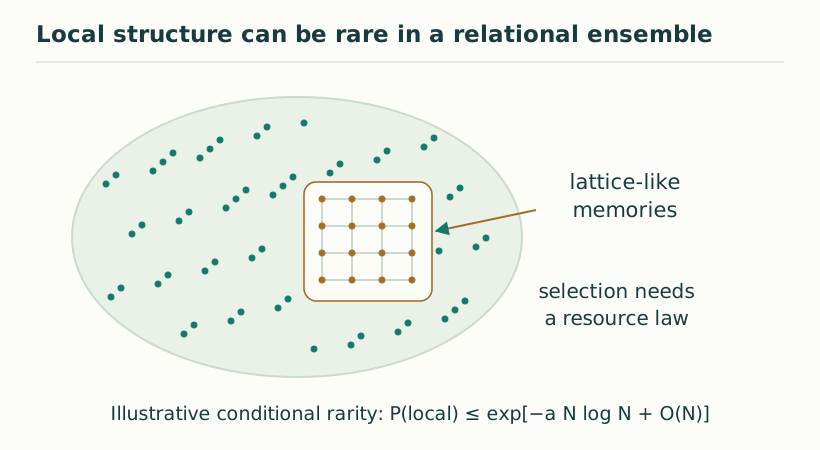
Figure 1. Local structure can be rare in a relational ensemble. A schematic ensemble contrasts arbitrary relational memories with a small lattice-like subset. In the stated permutation model, rarity is exponentially strong in N log N; constructing an example does not establish spontaneous selection. View full size ↗
03Why the ranks are 1, 1, 2, 2, 3, 3
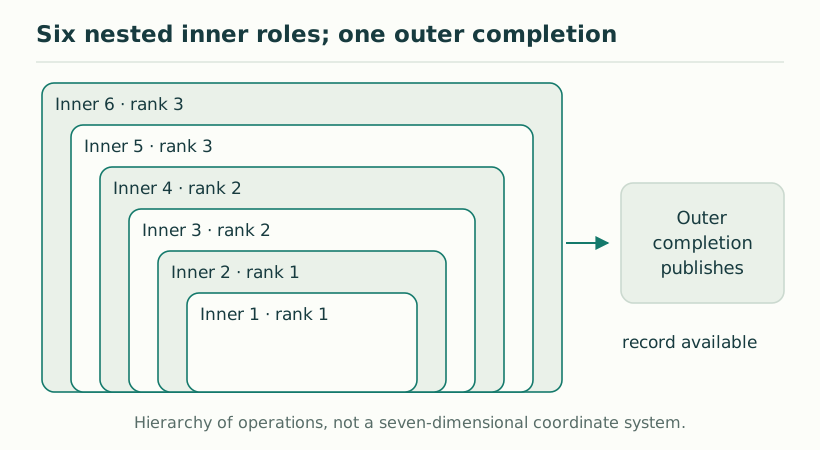
During the first qᵃ visited addresses, only the first a digits vary freely. One digit opens a direction; its partner extends the available signed differences in that same direction. A third digit opens the second direction, and so on. The affine rank therefore equals the ceiling of a/2. At each completed pair the corresponding coordinate ranges from −(q−1) to q−1. The rank calculation is elementary and exact for this specified readout, but does not prove that every possible three-dimensional generator must use this scheme.
rank of the a-stage prefix = ⌈a/2⌉
number of full-readout sites = (2q−1)³
04A binary example reveals both compression and bias
For q=2, the counter visits 64 addresses but the readout has only 27 sites in {−1,0,1}³. Each coordinate difference has multiplicities 1,2,1. Consequently the central site has eight source addresses while a corner has one. Uniform visitation of source addresses is therefore not uniform sampling of spatial sites. The example also shows why a completed archive must say whether it retains multiplicity, averages it away, or chooses a canonical representative. Those different record rules lead to different observable statistics.
Figure 2. Six nested inner roles; one outer completion. The six inner roles are nested functional stages with readout ranks 1, 1, 2, 2, 3, 3. The outer completion publishes the resulting record. These are not seven independent time axes. View full size ↗
05Publication and transport require their own rules
The seventh level publishes the completed archive after the designated episode. It is neither a seventh digit nor an additional spatial direction. The source scan can make large projected jumps when a carry resets digits, so its private traversal must not be identified with particle motion. Guarded transport can be applied to the retained sites after a complete episode, with a separate bound on support propagation. This makes the temporal hierarchy operationally coherent while leaving physical clock calibration, unbiased sampling and the selection of the pairing as explicit research tasks.
06What the six-channel lower bound really proves
The manuscript proves a restricted minimality result: if each primitive nonnegative channel is paired with an opposite partner under an involution and the readout is odd under that pairing, a rank-three output needs at least six channels. The odd eigenspace receives at most one dimension from each exchanged pair. However three already signed coordinates, or four nonnegative tetrahedral generators without individual opposite partners, evade that primitive-channel restriction. To turn the channel bound into a bound on nested stages one must additionally require one primitive channel per level. This careful qualification preserves the exact result while identifying which architectural choice carries the six-stage claim.
07What would complete the physical explanation
The six inner stages in this research programme are nested roles of a single generation–completion process. The seventh level publishes a completed configuration; it is not another independent time coordinate. The locality paper supplies concrete finite implementations of this architecture, but their schedules, memory and permitted transport remain specified inputs. A stronger SMM/DTT account would select those ingredients with one physical update law and explain why they persist under perturbation. It would also calibrate graph steps and completion counts against actual rulers and clocks. A proof about a finite labelled memory is valuable even before that programme is complete, provided its conclusion is kept at the level established by its hypotheses.
There is also a metric distinction inside the lattice example. Counting elementary signed operations produces a word metric, which on the standard lattice is the Manhattan metric. A Euclidean-looking embedding or cubic volume growth does not automatically replace that metric by an isotropic Euclidean norm. A continuum limit must specify the probe, its allowed directions and any averaging or refinement that makes its comparison law isotropic. This is why adjacency, volume growth, diffusion, calibrated distance and signal propagation should be checked separately even after an exact lattice neighbourhood theorem has been proved.
KEEP THE CONNECTION
Key ideas
Six stages are nested carry roles of one update process.
The rank sequence follows from a supplied paired readout.
The seventh level publishes records; source scan order is not particle motion.
Scope of the argument. Finite realization of the specified bilateral hierarchy; no universal necessity theorem for six stages.
Sources & further reading
temporal_locality_v8(1).pdf — working draftpp. 3–4, Proposition 1.1; pp. 21–23, §11.4
Source editions and catalogue entries
Working manuscript
Temporal locality — working draft v8
Working manuscript. Article-level references identify the consulted sections and the scope of the interpretation. No public URL was supplied for this exact manuscript version.