
SMM supplies the common-source proposal. DTT develops the distinction between inner generation and outer completion. The research connects these ideas to explicit operations, retained records, mathematical structures, and physical readouts.
1. Begin with the question
Ordinary descriptions of motion begin with objects, positions, and a time coordinate. SMM/DTT asks a prior question: what process makes those objects and spatial relations available in the first place? In this programme, a completed spatial configuration is something to explain. The investigation therefore begins with generation, the retention of distinctions, and the rules that allow one configuration to be compared with another.
The Single Monad Model proposes a common origin for observable multiplicity. “Monad” refers to that proposed source; it does not mean a small particle sitting at the centre of an already existing space. The Duality of Time Theory distinguishes the organization of generation from the order in which completed results become available. These two temporal roles motivate a research programme rather than a second ordinary clock placed beside the first.
A reader can enter through philosophy, mathematics, or physics. The philosophical question concerns unity and multiplicity. The mathematical question asks which structures follow from stated operations. The physical question asks how those structures correspond to actual preparations, clocks, distances, and particles. Moving between these questions requires an explicit argument at each step.
2. Two temporal roles in one process
Imagine a process that prepares a result through several internal operations and exposes the result only after a completion condition is met. Substantial internal activity can occur while the accessible record remains unchanged. When a new record is retained, an observer can distinguish a new event. DTT uses this difference between formation and completed availability as its starting point.
A manuscript being composed before a finished paragraph is saved offers a useful everyday analogy. It shows why internal work and accessible versions need not coincide. The physical model must go further: it must identify what plays the roles of working state, memory, completion condition, and observer. A familiar analogy does not establish that nature uses the same mechanism.
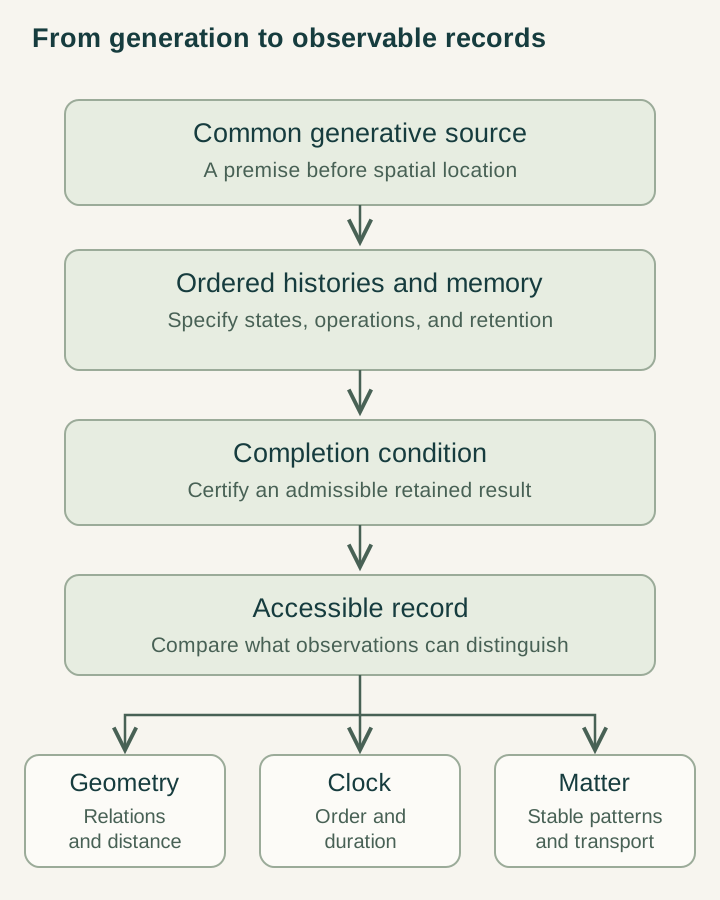
Open the full-size diagram →
The key vocabulary is therefore compact: a history is an allowed sequence of operations; a record is information retained for observation; completion is the rule that makes a result available; and a clock reading is a physical observable used to compare durations. Record order alone does not yet supply a duration in seconds.
3. A first worked example
Consider an internal phase with four positions, q = 0, 1, 2, 3. A fixed update advances q by one, returning to zero after four steps. Let a record register m increase only on that return. The same update then supports two descriptions: four elementary internal advances and one new completed record.
(3,m) → (0,m+1).Illustrative discrete update. The register is part of the state; it is not an unexplained external observer.
Starting at (0,0), the states are (1,0), (2,0), (3,0), and (0,1). The record m is unchanged during the first three advances. After completion it distinguishes the new event. This is an exact example of a process with internal and recorded order, but its four-step rule and register behaviour were chosen as inputs.
A physical implementation must also explain the register’s capacity and the mechanism that protects its contents. An indefinitely growing mathematical counter assumes indefinitely available memory. A finite device has a finite retention window or must specify what is erased, exported, or overwritten. These questions make the example more informative: they identify the work needed to turn a diagram of time into a dynamical model.
4. What the six inner levels mean
The current nested-stage interpretation assigns six inner functional roles to the construction of spatial records, with an outer completion as a seventh role. Higher stages depend on completed lower-stage activity. The levels are therefore a hierarchy within generation; they are not six independently adjustable time coordinates.
One illustrative paired readout has ranks 1, 1, 2, 2, 3, 3. A first channel opens a direction and its partner supplies an opposite contribution in that direction; the next pair opens a second direction, then the final pair a third. The detailed DTT guide shows a finite counter example, including what is assumed in that pairing and what the rank calculation actually proves.
It is helpful to distinguish realizing this hierarchy from proving that it is necessary. A realization gives an explicit model with the intended behaviour. Necessity would show that every model satisfying the stated source principles must have the relevant structure, or that specified alternatives are excluded. Both are useful results, but they answer different questions.
5. How the parts of the programme connect
| Question | The connection to investigate | Where to continue |
|---|---|---|
| Why is there multiplicity? | One source generates distinguishable histories and retained relations. | The SMM guide |
| Why do events appear ordered? | Completed records support an availability order and a calibrated clock. | The DTT guide |
| Why use complex amplitudes? | An oriented real dynamics can constrain compatible phase structures. | Real-commutant phase selection: a paper guide |
| How could space emerge? | Record relations must select locality, dimensionality, distance, and propagation. | Why local geometry can be statistically rare |
| What could fix a constant? | A structural construction must connect to a normalized physical response. | The constants programme |
These questions are connected without being interchangeable. A three-dimensional algebraic readout is not yet a metric space with stable local matter. A clock variable is not yet a universal physical time standard. A finite integer count is not yet a measured interaction strength. The research becomes stronger when the same source law constrains these quantities together.
6. How to read a result on this website
Look first for the input data. Which state space, update, observer, or algebra is being assumed? Next identify the exact conclusion. Does it concern an equivalence relation, a dimension, a spectrum, a response, or an observable protocol? Finally ask what connects the mathematical object to a physical measurement. This three-step reading method prevents a useful construction from being mistaken for a broader claim it does not establish.
For example, a selected counting rule can give 137 exactly. To identify its reciprocal with an electromagnetic coupling, the model must also select the response operator, the source normalization, and the matter interaction. The research guide works through why this extra bridge matters. The ideal vacuum label α₀ is also distinct from assigning a value at a particular renormalization scale.
Published papers, explanatory articles, and working-draft developments have different roles. A paper is the source for its stated theorem. A guide helps make the argument accessible. A draft can explore an unfinished extension. Use the papers catalogue and each article’s references to locate the relevant source and version.
7. Choose a route through the site
For a first conceptual reading: continue to the SMM guide, then DTT, then the postulate. Read the examples before following the notation. The glossary is designed to be used alongside those pages.
For a mathematical reading: start with histories and observable equivalence, then phase selection, geometry, clocks, and response. Keep track of the assumptions that are carried from one construction into the next.
For the books and historical motivation: use the historical route and the book guides. They provide the setting for the source idea and renewed creation, while the technical articles describe later mathematical developments.
The expanded reading paths give ordered article sequences, prerequisites, and a specific question to answer at the end of each route. You can stop after an introductory route or continue into the detailed derivations without losing the thread.
Further reading
Continue with the individual articles and their source references.
- The Single Monad Model of the Cosmos
The Single Monad Model proposes one generative source for the many events of experience. Its central concepts lead to a precise question: how can common dynamics produce geometry, clocks and matter together?
- The Principle of Ever-renewed Creation
Ever-renewed creation motivates an account of persistence through changing states. Update rules, invariants and retained memory show what SMM/DTT must specify for renewed records to support recognizable objects and continuous histories.
- One action, two temporal roles
Inner generation and outer record order can be roles of one process. A completed return becomes an observable advance only when its action respects the retained records and their tests.
- When two histories count as the same observation
Completion identifies histories that leave the same record, while observation identifies records that available tests cannot distinguish. Their combined quotient is consistent only with the declared operations and contexts.
- Six inner stages and one publication interface
A six-digit nested counter with paired signed readout realizes ranks 1, 1, 2, 2, 3, 3 before one completion interface. Its exact counts reveal sampling bias and the restricted assumptions behind the six-channel bound.
- Completion, commutants, and positive frequency
This guide follows completion, compatible complex structures and positive-frequency selection through their separate mathematical roles. Finite examples connect the framework to SMM/DTT while keeping causal readout and physical calibration as additional constructions.
- Real-commutant phase selection: a paper guide
An oriented real orthogonal flow can select an ordinary complex structure on its dynamic sector. Planar examples explain residual zero-mode freedom, time-reversal antilinearity and the extra balancing rule needed for composite systems.
- Temporal asymmetry: reading the published model
The temporal-asymmetry model connects projected dynamics with memory and path dependence. A solvable hidden-mode example distinguishes those effects from dissipative stability and from evidence for a second observable clock.
- The DoT postulate: a compact reading route
The DoT postulate connects nested inner generation with completed outer observation. This guide turns that statement into explicit requirements for histories, updates, retained records, spatial readout and covariant physical clocks.
Continue the connection
Follow the next guide, or return to the reading paths.