
The postulate motivates the repeated generation of spatial configurations through nested inner activity before outer completion. A constructive formulation states the dynamics, memory, completion criterion, and readouts before deriving their consequences.
1. A working statement of the postulate
In the DTT picture, a spatial configuration is generated through nested inner temporal activity and becomes available to observation through outer completion. This sentence is an explanatory paraphrase for the website, not a quotation from a particular edition of the DoT book. Its purpose is to identify the task that a mathematical formulation must carry out.
The statement changes the starting point of the explanation. A spatial arena is not simply assumed to be fully present while objects move within it. The construction of spatial relations is included in what the theory seeks to explain. Matter and clocks must ultimately belong to the same generated structure if the programme is to provide a unified account.
Several consequences are objectives of this research: stable locality, physical dimensionality, a common clock–propagation relation, and the appearance of familiar quantum and relativistic structures. These objectives do not follow merely by restating the postulate. Each requires definitions and a derivation from specified source properties.
2. The minimum specification of a model
| Object | Operational question |
|---|---|
| State space Z | What information is needed to predict the next update? |
| Retained memory M | Which distinctions survive from earlier activity, and at what capacity cost? |
| Autonomous update U | What one law advances the complete state, including its controller? |
| Admitted operations | Which preparations, local controls, and compositions are physically permitted? |
| Completion rule κ | How is a completed result certified, and what happens on other outcomes? |
| Clock observable T | Which measurable quantity supplies a duration reading? |
| Spatial readout Q | Which comparisons define adjacency, length, direction, or geometry? |
| Resource budget | What memory, energy, precision, preparation, and reset resources are available? |
These ingredients can be linked, but their links should be shown. A source can use one controller to execute separately chosen rules for space, clocks, and matter. That is an implementation of several rules; it is not yet a reason that those rules agree. A stronger result derives the agreement from a shared interaction, constraint, or invariance principle.
3. From updates to completed records
Let zₙ = Uⁿ(z₀) describe the complete state after n elementary updates. Let nₖ label the selected visits to a completion section κ(z) = 1. A record map R and a physical clock readout T give the observable sequence below.
rₖ = R(znₖ), τₖ = T(znₖ).The iteration label n, completed-event label k, and physical reading τ have different definitions.
The waiting time nₖ₊₁ − nₖ may depend on the state. Even if it is constant, the conversion from elementary updates to seconds requires a clock calibration. If completion is probabilistic, waiting-time distributions and incomplete outcomes must be included rather than replaced by successful-event averages alone.
This notation makes an important question visible: do the records contain enough information to predict the next completed record? If two complete states have the same rₖ but different future record distributions, a description using rₖ alone needs additional memory or a restricted domain of validity.
4. A complete small example of the two roles
Use states (q,m), where q ∈ {0,1,2,3} is an internal phase and m counts retained completed records. The fixed update advances q and increases m precisely when q returns from 3 to 0. The completion section is q = 0. For an ideal unbounded register, the completed sequence reads m = 0,1,2,… while each event contains four internal advances.
U(3,m) = (0,m+1); κ(q,m) = 1 exactly when q = 0.
All rules are now explicit. The same state update produces the internal recurrence and the registered event sequence. But the example contains a chosen four-phase schedule, a chosen completion section, and a chosen memory update. It neither derives six inner levels nor produces spatial locality or a particle spectrum.
To make a finite version, restrict m to 0,…,M and specify what happens at capacity. One option is a terminal state with no further accepted records. Another is overwrite with a finite accessible history. These options produce different observable processes, so the capacity rule is part of the model. The exercise shows what “complete specification” means even before the richer physics is added.
5. A short derivation of observable dynamics
Suppose Π maps complete histories to their observable records. We want a map V that advances a record without needing to know which hidden history produced it. Define V(Π(h)) = Π(Uh). This definition works if and only if equal observable inputs give equal observable outputs.
Then V ∘ Π = Π ∘ U.
The proof is direct. Choose any representative h of a record r. Set V(r) = Π(Uh). If k is another representative, the displayed implication guarantees the same result. Conversely, if V is already a function of r alone, then equivalent representatives must give equal updated records. This is the exact condition for the update to descend to the quotient.
For stochastic or quantum models, the corresponding statement concerns equality of future output probabilities under the admitted controls. A reduced evolution can remain valid without being memoryless, provided the needed history dependence is stated. The postulate therefore leads naturally to a concrete information question: what must a completed record retain to support the predictions we ask of it?
6. What a six-level necessity result would need
The paired-readout construction explains the ranks 1,1,2,2,3,3 once the channel organization is given. A restricted lower bound can also be stated: if primitive nonnegative channels occur in exchanged opposite pairs and the readout is odd under that exchange, each pair contributes at most one independent odd direction. Three independent directions therefore require at least three pairs, or six channels.
This conclusion is tied to its hypotheses. Three primitive signed coordinates do not satisfy the same nonnegative-channel restriction; other generator sets may not carry individual opposite partners. To convert a lower bound on channels into a lower bound on nested levels, one also needs the rule that each level supplies one primitive channel.
The mathematical task is to derive those restrictions from the source principles or to justify them operationally. The resulting theorem would then say exactly why the nested architecture is selected within the declared model class. The six-stage article provides the finite realization and its qualifications.
7. A conditional geometry–clock relation
Suppose each parent record has B distinguishable children and the measured scale shrinks by q⁻¹ at each refinement, with B > 1 and q > 1. After n refinements, Nₙ = Bⁿ and ℓₙ = Lq⁻ⁿ. The associated scaling exponent is obtained by eliminating n.
Now suppose an independently specified encoder assigns a branch activity u = a⋆ log B and a scale activity τ = a⋆ log q with one common calibration a⋆. Their ratio equals D. If matter evolves against u and a protected physical clock reads τ, its band velocity converts by the same factor.
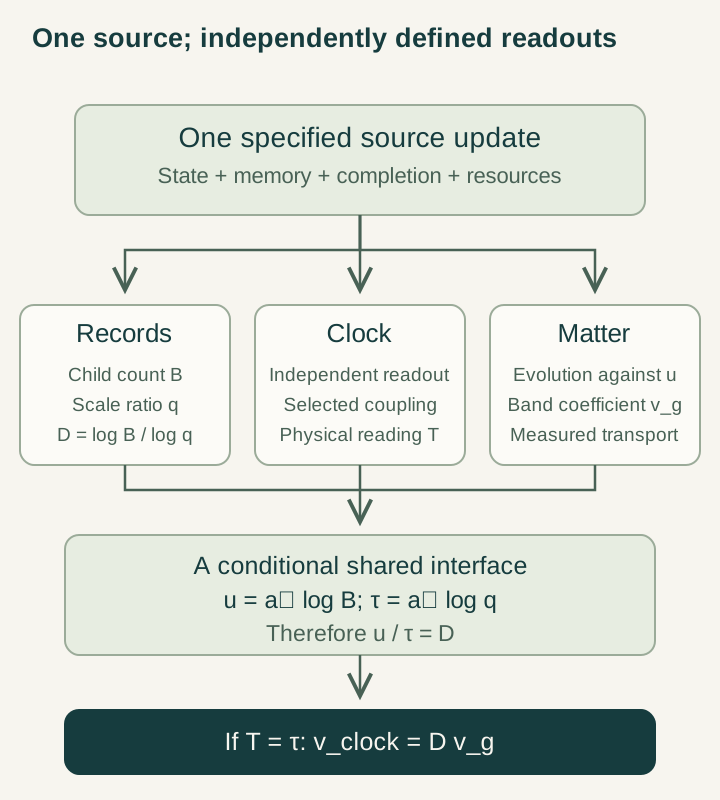
Open the full-size diagram →
A counterexample identifies the remaining freedom. Keep the same record geometry and matter evolution, but use a clock reading T = u + τ. Then u/T = D/(D+1), and the converted velocity becomes Dv₍g₎/(D+1). The desired D factor therefore requires selection of the relevant clock class. A stronger source theorem would make that selection follow from the common dynamics.
8. A cone bound and its physical interpretation
Suppose each completed operation has positive delay Θ and its readout displacement satisfies ‖Δx‖ ≤ c⋆Θ. Concatenating two such operations preserves the bound: the triangle inequality gives ‖Δx₁ + Δx₂‖ ≤ ‖Δx₁‖ + ‖Δx₂‖ ≤ c⋆(Θ₁ + Θ₂). Thus the admitted displacement–delay pairs form a composition-stable causal bound.
This is a useful exact result once the length, delay, and composition rules are fixed. Interpreting the cone as the physical light cone requires more: the same calibrated bound must govern the relevant signals, and accessible clock–ruler transformations must realize the appropriate symmetries. A group velocity for a selected band, a bound on influence, and a universal limiting speed are not automatically the same quantity.
Likewise, an algebraic Lorentzian cone does not by itself supply gravitational field equations. The next question is which further laws for dynamics, curvature, and matter are selected by the source. Keeping these steps explicit makes the route to relativity assessable.
9. How to use the postulate constructively
For any proposed consequence, write down four things: the source assumptions, the mathematical result, the observation map, and the remaining selection problem. Then try to construct an alternative model that satisfies the assumptions but changes the conclusion. If an alternative exists, it identifies a missing premise or a genuinely open degree of freedom.
The aim is not to accumulate separate mechanisms under one name. It is to reduce the number of independently chosen rules by deriving their compatibility. Stable locality, a physically selected clock, matter propagation, and normalized response are especially useful targets because each connects several parts of the programme.
The research map organizes these targets and links them to published results and detailed article sequences. For the concise book presentation, begin with the DoT reading guide.
Further reading
Continue with the individual articles and their source references.
- One action, two temporal roles
Inner generation and outer record order can be roles of one process. A completed return becomes an observable advance only when its action respects the retained records and their tests.
- When two histories count as the same observation
Completion identifies histories that leave the same record, while observation identifies records that available tests cannot distinguish. Their combined quotient is consistent only with the declared operations and contexts.
- From available records to a temporal arrow
Completed returns that preserve or increase accessible records form a positive monoid. Under additional separation and clock conditions, this supplies an effective forward order without proving thermodynamic irreversibility.
- Nested operations and clock independence
Clock independence must survive every admitted interleaving of branch and resolution operations. The orbit-algebra criterion removes branch effects from all such finite sequences and supplies an accumulated-error bound.
- From record refinement to a joint clock–band relation
Independent count, scale, phase, clock, and band measurements can satisfy a joint refinement relation under the supplied interfaces. The ungated-clock alternative identifies why the protected-clock premise remains essential.
- Six inner stages and one publication interface
A six-digit nested counter with paired signed readout realizes ranks 1, 1, 2, 2, 3, 3 before one completion interface. Its exact counts reveal sampling bias and the restricted assumptions behind the six-channel bound.
- Why a bare source does not imply spacetime
A structureless source cannot select a nonzero metric, an oriented vector or a proper causal cone while preserving every change of representation. Recurrence, composition and observable readout supply the additional structure needed for an SMM/DTT reconstruction.
- One clock direction plus three readout directions
A rank-one duration space and a rank-three quaternionic readout combine into four record directions under stated clock and detector assumptions. A separate soldering map connects those internal directions to a smooth spacetime manifold.
- When geometric symmetries become physical boosts
A geometry can admit Lorentz transformations that its material observers cannot realize. The frame-richness argument identifies the extra reachability and clock-calibration conditions needed to turn geometric automorphisms into physical boosts.
- The DoT postulate: a compact reading route
The DoT postulate connects nested inner generation with completed outer observation. This guide turns that statement into explicit requirements for histories, updates, retained records, spatial readout and covariant physical clocks.
Continue the connection
Follow the next guide, or return to the reading paths.