
In this article
- Two different reasons for identifying histories
- First identify completed records
- Then identify what tests cannot distinguish
- A small finite example
- Combining the two quotients
- The SMM/DTT meaning and the predictive caveat
Completion identifies histories that leave the same record, while observation identifies records that available tests cannot distinguish. Their combined quotient is consistent only with the declared operations and contexts.
Two preparation procedures may be physically different while leaving the same record. Two different completed records may also be indistinguishable with a restricted apparatus. The draft distinguishes these cases because they have different consequences for future experiments. Completion equivalence concerns what a history has become; observational equivalence concerns what an admitted family of tests can distinguish.
This distinction gives the SMM principle of unity a concrete operational use. A single source may generate many histories, while the public world retains only certain distinctions among them. Unity of source does not imply identity of every generated history, and limited observation does not imply that the hidden differences have ceased to matter dynamically.
Let h and k be histories with the same input and output type. Write h≡c k when the supplied completion rule assigns them the same record. For these records to compose consistently, this relation must be a congruence: placing equivalent histories inside the same allowed preparation and follow-up must preserve their equivalence.
The quotient R=A/≡c contains completed record classes. Its existence as a useful compositional model depends on the congruence property. An arbitrary grouping of histories can fail it: two histories declared equivalent in isolation may produce different records after the same later operation.
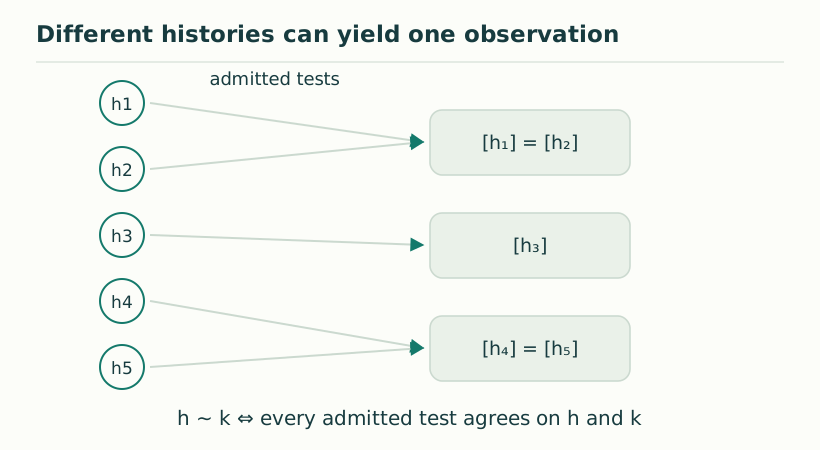
For completed records r and s, define r≡o s when every admitted contextual test has the same outcome. A contextual test includes both preparation before the record and processing afterward. This is stronger than checking a few immediate display values.
The context requirement is what makes observational equivalence compositional. If a later operation exposes a phase difference, that later operation followed by measurement is already a contextual test. A model cannot erase the phase while simultaneously claiming to predict that test from the erased record.
Consider histories labelled by a bit b and an internal sign σ. Suppose completion retains both labels, but the only immediate detector reads b. With that restricted test, records (0,+) and (0,−) are indistinguishable. If no admissible preparation or later operation ever converts σ into a readable difference, identifying them is consistent.
Now admit a transformation that flips b precisely when σ is negative. Applying it before the bit detector separates the two records. The enriched test language therefore has a finer observational quotient. The completion record has not changed; the observer’s operational access has. This example demonstrates why “same observation” always needs an explicit test class.
Define histories h and k to be observably equivalent when c(h)≡o c(k). Taking this combined quotient directly gives the same observable model as first completing and then identifying indistinguishable records. The proof is constructive: send the direct class of h to the observational class of its completed record.
The map is well defined because the two descriptions use exactly the same equality condition. It is surjective because every observable record comes from a history, and injective because equal observable images mean combined equivalence. This is a consistency theorem for the architecture; it does not tell us which physical history distinctions should be discarded.
DTT interprets inner generation as the history-sensitive side and outer observation as access to completed distinctions. The two-quotient construction explains how an observable world can contain fewer distinctions than its generating description without declaring the generating description unreal. It also supplies a precise language for persistent identity: an object persists when the relevant record class persists.
Prediction requires an additional check. If two histories are indistinguishable now but evolve to distinguishable outputs, the current quotient is not an autonomous state description for that evolution. One must retain more memory, restrict the admitted operations, or use a non-Markovian model. The correct response is to identify the missing information, rather than interpreting every predictive failure as evidence for a new time coordinate.
KEEP THE CONNECTION
Scope of the argument. Mathematical equivalence is relative to explicitly supplied completion and test rules.
Working manuscript. Article-level references identify the consulted sections and the scope of the interpretation. No public URL was supplied for this exact manuscript version.
Source register →