
In this article
- What clock uniqueness should mean
- The elementary counting proof
- The rank-one generalization
- Why rank one cannot be omitted
- An additive delay need not be a global time
- How to use the theorem in model building
An ordered rank-one return structure permits a faithful additive scalar clock only up to positive rescaling. Independent return directions and path-dependent delays show where that uniqueness stops.
If two instruments both count the same completed returns, their numerical readings may differ only because one reports seconds and the other reports another unit. The draft proves a precise version of this statement under ordered rank-one assumptions. It does not claim that every possible temporal quantity in every SMM/DTT realization is the same clock.
The distinction matters because inner generation and outer observation are different roles, but different roles do not automatically create independent scalar durations. A model can have a rich internal phase and memory structure while its completed return order admits only one faithful additive scalar calibration up to scale.
Consider a completed-return monoid isomorphic to the nonnegative integers. An additive clock θ obeys θ(n+m)=θ(n)+θ(m) and θ(0)=0. Let δ=θ(1). Repeated addition then forces θ(n)=nδ. If δ>0, distinct return counts have distinct readings; if δ=0, the clock detects nothing.
Thus any two faithful clocks θ and ψ satisfy ψ(n)=[ψ(1)/θ(1)]θ(n). The conversion factor is positive. No additional dynamics was needed for this elementary result, but the premise that all completed advances lie on one countable direction is doing real work.
The draft allows a commutative cancellative monoid whose associated difference group is torsion-free and has rational rank one. Informally, all increments are rationally related to one nonzero reference increment u. For every group element g, there are integers n>0 and m with ng=mu.
Normalize u to one and define λu(g)=m/n. Torsion-freeness makes this independent of the chosen integers, while common denominators prove additivity. The ordered positive cone fixes the sign. Every faithful additive scalar clock is consequently δλu for a unique δ>0. This includes finer rational subdivisions without adding a second independent clock direction.
For a monoid with two independent nonnegative counts, such as pairs (m,n), additive clocks can assign independent weights: θ(m,n)=am+bn. Different ratios a/b need not be related by one overall scale. This is a simple counterexample to deriving scalar uniqueness merely because clocks factor through the same observable action.
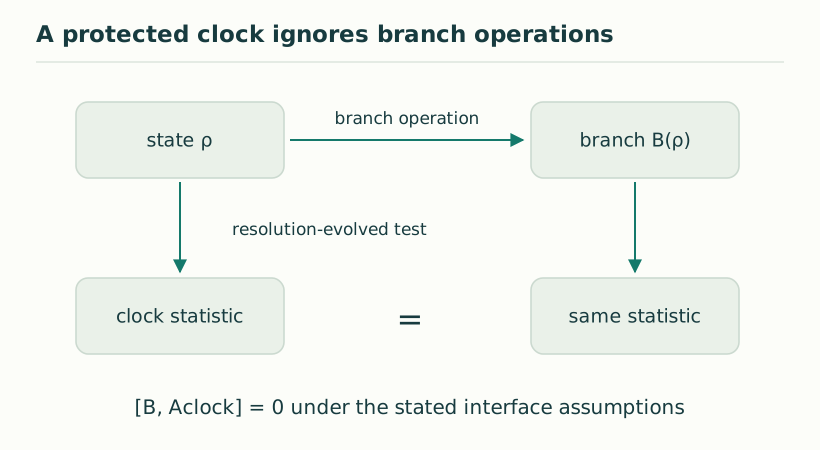
Physical clock universality is stronger still. One must show that all admitted material instruments couple to the relevant completed order in the required way. A theorem about additive maps on a selected monoid does not prove that an ungated oscillator, a protected logical clock, and a transport delay all realize those maps.
A clock can assign a duration to each history of advances and add those durations under composition. Such an assignment is a cocycle. To obtain a global event clock t, one additionally needs every assigned delay to equal t(final)−t(initial).
For example, an advance that loops back to the identical event could have a nonzero additive winding delay. No single-valued event time can represent that delay as an endpoint difference. The loop remembers history that the event label does not. This is a useful DTT lesson: a record quotient can retain an event while discarding the winding information needed for a path-dependent duration.
First specify which completed returns observers can distinguish and prove their composition law. Next determine the effective ordered monoid and test the rank-one conditions. Then construct an actual additive readout and calibrate one positive reference increment. Only after these steps is “unique up to units” justified.
The result fits the SMM ambition of a common origin of temporal order, but leaves the absolute scale open. The value of δ is a physical calibration unless a source dynamics selects a ratio to independently defined standards. Nor does this theorem establish Lorentzian proper time, universal clock response, or the necessity of six nested inner stages. It isolates a rigorous and useful uniqueness claim from those further questions.
KEEP THE CONNECTION
Scope of the argument. Conditional uniqueness of scalar calibration; no absolute time unit or universal material-clock law is derived.
Working manuscript. Article-level references identify the consulted sections and the scope of the interpretation. No public URL was supplied for this exact manuscript version.
Source register →