From three-dimensional readout to retained records
A quaternionic readout, ten-mode pair memory, and a selected stopping grammar produce 137 distinguishable records. The construction makes its retention assumptions explicit and leaves physical coupling as a separate problem.
The SMM/DTT program asks whether a three-dimensional observable world and its retained histories can lead to a distinguished finite receiver. The retention construction developed here has a completed record space of dimension 137 under its stated assumptions. Its strength is that the integer counts explicitly described records; it is not introduced by writing the decimal digits of a measured coupling.
The argument has several interfaces. Positive associative phase composition selects a quaternionic carrier under additional hypotheses. Accessible tests then produce a rank-three local readout. Free quadratic and alternating retention define memory alphabets, and a particular stopping grammar combines them. Each interface must remain visible when interpreting the final number.
02From phase composition to three readable directions
Let A be a finite-dimensional real unital associative algebra with a positive multiplicative quadratic norm. Two available circular phases square to −1 and do not commute. Positivity excludes zero divisors; finite dimension and associativity then lead to a real division algebra. The incompatible phases exclude the real and complex alternatives, leaving the quaternions.
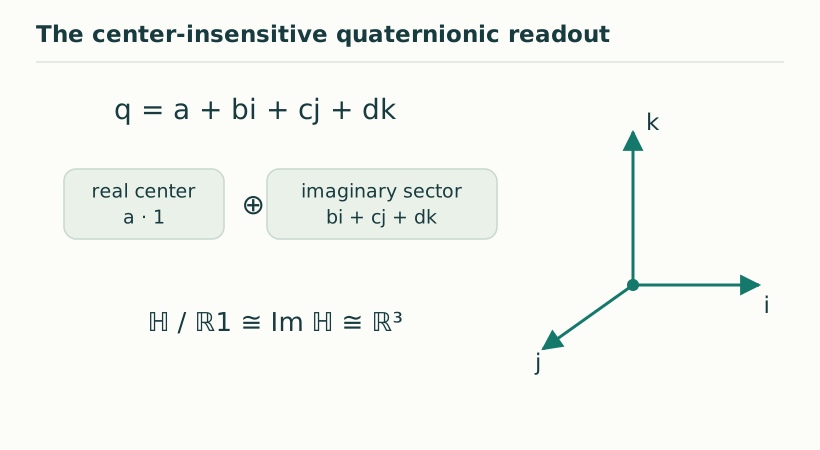
A detector insensitive to scalar changes can be reoriented by accessible phase circles. If those circles generate the full quaternionic rotation group and all detector-orbit data are retained, their span sees all three imaginary quaternionic components. This is a local linear readout result. It does not yet construct distances, neighboring events, or a global spatial manifold.
W≅H/R1≅Im H≅R³
Figure 1. The center-insensitive quaternionic readout. Under the stated associative positive-norm and noncommutation hypotheses, the carrier is quaternionic. Quotienting the real center leaves the three-dimensional imaginary sector. This is a conditional readout result, not a standalone spatial dynamics. View full size ↗
03The ten-mode pair memory
Restore the scalar identity channel as part of a unital reconstruction envelope V=C⊕W_C, which has complex dimension four. It is not a fourth spatial direction. The selected quadratic memory is the symmetric square Q=Sym²V. Its independent basis pairs are labelled by 0≤a≤b≤3.
There are four repeated pairs and six distinct cross pairs, so dim Q=10. Retaining these pairs is stronger than retaining only their quaternionic product. The symmetrized product maps the ten-dimensional pair space onto a four-dimensional envelope and erases six independent combinations. A physical realization must therefore supply genuine memory if it claims to preserve every pair distinction.
dim Sym²(C⁴)=4(4+1)/2=10
04Branch alphabets and the stopping rule
At depth d, the branch receiver contains positive-degree exterior combinations of d innovations. A basis is indexed by nonempty subsets, giving 2ᵈ−1 branch labels. At depths one, two, and three, these counts are 1, 3, and 7. The empty subset is excluded by the chosen rule.
The grammar now says: either terminate with a branch label at the current depth, or append one quadratic-memory label and continue to the previous depth. Continuation stops at depth one. The three possible terminal word types at full depth are B₃, QB₂, and Q²B₁. They are disjoint because terminal and continuation letters are different symbol types.
L₀=∅; Ld=Bd ⊔ QLd−1
|L₃|=7+10×3+10²×1=137
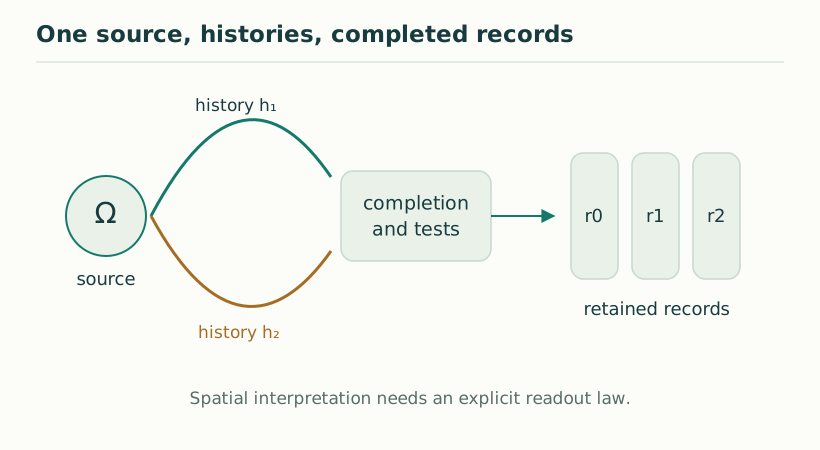
Figure 2. One source, histories, completed records. Conceptual reconstruction: composable source histories are tested and completed before a retained record becomes available. The source is not depicted as a point already located in space. View full size ↗
05What the count actually establishes
Every legal word can be parsed uniquely from its continuation prefix and terminal branch letter. An error-free single readout that distinguishes all 137 legal words therefore needs at least 137 mutually orthogonal record states, and the free word space attains this bound. This is a conditional minimality theorem for the stated task.
It does not imply equal probabilities. Uniform local choices give probability 1/17 to each immediate terminal word and 1/221 to each longer terminal word. A different count-weighted sampler makes every final word equally probable. Both use the same 137-dimensional receiver. Probability, coherent amplitude, and static response are different mathematical quantities even when related numerical factors appear.
06The conceptual connection and the remaining derivation
The construction expresses a recognizable SMM/DTT idea: observable multiplicity may reflect retained histories of one generative process rather than independent primitive substances. It also shows why memory is central. Compressing histories into their current product can destroy the very distinctions used by the count.
The three grammar depths are not an implementation of the six nested inner stages, and the finite Markov realization does not select the grammar from source ontology. Connecting the receiver to a physical coupling additionally requires a source law, a response operator, continuum calibration, and matter matching. The structural integer is a well-defined intermediate result; its physical interpretation is a separate research problem.
KEEP THE CONNECTION
Key ideas
The integer counts a specified prefix-free history language.
The ten-mode memory retains more information than a quaternionic product.
Dimension 137 alone fixes neither probabilities nor electromagnetic response.
Scope of the argument. Conditional reconstruction for a selected retention grammar; six-stage generation and electromagnetic matching remain open.
Sources & further reading
smm_dtt_alpha0_137_v3.pdfWorking draft, pp. 3–5, 7–14
Source editions and catalogue entries
Working manuscript
Three-Dimensional Readout and the Structural Value 137 — Version 3
Working manuscript. Article-level references identify the consulted sections and the scope of the interpretation. No public URL was supplied for this exact manuscript version.