
In this article
- What the Single Monad contributes
- The symmetry obstruction
- A short proof using scale
- Why a recurrence is a useful first addition
- Inner generation and outer records
- A constructive route forward
A structureless source cannot select a nonzero metric, an oriented vector or a proper causal cone while preserving every change of representation. Recurrence, composition and observable readout supply the additional structure needed for an SMM/DTT reconstruction.
SMM begins with a common non-spatial source of histories. This is an ontological proposal about the origin of multiplicity: the many distinguishable records need not correspond to many independently existing fundamental substances. It does not make the source an unusually small point inside an already available universe. A spatial point already presupposes a space, and therefore cannot explain that space without further construction. In the draft, a source becomes mathematically active through admissible operations, their composition and their action on retained states. These ingredients are the beginning of a model; the word “one” alone is not its dynamics.
Suppose a structureless source is represented on a nonzero real vector space V. With no distinguished operations or observations, every invertible change of basis is equally admissible. Any geometry selected without additional choices would have to survive every such change. This is much stronger than ordinary rotational invariance. Dilations change lengths, reflections reverse orientations, and general linear maps shear angles. A fixed nonzero vector or positive length standard cannot be invariant under this entire freedom. The obstruction concerns a natural selection from the declared data; it does not say that a model can never acquire structure.
Let B be a proposed bilinear form selected by the bare source and invariant under all changes of representation. Apply the basis transformation λI. Invariance would require B(λv,λw)=B(v,w), while bilinearity gives the left side as λ²B(v,w). Choosing λ=2 forces B to vanish. A similar argument handles a selected vector: if 2v=v, then v=0. For a cone, the general linear group carries any nonzero vector to any other. An invariant cone containing one such vector would contain all directions, defeating the pointedness required for a future cone.
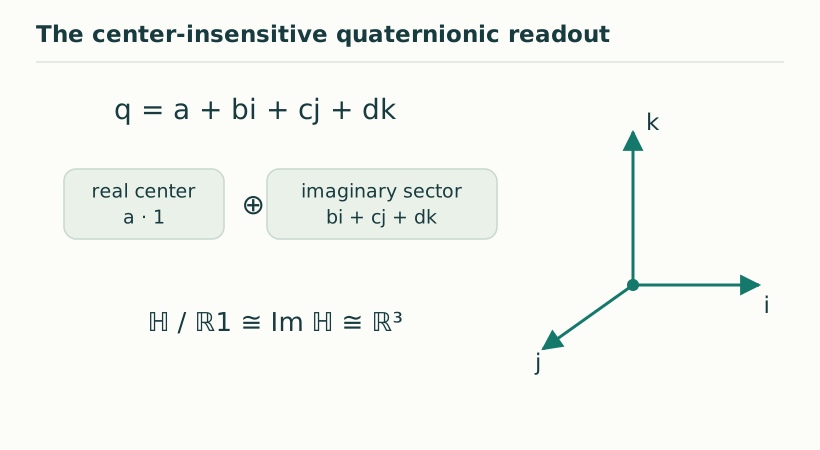
The draft adds reversible phase order. A faithful four-step cyclic source cannot be represented by a one-dimensional real sign alone: a real scalar sign has order at most two. A minimal faithful real carrier is a plane with a quarter-turn J satisfying J²=−I. This makes an internal complex structure available without declaring that plane to be physical space. Further positive-norm associative noncommutative composition selects a quaternionic carrier under the manuscript’s assumptions. Complete center-insensitive readout then supplies three real record directions. Every arrow in this chain has a specific mathematical premise.
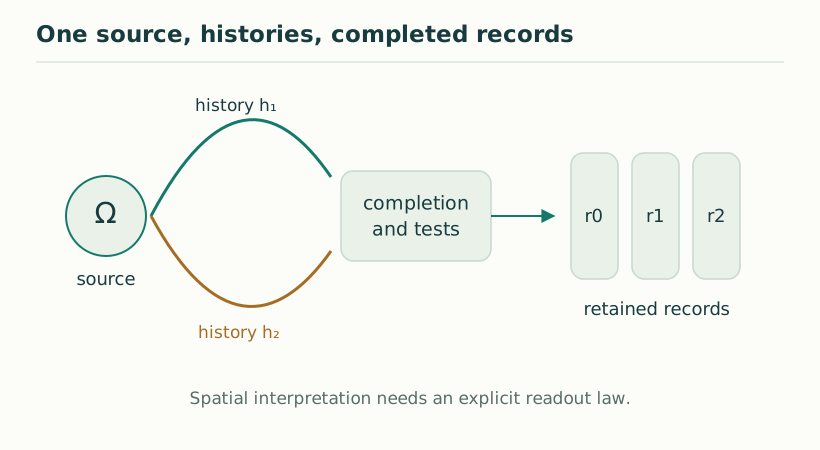
DTT distinguishes the order of generative operations from the order of their completed public records. This supplies a productive question: which distinctions in a history survive completion and which are observationally identified? A quotient can reduce an elaborate microscopic carrier to a smaller public state. The six inner levels should be treated as nested construction stages of that same source, with outer completion as the seventh role. Calling them six spatial axes or six independent laboratory clocks would replace the intended hierarchy with a different model. Their actual update maps must still be provided.
A successful next model can respond directly to the obstruction. Define the source state and retained memory, one autonomous operation, the permitted compositions, a completion criterion and the tests that distinguish records. Then prove which structures those data select. Countermodels are valuable: if two admissible sources produce different dimensions, the stated axioms have not selected dimension. If the same record geometry admits different clock rates, geometry has not yet selected time calibration. Unity supplies the research starting point; explicit source dynamics supplies the mechanism that can give it physical explanatory content.
KEEP THE CONNECTION
Scope of the argument. Conditional reconstruction: the obstruction is mathematical; the selected source dynamics remains a physical construction problem.
Working manuscript. Article-level references identify the consulted sections and the scope of the interpretation. No public URL was supplied for this exact manuscript version.
Source register →