A054Public article topicExpanded article5 min read
The Principle of Ever-renewed Creation
Ever-renewed creation motivates an account of persistence through changing states. Update rules, invariants and retained memory show what SMM/DTT must specify for renewed records to support recognizable objects and continuous histories.
The source treats created forms as continuously renewed rather than self-sustaining through successive moments. It connects this principle with dependence on the Creator and uses it to motivate a new account of persistence and motion. The philosophical emphasis is not simply that objects change, but that their continued appearance itself requires explanation. This is one of the principal conceptual foundations of the Single Monad Model.
02What does it mean for something to persist?
A flame persists even though its material constituents change. A wave pattern persists while different portions of a medium participate in it. These familiar examples show that persistence can belong to an organized process rather than to an unchanged inventory of constituents. They do not prove universal recreation, but they provide a clear model of how continuity of form can coexist with turnover.
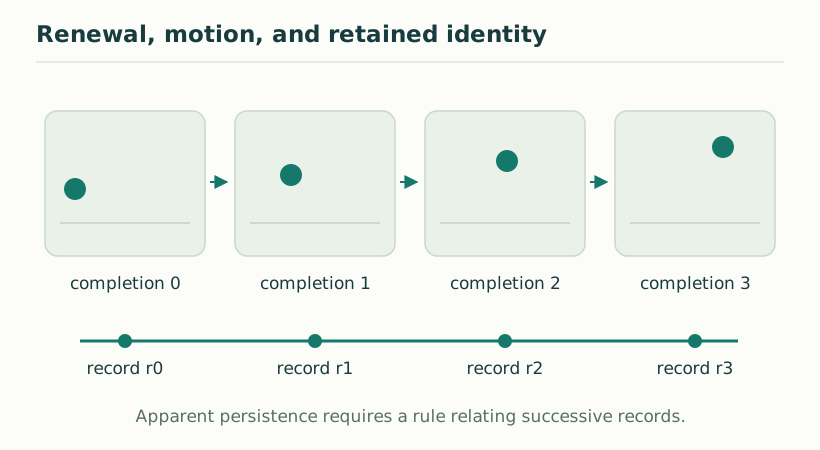
A theory must specify the relation that identifies one later pattern as the continuation of an earlier one. Similar appearance alone can be insufficient if two independent copies happen to look alike.
Figure 1. Renewal, motion, and retained identity. A film-frame analogy clarifies successive creation and apparent motion. It does not itself provide an update law, a conserved identity, or a continuum limit. View full size ↗
03An update equation makes the issue explicit
Let sₙ denote the full retained state and let sₙ₊₁ = F(sₙ) describe one update. An observable record is rₙ = R(sₙ). The same update rule can produce changing records while preserving an invariant I, so that I(F(s)) = I(s). This illustrates how renewal and conservation can coexist.
If the model instead resets every state independently, neither persistence nor conservation follows. The distinction between an update and an unconstrained replacement is therefore central. A recreation account needs lawful dependence between successive completions, even if it rejects enduring self-sufficient material substances.
sₙ₊₁ = F(sₙ), rₙ = R(sₙ)
I(F(s)) = I(s)
04Memory cannot disappear from the explanation
An observer who compares two records is itself a physical system with retained information. A proposed world update must therefore include the observer's memory and the correlations that make it reliable. Merely saying that a new world contains a memory of an old one leaves open why that memory has the correct relation to the previous record.
A generative account can address this through a retained state, a transfer rule or an explicit history-dependent process. The choice matters: it determines which correlations can be generated and what resource budget is required.
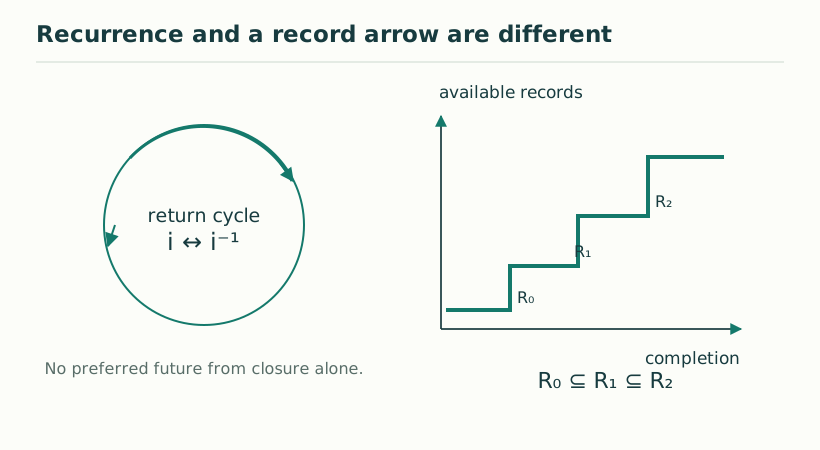
Figure 2. Recurrence and a record arrow are different. A reversible cycle admits both orientations. A record arrow requires an ordered availability relation, such as inclusion of retained records. Recurrence alone does not select a future. View full size ↗
05DTT separates formation from readability
DTT's inner stages concern how a completed configuration is formed; outer time concerns the sequence accessible through completion. The six inner roles are nested parts of a generative account, not six external waits during which an observer watches its own nonexistence. The observer's accessible history consists of records that the theory must make mutually consistent.
This perspective suggests that motion is a relation among completed configurations. It does not automatically determine the velocity law. To obtain dynamics, the model must explain which transitions are allowed, how they are weighted and how displacement is calibrated against physical clock readings.
06Perfect similarity is not required for identity
A moving pattern can change its location and internal state while remaining identifiable through a conserved relation. Imagine an encoded record whose bits are transformed by a known reversible rule. Its appearance changes, but applying the inverse rule recovers the same information. This demonstrates a kind of continuity based on recoverable structure rather than visual sameness. For a recreation account, such a relation is more useful than the claim that each new form merely resembles the old one. It provides an operational criterion for persistence and a way to test whether information has been preserved. The physical implementation and its resource requirements remain part of the explicit dynamics.
07Persistence as an achievement
The strongest version of renewal is an explicit mechanism generating stable patterns, correlations and conservation relations across completions. A changing source state can retain a recognizable relational pattern and carry memory forward. This makes persistence an achievement of lawful organization. SMM/DTT’s contribution is to demand an explanation of that achievement instead of treating endurance as a self-explanatory property of material substance.
KEEP THE CONNECTION
Key ideas
Persistence can belong to a process or pattern.
Renewal needs a lawful relation between successive records.
Memory and conservation must be generated alongside apparent continuity.
Scope of the argument. Historical interpretation and original conceptual analysis; illustrative mathematical constructions are not identifications of theological realities with physical objects.
Historical public topic address, redirected to this edition’s revised explanation. It identifies the topic’s provenance; the revised page supplies its own reading locators and claim scope.