A055Public article topicExpanded article5 min read
The Three Hypotheses of the Single Monad Model
The three SMM hypotheses concern a common source, lawful renewal and the relation between generative order and observed time. Their combined physical content depends on a shared dynamics that constrains geometry, clocks and propagation together.
01The three hypotheses in the original presentation
The source organizes SMM around a unique Single Monad, perpetual recreation of forms, and a distinction between actual generative flow and observed temporal succession. It describes the creative week as corresponding to an observer's completed moment. These hypotheses should be read together: one identifies a proposed origin, one describes continuing manifestation, and one proposes how the generating order differs from experienced time.
The three hypotheses in the original presentation
Hypothesis
Conceptual role
Formal obligation
Single Monad
Common origin
One constrained source dynamics
Recreation
Continuing manifestation
Lawful update and retained correlations
Actual temporal flow
Generation differs from observed succession
A completion map and independent clock readout
02First hypothesis: a common generative origin
A unique source is stronger than a shared vocabulary. To have mathematical consequences, it must constrain how different observable quantities arise. If spatial relations, clock rates and particle motion can each be chosen independently, placing them inside one controller does not explain their agreement.
A useful formal requirement is that the same autonomous update F determines all three through independently defined readouts. Their compatibility then becomes something to prove. A joint result would establish that the geometry measured from records, the duration measured by clocks and the propagation limits of matter follow from one specified mechanism.
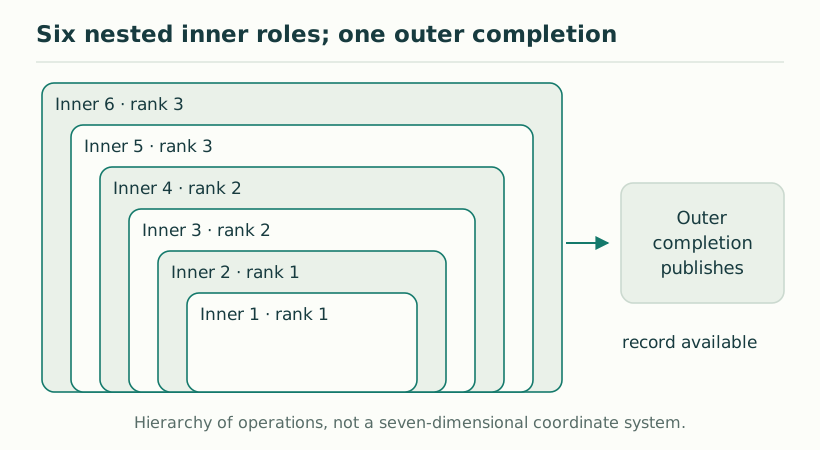
Figure 1. Six nested inner roles; one outer completion. The six inner roles are nested functional stages with readout ranks 1, 1, 2, 2, 3, 3. The outer completion publishes the resulting record. These are not seven independent time axes. View full size ↗
03Second hypothesis: lawful recreation
Recreation concerns successive appearances, but regularity requires retained structure. Write sₙ₊₁ = F(sₙ), with record rₙ = R(sₙ). The source state must include whatever memory is necessary for the next record to be consistent with earlier ones. An invariant I satisfying I(F(s)) = I(s) is one simple way that a stable property can survive changing forms.
Without an update rule, recreation allows any sequence whatsoever. With a rule, it becomes a constrained dynamics. The transition from a philosophical principle to a physical model occurs precisely at this point.
04Third hypothesis: generating order and observed time
The order of inner operations need not equal the sequence displayed by a physical clock. In DTT, inner stages concern formation and the outer level concerns completion. A clock reading τ must therefore be defined from an accessible physical record, not simply declared equal to a theorist's update label n.
For a uniform clock one might obtain τ(n) = nτ₀. A more general clock could have state-dependent increments. Whether either relation follows from the source dynamics is an independent question. Its answer determines whether generative order is merely a calculation parameter or a physically explanatory structure.
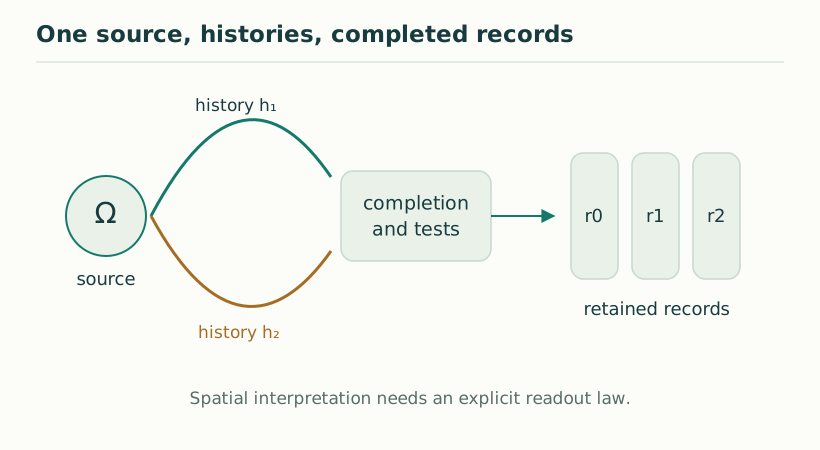
Figure 2. One source, histories, completed records. Conceptual reconstruction: composable source histories are tested and completed before a retained record becomes available. The source is not depicted as a point already located in space. View full size ↗
05What six plus one does and does not specify
The six inner stages are nested generative roles and the seventh is outer completion. This is an organizational postulate. It does not alone establish three-dimensional Euclidean geometry, Lorentz symmetry or quantum probabilities. Each claimed consequence needs a bridge: a spatial readout, a transformation law, a state space and an outcome rule.
The scheme is valuable because it identifies where those bridges should be sought. It requires a theory to explain the availability of a completed spatial world before treating that world as the background of all dynamics.
06Testing whether the hypotheses actually unify
Imagine two implementations sharing the three verbal hypotheses. In the first, geometry, clock rate and signal speed are independent parameters. In the second, a single update law forces a relation among them. Only the second explains their agreement through a common mechanism. This comparison gives a practical standard for evaluating progress: ask whether the admissible models have become more constrained. A new notation or a common controller is insufficient if the same independent choices remain. A theorem that excludes incompatible clock and geometry assignments, even within a restricted family, would be a substantive step toward the intended SMM/DTT unification.
07A coherent reconstruction program
A precise SMM/DTT model can be summarized by source states, autonomous update, retained memory, admissible operations, completion map and clock observable. Once these are specified, one can ask which consequences are theorems and which remain extra assumptions. This preserves the ambition of the three hypotheses while making their scientific content assessable. The goal is a common construction whose outputs agree for a reason, rather than three independent descriptions placed side by side.
KEEP THE CONNECTION
Key ideas
The hypotheses concern source, renewal and temporal organization.
A single dynamics must constrain all its readouts.
Clock, geometry and propagation relations require explicit derivations.
Scope of the argument. Historical interpretation and original conceptual analysis; illustrative mathematical constructions are not identifications of theological realities with physical objects.
Historical public topic address, redirected to this edition’s revised explanation. It identifies the topic’s provenance; the revised page supplies its own reading locators and claim scope.