A062Public article topicExpanded article4 min read
Creation Scenario: the World as a Movie
The world-as-a-movie analogy connects renewed appearances with apparent continuity. Its limits reveal why a physical model needs linked frames, embedded observers, clock readings and retained correlations to explain motion and memory.
The source compares repeated creation with a movie or computer display and connects this image with earlier shadow-theatre symbolism. The analogy makes it easy to imagine continuity arising from successive appearances. Its explanatory value is strongest when it draws attention to the relation between generation and display. It becomes incomplete when the machinery, memory and timing needed by an actual movie are left outside the comparison.
02Frames alone do not determine motion
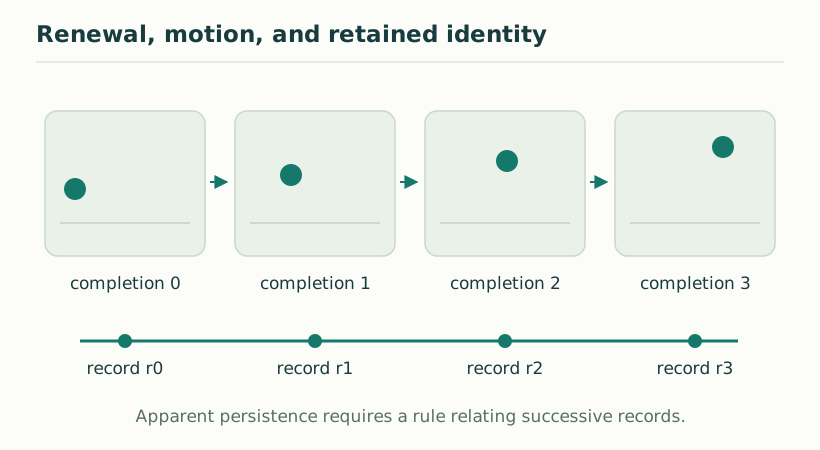
Two frames showing a dot at different positions define a displacement. They do not yet determine a velocity unless an elapsed duration is assigned. With positions xₙ and xₙ₊₁ and clock readings τₙ and τₙ₊₁, the average velocity is v = (xₙ₊₁−xₙ)/(τₙ₊₁−τₙ). The same two pictures can represent slow or fast motion depending on the denominator.
A sequence of images also does not uniquely specify what happens between them. Different trajectories may pass through the same sampled positions. A physical model needs a dynamical rule, not just a succession of snapshots.
v̄ = (xₙ₊₁ − xₙ)/(τₙ₊₁ − τₙ)
Figure 1. Renewal, motion, and retained identity. A film-frame analogy clarifies successive creation and apparent motion. It does not itself provide an update law, a conserved identity, or a continuum limit. View full size ↗
03Continuity requires correlations
A film appears coherent because neighboring frames are related. Randomly generated independent frames generally do not depict a persistent world. In a source model, correlations can be carried by a retained state sₙ with update sₙ₊₁ = F(sₙ). The visible frame is then only a readout R(sₙ), while the source state may contain information not directly displayed.
This distinguishes two ideas often conflated in the analogy: replacing an image and erasing all memory. A lawful replacement can preserve identity, momentum or phase relationships through the retained dynamics.
04The observer belongs in the film
An external viewer of a cinema has a clock and memory outside the screen. A cosmological model cannot simply borrow that external perspective. Its observers, clocks and measuring devices are among the phenomena to be explained. The model must therefore produce records that allow an internal observer to compare events.
This is the reason a cosmic refresh cannot automatically be detected as visible flicker. Whether any signature exists depends on the relation between the proposed updating process and physical detectors. It must be calculated from a specified interaction, rather than inferred from the familiar behavior of a monitor.
05DTT improves the analogy through completion
DTT distinguishes inner generation from outer readability. A completed frame can stand for a record, while nested inner operations stand for its preparation. The six inner roles should not be drawn as six simultaneous screens or six laboratory clocks. Their dependencies belong inside the generative model.
The outer succession is also not automatically an absolute universal frame rate. A relativistic account must explain how different observers assign clock readings and how accessible influences respect the recovered causal structure.
06Sampling can conceal different motions
Suppose a periodic motion is observed only once per cycle. Every sampled image can show the same position, even though motion occurred between observations. Sampling at a different rate can reveal a different apparent pattern. This elementary ambiguity shows why frames alone cannot establish the underlying dynamics. A source model needs a specified observation process and sufficient information to distinguish admissible histories. The movie analogy becomes stronger when it includes this limitation: completed records need not display every inner distinction, but their omissions must be accounted for when predicting future records. Otherwise smooth appearance is simply imposed by the chosen sequence of pictures.
07A self-contained generating account
Source state, update, retained memory, completed records and an internal clock are all needed for the movie analogy to become a self-contained model. SMM contributes a common generative ambition; DTT distinguishes preparation from completion. The dynamical laws must then explain why the records form a coherent moving world and why observers within that world recover compatible measurements of distance and duration.
KEEP THE CONNECTION
Key ideas
Frames need clock readings and dynamics to describe motion.
Coherent renewal requires retained correlations.
A cosmological model must include its own observers and clocks.
Scope of the argument. Source-based conceptual interpretation with original worked examples; physical conclusions are stated with their assumptions.
Historical public topic address, redirected to this edition’s revised explanation. It identifies the topic’s provenance; the revised page supplies its own reading locators and claim scope.