A063Public article topicExpanded article4 min read
Testing Possibilities
A testable SMM/DTT model specifies an observable, a quantitative prediction and a reproducible comparison. Simple residual models distinguish reinterpretation from a new prediction and show what positive and null results can constrain.
The source considers whether cosmic renewal might be investigated through light, particle transitions or perception, and notes the difficulty of observing a putative refresh when the apparatus itself belongs to the renewed world. This is a useful starting question. A modern test, however, needs a quantitative observable that differs from an established baseline under specified conditions. An evocative mechanism is not yet a prediction.
02The difference between reinterpretation and deviation
A model can reproduce existing physics while offering a different account of its origin. That may be conceptually valuable, but observations agreeing with the shared predictions cannot distinguish the interpretations. To test a difference, one needs a prediction such as a particular frequency dependence, a correlation constraint or a relation among independently measured quantities.
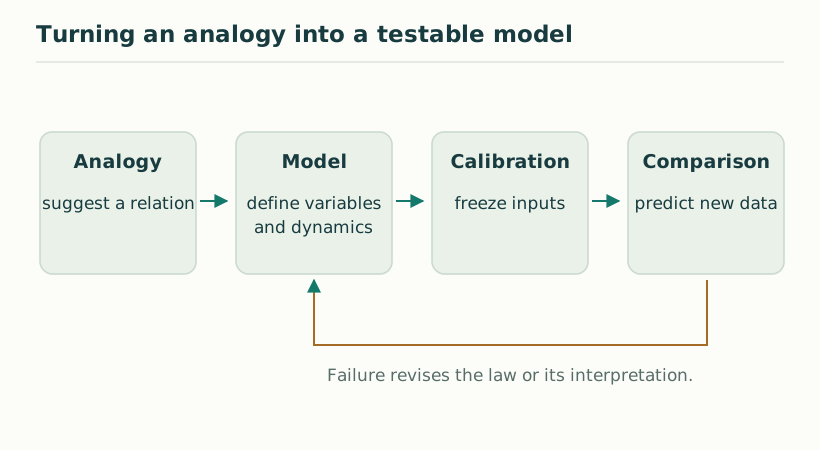
If a proposed parameter can always be adjusted after seeing the result, a successful fit has limited evidential force. The strongest test fixes the relevant parameters using separate information and then predicts an outcome not used in the calibration.
Figure 1. Turning an analogy into a testable model. A numerical or symbolic correspondence motivates a question. A physical claim needs a specified model, independent calibration, and a result that could disagree with observation. View full size ↗
03A simple prediction template
Let O₀ denote a baseline prediction and let a temporal model predict O = O₀[1 + εf(z)], where z is a controlled variable and ε is a specified dimensionless coefficient. The residual (O−O₀)/O₀ should follow the shape εf(z). Varying z can distinguish this shape from a constant calibration offset.
This is a methodological template, not a claimed DTT effect. Its purpose is to show what must be supplied: the function f, the coefficient's origin, the regime of validity and the uncertainties of both the baseline and measurement.
O = O₀[1 + εf(z)]
(O − O₀)/O₀ = εf(z)
04Shared origin as a source of overconstraint
SMM's strongest potential tests arise when one generating mechanism links several observables. If the same parameter controls both a clock effect and a spectral shift, fitting it to one observation leaves the other as a prediction. A relation among observables can be more robust than an absolute number because some calibration uncertainties cancel.
For example, if residuals satisfy δO₁ = aε and δO₂ = bε with independently derived a and b, then bδO₁−aδO₂ = 0 is a testable consistency condition. The relation is useful only when a and b were not selected to enforce the observed cancellation.
05DTT must specify access
An inner process can influence observations only through an allowed completion or interaction. The theory must say what an apparatus couples to and which retained records it produces. A hidden update rate with no possible observable effect cannot be measured simply by using a faster camera. Conversely, an inaccessible internal variable may still constrain observable correlations.
This shifts attention from directly photographing inner time to deriving consequences of its proposed structure. It also prevents the introduction of detectors that operate outside the very clock and causal rules the theory seeks to explain.
06A null result can constrain a model
If a model predicts a nonzero residual εf(z), measurements consistent with zero can limit the allowed magnitude of ε, provided the experimental sensitivity and systematic uncertainties are known. The result does not necessarily reject the entire ontology; it rejects or constrains the particular quantitative implementation tested. Conversely, allowing ε to become arbitrarily small may preserve the model while reducing its distinct predictive content. A clear SMM/DTT test should state in advance whether the coefficient is fixed, bounded by theory or freely adjustable. This makes the interpretation of both positive and null results transparent and prevents the theory from changing its claim after the measurement.
07A complete comparison
A useful test specifies the model, baseline, observable, independent calibration, predicted relation and failure condition. It also identifies ordinary effects that could imitate the signal. The distinction between an illustrative residual formula and an actual DTT prediction is essential: the latter needs derived coefficients and a justified range of validity. Explicit constraints make the framework assessable through outcomes rather than through vocabulary.
KEEP THE CONNECTION
Key ideas
A reinterpretation and a distinct prediction are different achievements.
Shared parameters can yield independent consistency tests.
Access to inner dynamics must be specified through physical records.
Scope of the argument. Source-based conceptual interpretation with original worked examples; physical conclusions are stated with their assumptions.
Historical public topic address, redirected to this edition’s revised explanation. It identifies the topic’s provenance; the revised page supplies its own reading locators and claim scope.