A064Public article topicExpanded article4 min read
Timeless Motion
Timeless motion distinguishes the ordering of generative operations from elapsed observational time. A meaningful physical account still needs a clock relation, a transport rule and a clear limit on controllable communication.
The source discusses a religious narrative through annihilation and recreation rather than ordinary transport. Its conceptual proposal is that a change of manifested location need not be described as continuous travel through intermediate positions. When this idea is connected with physics, the phrase timeless motion must be unpacked carefully. It may mean no elapsed observer-clock time, or it may mean an ordering that is not itself a physical clock variable. Those are different claims.
02Order does not require a duration assignment
A mathematical algorithm has dependencies: operation B may require the output of operation A. That order can be specified before assigning a runtime. Similarly, a model can contain a parameter labeling generative steps without identifying it with the reading of a laboratory clock.
The absence of an assigned duration does not imply that a physical process has been shown to occur instantaneously. It means that the relation between the model's order and measured time remains to be supplied. This distinction is central to a clear DTT formulation.
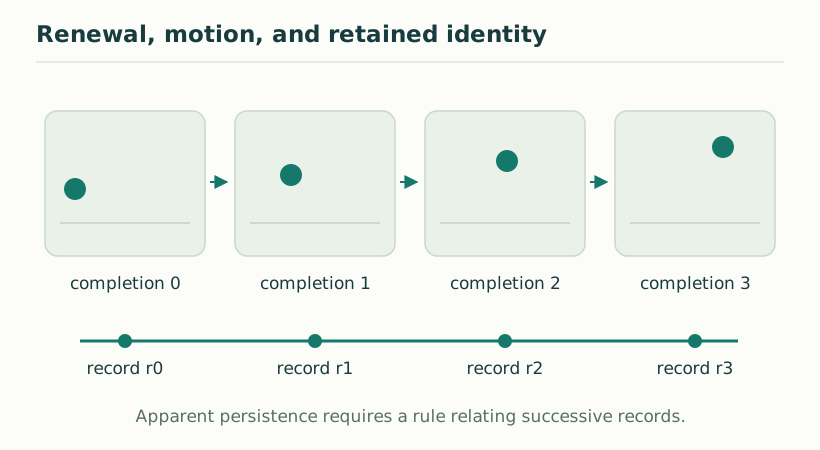
Figure 1. Renewal, motion, and retained identity. A film-frame analogy clarifies successive creation and apparent motion. It does not itself provide an update law, a conserved identity, or a continuum limit. View full size ↗
03A completed displacement still needs a clock
Suppose completed records locate an object first at x₁ and later at x₂. The observed displacement is x₂−x₁. Its average velocity requires the independently measured time difference τ₂−τ₁. If that difference is nonzero, ordinary kinematic reasoning applies. If it is claimed to be zero, the model must explain how two distinct records are ordered and how the observation is operationally performed.
One should not define a velocity by dividing by an undefined or vanishing interval and then treat the result as a measured speed. A generative replacement rule and a transport law are different mathematical objects.
04The no-signaling question
Even if a proposed inner account is nonlocal, physical communication depends on controllable operations and accessible records. To demonstrate superluminal communication, an agent would have to choose an input at one location and thereby alter a remote outcome distribution outside the permitted causal relation. Mere correlation or an unobserved internal association is insufficient.
This gives DTT a precise compatibility requirement: its inner ordering and completion rule must produce observable propagation laws consistent with the intended causal structure. If they do not, the model predicts a real deviation that must be stated and assessed.
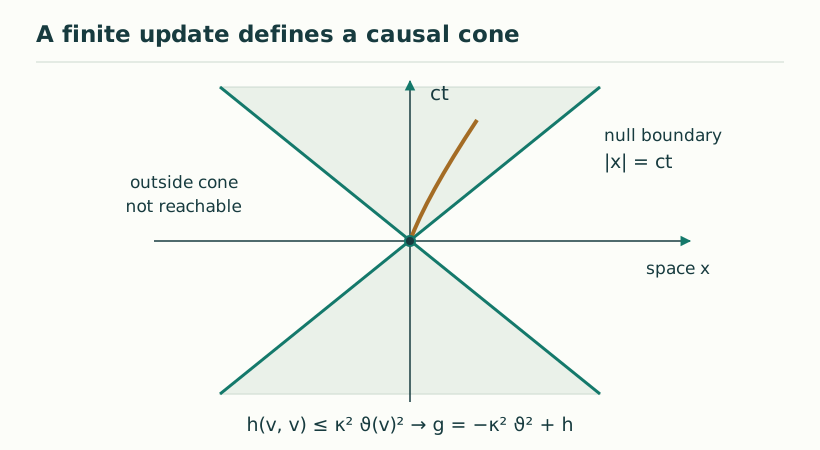
Figure 2. A finite update defines a causal cone. Illustrative finite-update geometry: displacement is bounded by update scale κ times projected inner duration. A Lorentzian metric or a shared light cone still requires the stated readout and field assumptions. View full size ↗
05SMM and the ontology of motion
SMM can treat motion as an organized relation among renewed manifestations rather than the passage of an enduring substance through every intermediate point. This changes the ontological picture while leaving the task of deriving observed trajectories intact. The allowed transitions must explain inertia, momentum transfer and the stability of moving patterns.
A rule that permits arbitrary disappearance and reappearance anywhere would not recover those laws. Constraints on transitions are therefore essential, and their origin in a common source is part of the theory's explanatory burden.
06A hidden ordering is not a communication channel
Consider a model in which internal operations are listed sequentially while observers access only completed joint records. The internal list can specify a computational order without giving either observer control over a remote outcome. To establish a signal, the model must contain an operation whose deliberate alteration changes the remote marginal statistics in a detectable way. This criterion separates explanatory nonlocality from usable communication. It also makes the relation to relativity testable rather than rhetorical. A DTT construction can have an unfamiliar inner organization and still preserve ordinary operational causal limits, but that preservation must follow from its allowed operations and completion rules.
07Ordering without an invented clock
An inner dependency sequence can be defined without assigning it a fabricated duration. Completed records belong to a separately specified physical clock description. The connection between those descriptions is the substantive DTT problem. Preserving this distinction allows a philosophical account of recreation to be discussed clearly without presenting it as an established mechanism for instantaneous transport or controllable superluminal communication.
KEEP THE CONNECTION
Key ideas
Generative order and measured duration are different structures.
A displacement needs a physical clock relation to define velocity.
Observable communication depends on controllable changes in remote records.
Scope of the argument. Source-based conceptual interpretation with original worked examples; physical conclusions are stated with their assumptions.
Historical public topic address, redirected to this edition’s revised explanation. It identifies the topic’s provenance; the revised page supplies its own reading locators and claim scope.