
In this article
- Computation as an explanatory analogy
- What a complete update model contains
- One controller does not guarantee one explanation
- Memory makes a history possible
- Nested stages and published results
- What the analogy can predict
The cosmic-computer analogy makes the distinction between generation and observable output concrete. An explanatory model also needs autonomous dynamics, retained memory and constraints linking its different readouts.
The cosmic-computer image treats the observed world as the outcome of an organized generative process. In the source article, renewed creation is compared with the sequential production of a spatial frame and the succession of frames. The analogy highlights the distinction between internal production and publicly available results.
It does not follow that reality is a simulation running on an external machine. A literal external computer would already possess hardware, time and spatial organization. SMM/DTT instead seeks a source from which those structures emerge. Computation is therefore useful as a formal language for updates and information, rather than an automatic answer about ultimate hardware.
A computational description requires a state space, an update rule, retained memory and an output map. If the rule varies with an external schedule, that schedule is another ingredient. If a controller decides when to complete a result, the controller’s state and resources also belong in the model.
For example, xₙ₊₁=F(xₙ) is autonomous only when all relevant control information is included in xₙ or fixed in F. Writing Fₙ instead may hide a clock or programme supplied from outside. A source theory should make such dependencies explicit because its objective is precisely to explain the origin of coordinated evolution.
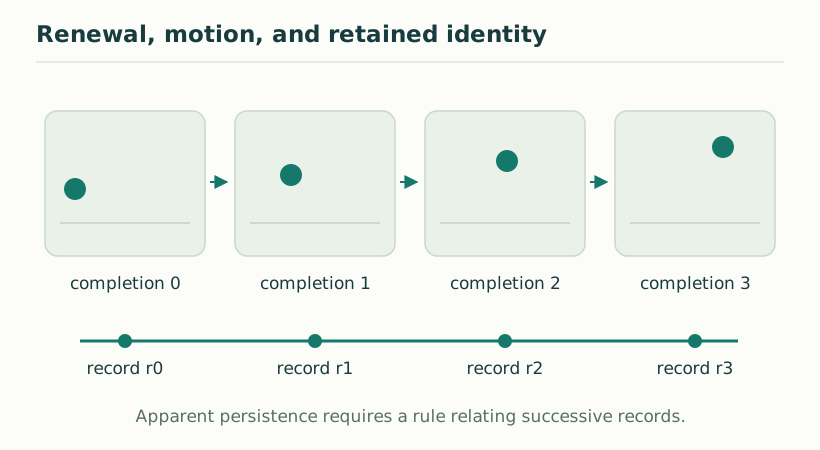
A computer can execute three unrelated routines: draw a grid, advance a clock and move a particle. Their coexistence on one processor does not explain why the particle speed matches the grid spacing divided by the clock interval. The agreement can be programmed independently in each routine.
This is a decisive issue for SMM/DTT. A common-source construction becomes explanatory when shared dynamics constrains geometry, clock response and matter propagation together. A single box containing arbitrary rules is organizational unity; a derived relation among observables is physical unity. The distinction gives a concrete criterion for assessing a proposed model.
A frame sequence requires more than repeatedly producing an image. To recognize change, the model must preserve information connecting frames. The retained state may include phase, identities, correlations or a counter. If it is erased at every completion, an observer inside the process may have no basis for comparing one appearance with another.
An economical model therefore distinguishes working information used during generation from memory required for future prediction and from records available to observers. These categories can overlap, but they should not be assumed identical. Hidden memory can influence later outcomes even when the current visible frame remains unchanged.
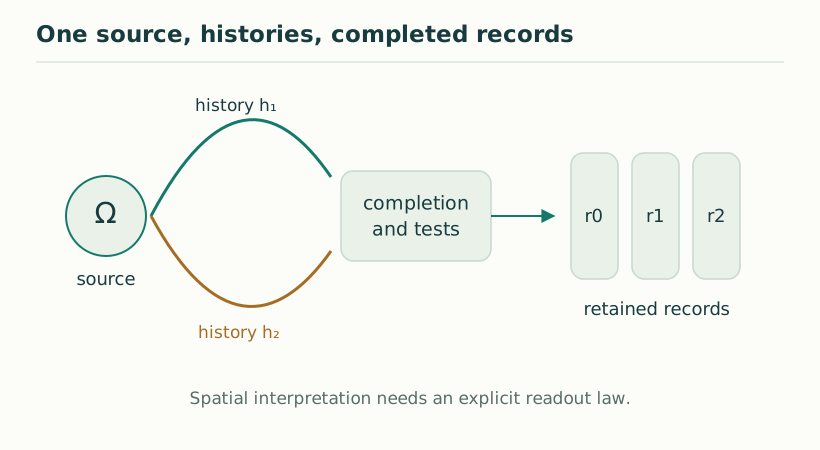
The six inner DTT stages can be represented as dependent operations within one generative hierarchy. The outer role marks completion into an observable state. This resembles a computation that preserves intermediate dependencies and publishes a result only when its completion condition is met.
The resemblance is informative if the operations are specified. It becomes empty if six arbitrary subroutines are named after the six stages and their desired output is inserted by hand. A convincing model should explain why the hierarchy has its selected form and how its symmetries survive in the published readout.
A finite-memory model may impose restrictions on distinguishable histories, recurrence, response bandwidth or the resources needed to prepare a particular geometry. These are calculable consequences once the model is fixed. They do not follow from the word computer alone, since computational systems can realize enormously different behaviours.
The useful scientific question is therefore specific: which observable patterns are permitted or excluded by this source, this memory and this completion rule? A successful answer could support the SMM/DTT programme even before a complete theory is available. It would turn the cosmic-computer metaphor into a controlled construction with identifiable assumptions and consequences.
KEEP THE CONNECTION
Scope of the argument. Computational analogy and model requirements, without asserting a literal external simulation.
Historical public topic address, redirected to this edition’s revised explanation. It identifies the topic’s provenance; the revised page supplies its own reading locators and claim scope.
Source register →