A material clock ignores branching exactly when the branch generator commutes with its full delayed-observation algebra. Immediate readouts alone can miss hidden motion that later resolution exposes.
01A material clock can respond to several operations
A clock is a physical system, so the operations that create records may also change its internal state. In the SMM/DTT construction, branch activity u and resolution activity τ are separately calibrated. The desired resolution-only clock should respond to τ while ignoring u. Source unity alone does not guarantee that property.
The draft asks an operational question: which branch generators leave every admitted clock statistic unchanged, including after later resolution evolution? The answer depends both on the coupling and on the observable algebra accessible to the instrument. It is a necessary-and-sufficient classification within a supplied finite-dimensional quantum model.
02Specify the dynamics and readout
Let Kb and Kr be stationary Hermitian generators in energy units. Branch and resolution evolutions are Ub(u)=exp(−iuKb/ℏ) and Ur(τ)=exp(−iτKr/ℏ). Accessible effects E belong to a declared unital operator algebra A. Their probabilities are Tr(ρE).
The model permits every initial density matrix on the tested sector and independently variable calibration activities. These are substantive access assumptions. Testing one state, or only the discrete settings used for a particular refinement hierarchy, does not automatically establish the all-input, open-window theorem.
U(u,τ)=Ur(τ)Ub(u)
p(E|ρ,u,τ)=Tr[E U(u,τ)ρU(u,τ)†]
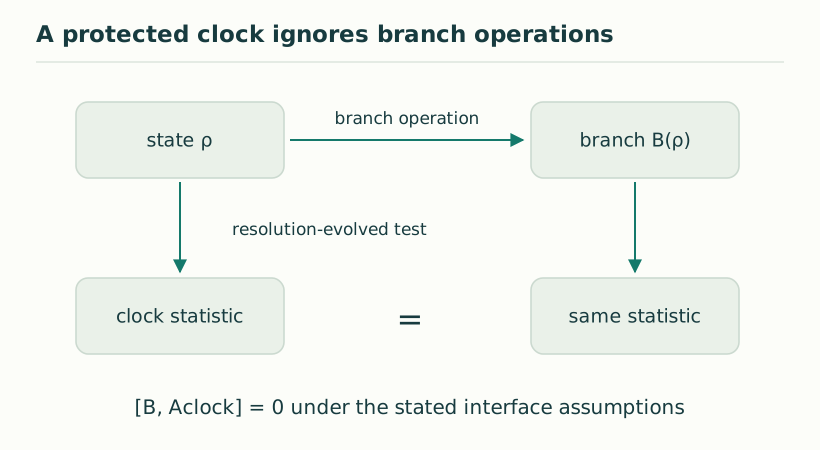
Figure 1. A protected clock ignores branch operations. In the stated stationary finite-dimensional model, branch invisibility is equivalent to the branch generator commuting with the resolution-evolved clock observable algebra. It is a criterion to verify, not an automatic law for every clock. View full size ↗
03Why later resolution must be included
Move the resolution operation from the state to the effect: Eτ=Ur(τ)†EUr(τ). The full resolution orbit generates an algebra Ar. Branching is invisible to every delayed test exactly when Ub(u)†EτUb(u)=Eτ for all admitted effects and activities.
Differentiating at u=0 gives [Kb,Eτ]=0. Conversely, if Kb commutes with the entire orbit algebra, exponentiating preserves every delayed effect. The exact criterion is therefore Kb∈Ar′, the commutant of Ar. This turns clock selection into a finite operator-algebra problem.
Ar=C*(Ur(τ)†AUr(τ))
Branch invisibility ⇔ Kb∈Ar′
04A qubit reveals hidden branch motion
Take a Z detector, branch generator ℏΩZ/2, and resolution generator ℏωX/2. Branching alone changes no Z probability for any state because its generator commutes with Z. But resolution rotates the detector into combinations of Z and Y, making the orbit algebra the full two-level matrix algebra.
For an initial +X state, the delayed Z-positive probability is [1+sin(Ωu)sin(ωτ)]/2. At τ=0 the branch response vanishes, while a quarter-period resolution delay exposes it. Thus a null immediate branch test can falsely suggest protection if the later operation is omitted.
pZ+=(1+sin(Ωu)sin(ωτ))/2
05What complete and restricted readout imply
If Ar is the full matrix algebra, its commutant contains only scalar operators. Branching can then add a global phase but cannot change the clock state. With restricted readout, a nontrivial hidden subsystem may move while all logical clock statistics remain unchanged.
In a block decomposition Ar=⊕λ(I_mλ⊗M_nλ), the invisible generators have the form ⊕λ(Bλ⊗I_nλ). The multiplicity factors can carry branch activity; the observable factors cannot. This is the same mathematical structure used to describe protected or noiseless subsystems, applied here to a specific clock-selection question.
06A useful clock needs more than invisibility
A device with constant output is branch insensitive but measures no time. A useful resolution-only clock also needs τ-dependent accessible statistics, coherent preparation where required, a calibration, and an unambiguous operating range. A periodic beat cannot distinguish arbitrary durations without winding information or an external range restriction.
Likewise, exact selection does not automatically give a robust experimental certificate. Small measured contrasts can hide a large coupling when the test window is short or the sampling suffers a revival. The subsequent finite-calibration theorem supplies the needed bandwidth and observability conditions.
07The SMM/DTT interpretation
The theorem gives a precise requirement for a clock whose outer reading ignores some inner generative work. It does not declare that all material clocks obey it. A source model must explain why its physical clock couplings lie in the invisible class and why matter transport uses the intended activity.
The six inner stages can be nested operation dependencies; they need not be separate clock coordinates. Their number is not used to derive the commutant criterion. The physical advance is to replace a verbal claim that outer time measures completion with an explicit, falsifiable condition on the apparatus dynamics and admitted measurements.
KEEP THE CONNECTION
Key ideas
Clock protection depends on resolution-delayed observables, not only immediate readout.
The exact condition is Kb in the commutant of the resolution-orbit algebra.
Useful time sensitivity and universal physical selection are additional requirements.
Scope of the argument. Classification of supplied stationary quantum-clock couplings, not a universal clock law derived from SMM ontology.
Sources & further reading
operational_clock_selection_focused.pdfWorking draft, pp. 2–5
Source editions and catalogue entries
Working manuscript
Operational Selection and Finite Calibration of Quantum Clocks
Working manuscript. Article-level references identify the consulted sections and the scope of the interpretation. No public URL was supplied for this exact manuscript version.