An encoded two-qubit clock can ignore branch activity while responding to resolution. A controlled coupling mismatch produces a calculable failure, making both the protection and its assumptions testable.
01A clock can be protected by its coupling structure
A material clock need not stop all internal motion to ignore branching. Its readable subsystem can be protected while another subsystem responds to branch activity. The draft constructs such a nonempty class using the operator-algebra condition for resolution-only clocks.
This is a useful realization of the DTT idea that substantial inner work can occur without advancing one selected outer readout. The realization is conditional on operation-dependent couplings and an invariant encoded subspace. It does not prove that every physical clock has that structure.
02Gauge and logical factors
Suppose the retained clock sector factors as Hg⊗Hℓ. Let branching act through Kb=Bg⊗Iℓ, while resolution acts through Kr=Cg⊗Iℓ+Ig⊗Hℓ. The admitted clock effects act only on the logical factor.
The branch evolution can change the gauge factor, and Bg need not commute with Cg. Nevertheless, tracing out the gauge factor leaves the logical state evolving only as exp(−iτHℓ/ℏ)ρℓexp(iτHℓ/ℏ). This remains true even when the initial gauge and logical states are correlated.
Kb=Bg⊗Iℓ
Kr=Cg⊗Iℓ+Ig⊗Hℓ
ρℓ′=e^(−iτHℓ/ℏ)ρℓe^(iτHℓ/ℏ)
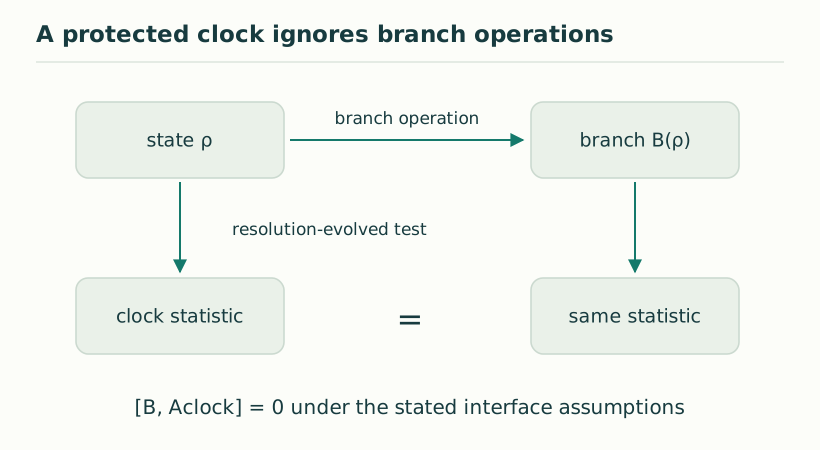
Figure 1. A protected clock ignores branch operations. In the stated stationary finite-dimensional model, branch invisibility is equivalent to the branch generator commuting with the resolution-evolved clock observable algebra. It is a criterion to verify, not an automatic law for every clock. View full size ↗
03An explicit two-qubit code
Take two co-located two-state systems and the code C=span{|01⟩,|10⟩}. Let Kb=κ(Z₁+Z₂) and Kr=(ℏω/4)(Z₁−Z₂). On the code, Z₁+Z₂ vanishes, so branching produces no logical evolution. Resolution restricts to ℏωZℓ/2.
Prepare the logical +X state. Measuring logical X and Y gives cos(ωτ) and sin(ωτ), independently of u. Two quadratures and a declared unwrapping range convert the phase into a material clock reading. The code is preserved exactly by both generators, which is stronger than merely asserting that it lies behind a large energy gap.
⟨Xℓ⟩=cos(ωτ); ⟨Yℓ⟩=sin(ωτ)
04A controlled imperfection gives a testable failure
Add a branch mismatch δ(Z₁−Z₂)/2. On the logical code this produces an additional phase 2δu/ℏ, so the total logical angle is φ=ωτ+2δu/ℏ. The clock is now sensitive to branching.
If an independently measured refinement interface gives u/τ=Drec, the inferred reading obeys Tclk/τ=1+[2δ/(ℏω)]Drec within the calibrated window. Varying the refinement settings while holding the coupling fixed tests this predicted dependence. It is stronger than merely observing that the ideal code has no branch response.
φ=ωτ+2δu/ℏ
Tclk/τ=1+[2δ/(ℏω)]Drec
05Resources and approximate protection
The construction needs two internal degrees of freedom, code preparation, joint logical readout, stable operation-dependent couplings, and a calibrated phase range. It also needs control of leakage outside the code. A large gap alone does not establish exact invariance.
For a bounded symmetry-breaking perturbation of norm λ over branch activity u, a finite-window bound gives contrast no larger than λ|u|/ℏ and leakage probability no larger than its square from an initially invariant code. These are sufficient perturbative estimates. They do not replace a hardware noise model or establish indefinite protection.
06How a protected clock can enter a joint law
If matter on a separate factor evolves during branch activity as exp(−iuHm/ℏ), while the logical clock reads τ, then a branch-band frequency is converted by u/τ. Combined with the independently calibrated geometry interface, this yields a conditional coefficient Drec times the branch transport coefficient.
Each premise has a separate measurement meaning. The protected clock does not itself create the geometry, and the geometry does not force the clock coupling. The construction demonstrates compatibility of the desired pieces within one quantum model while keeping their selection obligations visible.
07The SMM/DTT significance
The model turns “outer time ignores inner branching” into a concrete property of an encoded material device. It also provides a deliberate perturbation that breaks the property in a calculable way. Both are useful steps toward an operational dual-time theory.
The remaining fundamental question is universality: why should all physically relevant clocks realize this protection, or an equivalent law, rather than the allowed ungated alternative? A common source must supply that selection. The six nested stages organize the generative dependencies but do not, by their count alone, enforce the protected coupling.
KEEP THE CONNECTION
Key ideas
A logical clock can ignore branching while a hidden subsystem remains active.
The two-qubit code gives an explicit resolution-only clock.
A controlled symmetry-breaking term predicts a measurable branch dependence.
Scope of the argument. Explicit realizability result with supplied couplings; physical clock universality remains unproved.
Sources & further reading
operational_clock_selection_focused.pdfWorking draft, pp. 4–5, 9–10
Source editions and catalogue entries
Working manuscript
Operational Selection and Finite Calibration of Quantum Clocks
Working manuscript. Article-level references identify the consulted sections and the scope of the interpretation. No public URL was supplied for this exact manuscript version.