
In this article
- Why a dimensional dictionary is necessary
- Action, phase, and the free scale
- Length, time, and propagation
- Mass from a matched gap
- Gravity and curvature coefficients
- Dimensionless combinations reveal the physical target
A shared dictionary converts source outputs into calibrated actions, lengths, times, masses, and curvature coefficients. Dimensional checks expose missing scales and distinguish coefficient matching from an independent derivation.
A finite generative model may naturally produce integers, phases, eigenvalue ratios, and dimensionless stiffnesses. Laboratory quantities are expressed through calibrated lengths, durations, masses, and actions. A dictionary connects the two. Without it, a numerical match can conceal a unit error or an arbitrary scale choice.
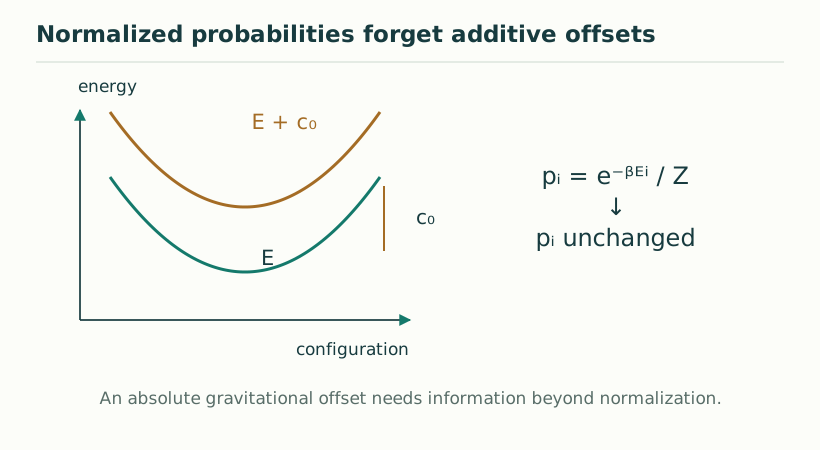
SMM/DTT aims to make the dictionary common across sectors: the same temporal generation should underlie matter, propagation, and geometry. Dimensional consistency is the first check of that aim. It is necessary, but it is not enough to select an absolute value.
If additive action S maps continuously and nontrivially into a phase character, then χ(S)=exp(iS/a) for some positive action scale a after choosing orientation. The character law fixes the exponential form because continuous additive phase lifts are linear.
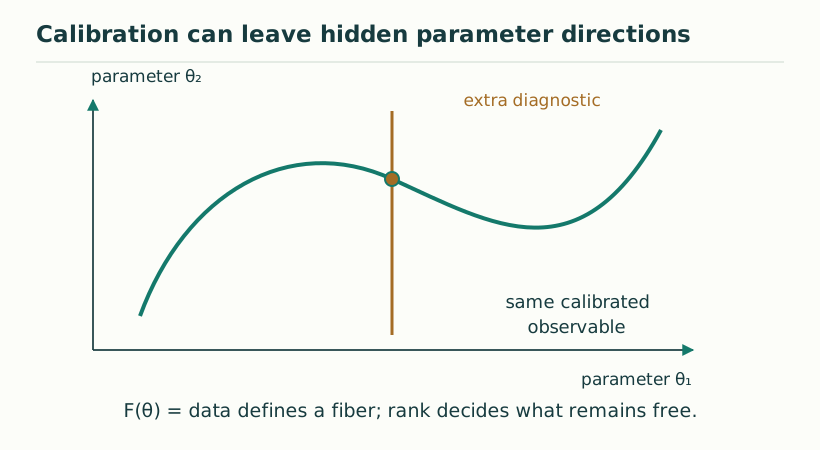
Every positive a is permitted by those assumptions. Identifying a with physical ℏ requires a quantum matching and a calibration to standards. A recurrence time already calculated with ℏ cannot then be used as an independent input to derive the same ℏ.
Let ℓ* and τ* convert dimensionless spatial and temporal readouts into physical units. If υ is a dimensionless sharp propagation coefficient, c=υℓ*/τ*. This has units length per time.
The formula does not prove that a lattice bound, group velocity, and relativistic signal cone are identical. Those are different measurements and may differ in a candidate model. A universal speed law requires the selected matter and signal sectors to share the appropriate operational coefficient.
For a positive physical transfer problem, define ε_s=−log(t_s/t₀) using a common reference eigenvalue. If the relevant physical time and relativistic rest-energy interpretation have been established, the mass dictionary is m_s=aε_s/(c²τ*). The numerator divided by τ* is an energy; division by c² gives mass.
A spatial radius R in m=na/(Rc²) would give the wrong units. With a spatial radius and a supplied linear dispersion, the corresponding mass form is na/(Rc). With a temporal radius, the c² denominator can be appropriate. The symbol’s physical meaning must therefore be stated before manipulating the formula.
Suppose a dimensionless geometric action contains κ times curvature and a constant term −r. Matching it to the stated Einstein-action convention gives G=c³ℓ*²/(16πaκ) and Λ=r/(2κℓ*²). The dimensions are respectively length cubed per mass-time squared and inverse length squared.
The matching does not calculate κ or r. Nor does it establish the correct sign of all dynamical modes, universal matter coupling, or a Lorentzian limit. A geometric inequality coefficient also needs an independently fixed energy normalization before it can be connected to Newton’s constant.
Combining these dictionaries removes the arbitrary conversion scales from ratios such as μ, Gm_e²/(ac), and Λ[a/(m_ec)]². Those are appropriate targets for a source theory because changing the unit labels cannot alter them. A prediction of their values still requires the source to determine the remaining dimensionless coefficients.
The practical discipline is simple: define every symbol’s units and operational role, check each equation, distinguish calibration from selection, and use one dictionary consistently. This makes SMM/DTT’s common-source ambition testable. It also prevents a dimensional identity from being advertised as an independent derivation of an action scale, an electron mass, or a gravitational coupling.
KEEP THE CONNECTION
Scope of the argument. Conditional unit and coefficient matching; no absolute action, length, time, or gravitational scale is selected.
Working manuscript. Article-level references identify the consulted sections and the scope of the interpretation. No public URL was supplied for this exact manuscript version.
Source register →