A programmed serial source can prepare a periodic lattice and reproduce its local neighborhoods exactly. This establishes feasibility while leaving spontaneous selection, dimension choice, and persistent growth as separate tasks.
One serial source can construct a lattice by writing carefully chosen translation tables into retained memory. The torus example makes that feasibility claim exact and identifies the local neighborhoods it produces. Its programmed success also exposes the remaining SMM/DTT question: what source dynamics selects this structure, its dimension, and its persistence without receiving the geometric answer as an input?
02An explicit lattice programme
Choose a finite periodic array (ℤ/Lℤ)ᵈ and define each operation P_a to add one to the corresponding coordinate. The operations commute, every label can be reached, and no short nonzero translation closes if the side length L is large enough. Consequently the completed operational graph has lattice neighbourhoods. Its construction is concrete: a serial controller can write the operation tables one entry at a time. The example demonstrates that one active source is compatible with a rich retained geometry; it does not demonstrate that a generic unprepared source discovers this programme.
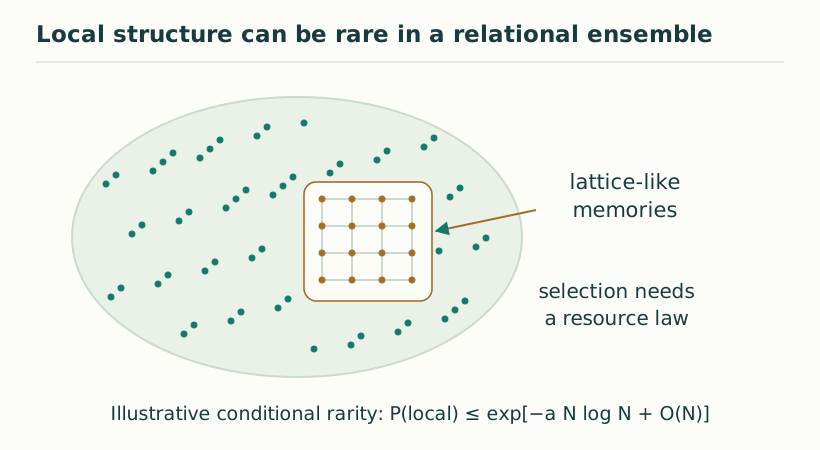
Figure 1. Local structure can be rare in a relational ensemble. A schematic ensemble contrasts arbitrary relational memories with a small lattice-like subset. In the stated permutation model, rarity is exponentially strong in N log N; constructing an example does not establish spontaneous selection. View full size ↗
03The quotient argument
For commuting operations, a signed word is characterized by its net translation vector n in ℤᵈ. Vectors returning the source cursor to its starting label form a subgroup Λ. Two words finish at the same label exactly when their difference belongs to Λ, so completed records are indexed by ℤᵈ/Λ. Excluding relations of length at most 2R+1 guarantees that radius-R induced neighbourhoods agree with the infinite lattice. The extra one in the bound also prevents unwanted edges between otherwise distinct points in the ball.
Λ = {n ∈ ℤᵈ : Pⁿr = r}
completed records ≅ ℤᵈ/Λ
min{|n|₁ : n∈Λ, n≠0} > 2R+1
04A small periodic example
Set d=2 and L=7. There are 49 labels, and the operations increment the two coordinates modulo seven. The shortest nonzero period has length seven, so radius-two induced neighbourhoods satisfy 2R+1=5<7. A viewer near any site sees a piece of the square lattice, although sufficiently long walks reveal periodicity. Nothing in the same proof prevents d=3 or d=4. Thus the programme creates whichever lattice dimension was encoded in its successor rules; dimension selection has not yet been explained.
05The distinction between feasibility and selection
A compact algorithm can specify a very large table. That observation does not contradict the entropy theorem, because algorithmic description length and relative entropy against a broad reference measure are different resources. The manuscript’s torus preparation deliberately supplies structured control that is not reference preserving. A stronger physical mechanism would make the desired programme attractive under one autonomous source law, quantify its basin and preparation time, and show stability after publication. This would explain why local geometry is selected, rather than merely demonstrating how to compile a known geometric answer into memory.
06A local limit is not a unique global universe
Lattice quotients can have different periods, shear and aspect ratios while sharing the same small neighbourhoods. Increasing the shortest nonzero relation length gives local convergence to an infinite lattice, but does not select a particular compact global topology. A rectangular torus and a sheared quotient may therefore satisfy the same finite-radius test. For an expanding SMM/DTT archive, the relevant question is also whether old records persist consistently as new ones are added. Rebuilding a larger torus from scratch supplies a sequence of geometries; it does not yet give one history-preserving growth process. These are useful separate targets for a stronger construction.
07What would complete the physical explanation
The six inner stages in this research programme are nested roles of a single generation–completion process. The seventh level publishes a completed configuration; it is not another independent time coordinate. The locality paper supplies concrete finite implementations of this architecture, but their schedules, memory and permitted transport remain specified inputs. A stronger SMM/DTT account would select those ingredients with one physical update law and explain why they persist under perturbation. It would also calibrate graph steps and completion counts against actual rulers and clocks. A proof about a finite labelled memory is valuable even before that programme is complete, provided its conclusion is kept at the level established by its hypotheses.
There is also a metric distinction inside the lattice example. Counting elementary signed operations produces a word metric, which on the standard lattice is the Manhattan metric. A Euclidean-looking embedding or cubic volume growth does not automatically replace that metric by an isotropic Euclidean norm. A continuum limit must specify the probe, its allowed directions and any averaging or refinement that makes its comparison law isotropic. This is why adjacency, volume growth, diffusion, calibrated distance and signal propagation should be checked separately even after an exact lattice neighbourhood theorem has been proved.
KEEP THE CONNECTION
Key ideas
A programmed torus gives an exact conditional locality example.
The quotient proof works in multiple dimensions.
Selecting the programme is a separate physical problem.
Scope of the argument. Explicit preparation proves feasibility; the origin and selection of its programme remain open.
Sources & further reading
temporal_locality_v8(1).pdf — working draftpp. 6–7 and 13–14, §§3–4 and 7
Source editions and catalogue entries
Working manuscript
Temporal locality — working draft v8
Working manuscript. Article-level references identify the consulted sections and the scope of the interpretation. No public URL was supplied for this exact manuscript version.