Preparing a geometric memory with appreciable probability requires relative entropy when geometry is rare in the reference ensemble. The bound quantifies information resources without automatically identifying them with work or elapsed time.
The rarity of a geometric memory becomes a quantitative preparation question when a reference ensemble and a target success probability are fixed. Relative entropy measures the information required to favor that event. For SMM/DTT, the bound separates the work of an active source from the structured memory and controls it must prepare; converting this information requirement into physical energy or duration needs additional laws.
02From a rare event to an information requirement
Let σ be the reference state of the memory, and let A denote the event that the memory has the selected geometric property. Its reference probability is p. A preparation produces another state ρ in which the same event has probability q. Relative entropy D(ρ∥σ) measures how distinguishable that preparation is from the reference. This quantity includes the statistical information favouring geometry; it is not automatically an amount of energy or a count of source ticks. The event must be tested in the same way in both states for the comparison to be meaningful.
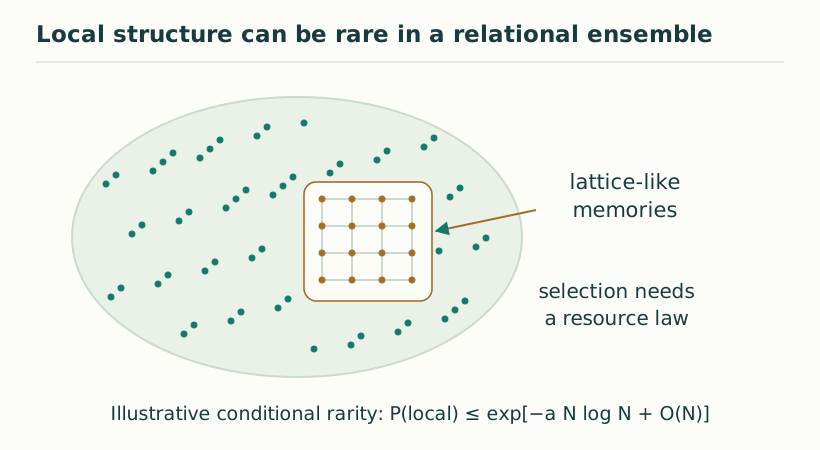
Figure 1. Local structure can be rare in a relational ensemble. A schematic ensemble contrasts arbitrary relational memories with a small lattice-like subset. In the stated permutation model, rarity is exponentially strong in N log N; constructing an example does not establish spontaneous selection. View full size ↗
03The binary-measurement derivation
Measure only whether A occurred. Data processing says that discarding all other information cannot increase relative entropy. The resulting binary distributions give a lower bound. Expanding the binary divergence leaves a term q log(1/p), minus the binary entropy h₂(q), and a further nonnegative contribution. If geometric reference probability is exponentially small in N log N, preparing order-one geometric occupation therefore requires relative entropy of that same order.
D(ρ∥σ) ≥ q log(q/p) + (1−q) log[(1−q)/(1−p)]
D(ρ∥σ) ≥ q log(1/p) − h₂(q)
p ≤ e^(−I_N) ⇒ D(ρ∥σ) ≥ q I_N − log 2
04A worked information budget
Suppose a toy reference gives p=e^(−1000), and the intended preparation succeeds with probability q=0.9. The simple lower bound is 900−log 2, approximately 899.31 nats. Dividing by log 2 expresses this as approximately 1297.4 bits of distinguishability. These numbers illustrate the bound; they do not estimate the information content of the universe. A controller, fresh ancillas and a retained success flag may carry part of this resource. Omitting them from the state description can make a costly protocol appear falsely free.
05When information can be converted into work language
For a specified thermal reference σ proportional to exp(−H/k_BT), the excess free energy is k_BT D(ρ∥σ). Only after this Hamiltonian, temperature and reservoir model are supplied does the information bound acquire an energy interpretation. An actual minimum-work statement still needs a preparation protocol and its operational restrictions. In DTT the distinction is particularly useful: generative time, memory capacity, thermodynamic work and observed elapsed time are different quantities. Deriving relations between them would be new physical content; relabelling one as another would not explain the preparation of space.
06The reference state is part of the statement
Relative entropy is always measured against a reference. If a proposed formation process changes the reference distribution, the original contraction argument cannot simply be reused. The draft accounts for a changing reference with a sum of operator-norm differences between consecutive logarithms of reference states. This is an information budget, not automatically work. It makes a physical escape from the obstruction explicit: a source may supply structured control that changes which memories are favoured, but that control then enters the accounting. This prevents an apparent solution that hides the required resource in an unreported change of ensemble or in a success-conditioned branch.
07What would complete the physical explanation
The six inner stages in this research programme are nested roles of a single generation–completion process. The seventh level publishes a completed configuration; it is not another independent time coordinate. The locality paper supplies concrete finite implementations of this architecture, but their schedules, memory and permitted transport remain specified inputs. A stronger SMM/DTT account would select those ingredients with one physical update law and explain why they persist under perturbation. It would also calibrate graph steps and completion counts against actual rulers and clocks. A proof about a finite labelled memory is valuable even before that programme is complete, provided its conclusion is kept at the level established by its hypotheses.
There is also a metric distinction inside the lattice example. Counting elementary signed operations produces a word metric, which on the standard lattice is the Manhattan metric. A Euclidean-looking embedding or cubic volume growth does not automatically replace that metric by an isotropic Euclidean norm. A continuum limit must specify the probe, its allowed directions and any averaging or refinement that makes its comparison law isotropic. This is why adjacency, volume growth, diffusion, calibrated distance and signal propagation should be checked separately even after an exact lattice neighbourhood theorem has been proved.
KEEP THE CONNECTION
Key ideas
Binary data processing supplies a rigorous preparation bound.
Ancillary memory and controllers belong in the resource accounting.
A thermodynamic work interpretation needs additional physical calibration.
Scope of the argument. Information-theoretic necessity; sufficiency and minimum physical work are not established.
Sources & further reading
temporal_locality_v8(1).pdf — working draftpp. 10–12, Theorem 6.3 and Propositions 6.4–6.5
Source editions and catalogue entries
Working manuscript
Temporal locality — working draft v8
Working manuscript. Article-level references identify the consulted sections and the scope of the interpretation. No public URL was supplied for this exact manuscript version.