


Two local choices are not yet a composite
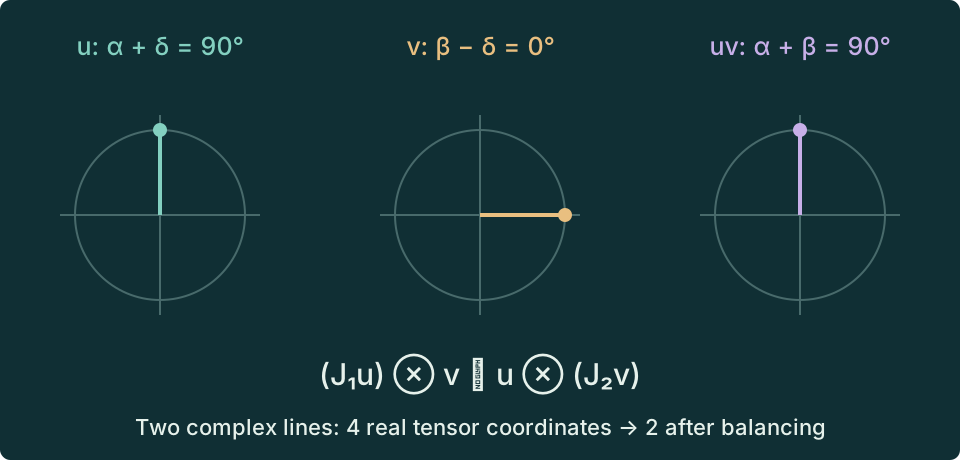
Take two real planes, each equipped with a chosen quarter turn. Each can be regarded as one complex line. Their raw real tensor product has four real dimensions, whereas the tensor product of the two complex lines has one complex dimension, or two real dimensions. Simply selecting the two local quarter turns does not remove this mismatch. [P03] [B24]
The standard complex composite imposes a balancing relation: multiplication by the imaginary scalar on the first factor is identified with multiplication by the same scalar on the second. This is an additional structural rule. It tells us how the two local scalar actions are to be compared.
The lab uses the simplest possible factors, complex lines. It is an exact demonstration of scalar balancing, not a model of two qubits or a claim about entanglement. Higher-dimensional systems require the full tensor-product construction and the appropriate Hilbert-space completion.
Transfer phase between the factors
Choose local angles α and β, then vary the transfer δ. The first factor becomes eⁱ⁽ᵅ⁺ᵟ⁾ and the second eⁱ⁽ᵝ⁻ᵟ⁾. Their product remains eⁱ⁽ᵅ⁺ᵝ⁾. Play animates the opposite transfers while leaving the product unchanged.
Explore · Exact finite illustration
Change the inputs and compare the numerical readout. Playback begins only when you press Play.
The interactive values require JavaScript. The diagram and worked equations provide the same mathematical construction.
The four raw real tensor coordinates generally change during this transfer. The two real coordinates of the complex product do not. The lab shows both, making the comparison rule visible rather than merely relabeling the same array.
The balancing relation
Write u=a+ib and v=c+id. The raw real tensor has coefficients (ac,ad,bc,bd). Complex multiplication maps these to (ac−bd,ad+bc). In this one-dimensional complex example, that multiplication identifies the complex tensor product with a complex line.
The map from four real tensor coordinates to two has rank two and a two-dimensional kernel. Factoring out the balancing relations accounts for the dimension reduction. This calculation is algebraic; the full Hilbert construction must also carry the appropriate inner-product and completion structure.
The equality explains why transferring opposite scalar phases leaves the balanced composite unchanged. By contrast, physically shifting one path before a fixed interferometer changes a relative phase. A scalar identification in a tensor construction and a laboratory operation are not the same assertion.
The SMM/DTT reconstruction target
A proposed source model must explain which local structures arise, which comparisons connect them, and which composition rule is physically appropriate. The published phase-selection work identifies the balancing requirement explicitly rather than treating it as a consequence of having local imaginary units. [P02] [P03]
This also clarifies what has not been obtained from the demonstration. It does not produce an interaction Hamiltonian, a gauge force, entanglement statistics, or a numerical coupling. Those questions need additional dynamics and physical identifications. The website's gauge section and open problems supply onward routes.
Continue to two geometries to distinguish this circular phase structure from the hyperbolic temporal pairing discussed elsewhere in the theory.