
Understand the temporal picture
Begin with Duality, then follow Emergence, Phase, and Observation from a generative proposal to completed comparisons.

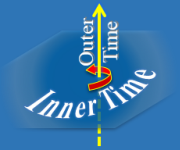
SMM / DTT · Explore through images and interaction
See how inner generation and outer observation connect to space, phase, matter, and the observable world.
Follow the illustrated journeys, adjust the models, and trace the assumptions behind each calculation. Start with the temporal picture or enter through the physical question that interests you.
Two temporal roles, one visual example, and a first experiment.
About 8–12 minutes →02 / Find your routeChoose a route through the pictures, mathematics, or evidence.
Three reading routes →03 / Build your vocabularyFind a definition, see an example, and follow it into a chapter.
24 linked concepts →Read them in sequence, or choose a topic. Each journey brings together explanations, visual models, and links for deeper reading.

Begin with the two temporal roles: how a configuration is generated and how its completion becomes available to observation.
Explore Duality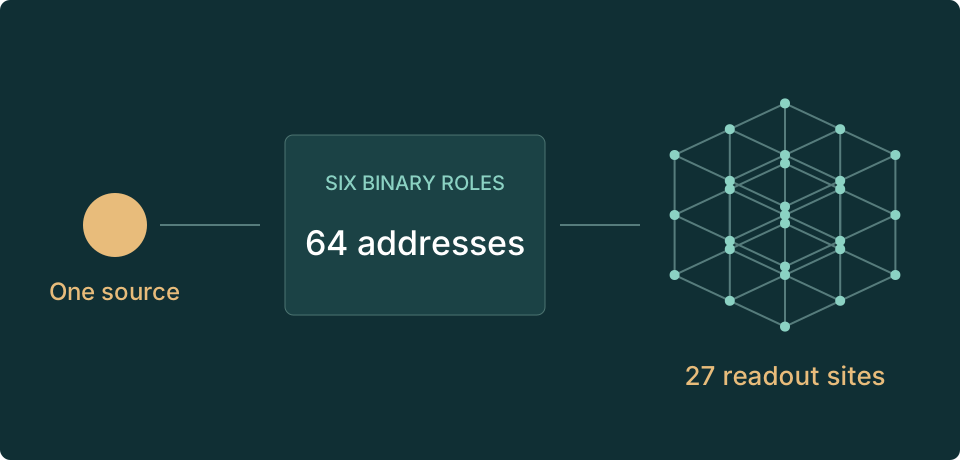
Follow the construction of relations, spatial readout, completed records, persistent structures, and physical clocks.
Explore Emergence
Explore complex structure, relative phase, composition, and the comparisons that make phase observable.
Explore Phase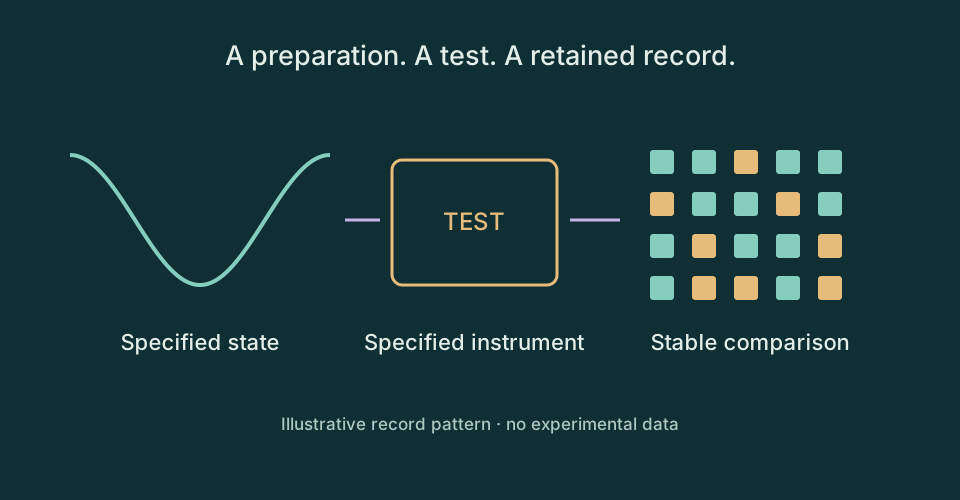
Compare measurement instruments, retained information, decoherence, memory, finite resolution, and correlations.
Explore Observation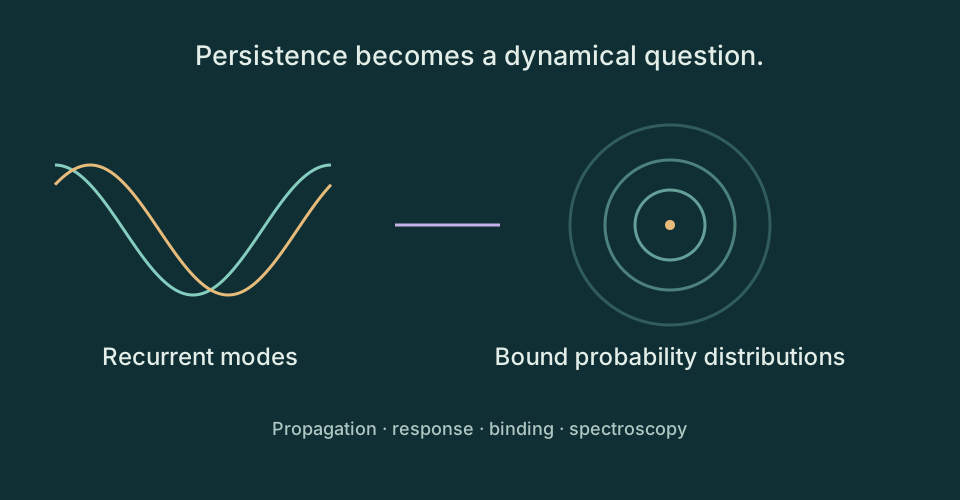
Work through recurrence, dispersion, spinors, atomic binding, hydrogen profiles, coupling, and spectral comparisons.
Explore Matter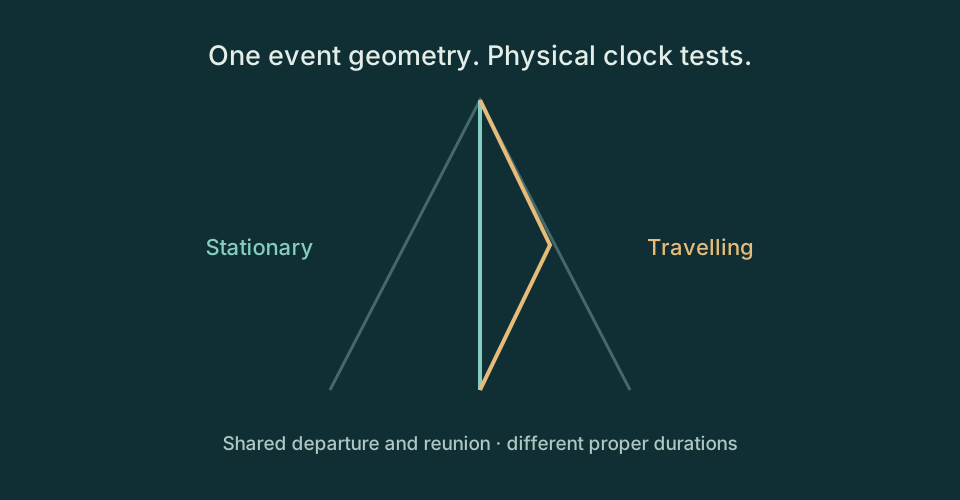
Inspect light clocks, Lorentz transformations, proper time, velocity composition, energy, and gravitational comparisons.
Explore Relativity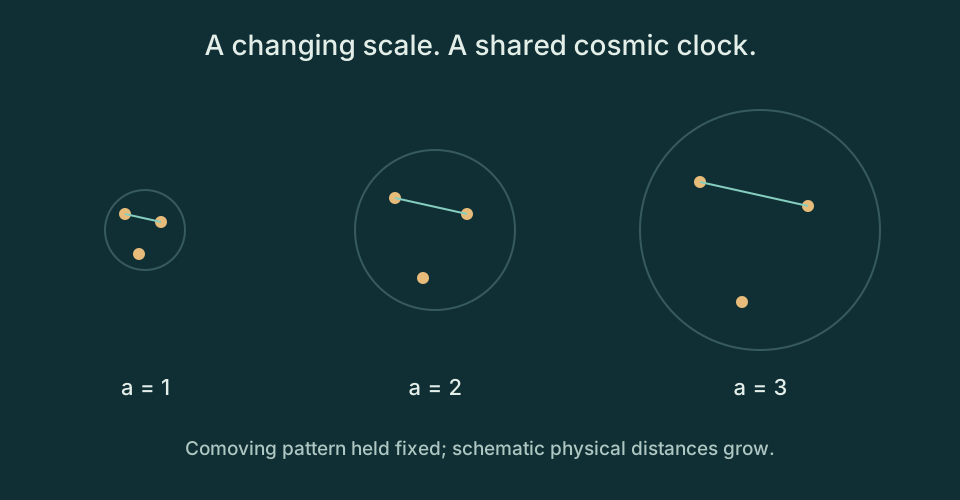
Compare expansion, redshift, cosmic clocks, horizons, vacuum response, and the growth of structure.
Explore Cosmology
Separate calibration from prediction through channel order, retry memory, atomic relations, and reserved comparisons.
Explore Experiments02 / Connect the programme
The interactive map links fifteen concepts through twenty-five explained relationships. Choose a reading path, inspect the conditions behind a result, or follow an open physical question into a possible test.
Explore the research map →Definitions & framing
Conditional mathematical results
Specified model inputs
Open physical tests
Begin with Duality, then follow Emergence, Phase, and Observation from a generative proposal to completed comparisons.
Move through Matter, Relativity, and Cosmology to compare material persistence, physical clocks, and cosmic history.
Start with Experiments, then use the research map to trace each comparison back to its assumptions and required inputs.
The illustrations distinguish supplied models, conditional mathematical results, and open physical questions. Numerical examples explain their conventions and sources; synthetic examples are identified where used.
For other tools, visit Applications or the existing mathematical demonstrations and research labs.
SMONAD
Share this page with its own title, summary and preview image.