


One construction, eight questions
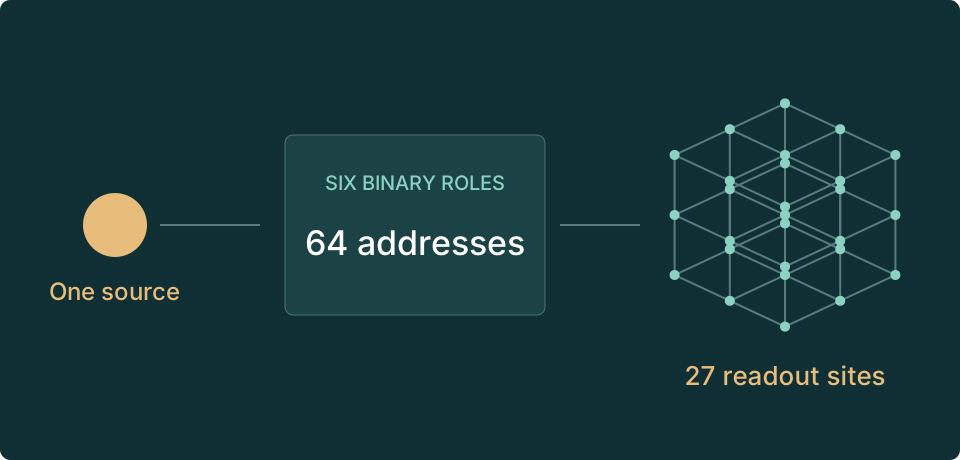
One source
Begin with the act of generating distinctions. Follow one explicit construction all the way to a completed, testable record.
↗02 / EXPLORERelations
A set of distinguishable outputs becomes a structured world only after we say which outputs can interact and how.
↗03 / EXPLORESix inner roles
Inspect the complete address-to-site map. See how internal distinctions can disappear in a completed readout.
↗04 / EXPLORESpatial readout
Three coordinates, a rank-three detector, and a three-dimensional physical space are related claims with different requirements.
↗05 / EXPLORECompletion
Prepare the next configuration one site at a time. Publish it only when every component is ready.
↗06 / EXPLOREClocks & motion
A succession of completed states provides an order. Physical duration needs an operational scale.
↗07 / EXPLOREPersistence
Conservation, a stationary state, and a persistent localized object are three different properties.
↗08 / EXPLOREPredictions
Use one completed record to set a parameter. Reserve the next record for a prediction.
↗The construction at a glance
Start with six binary roles. Pair them into three differences. Specify the relations between the resulting sites. Prepare a new state from a frozen previous record, publish it at completion, and compare successive records. Then ask what has persisted and what the next observation should show.
This section extends Duality with a single worked example. The paired address map follows the book's finite construction. The local diffusion law is a teaching choice introduced here to make scheduling, conservation, and prediction calculable. The section does not identify those weights with quantum amplitudes or particle masses. [B06] [B16]
Watch one complete update
Explore · teaching model v1
Teal: generated values. Gold: highlighted readout or reference.
Enable JavaScript to explore this model. The figure, worked values, and equations explain the same construction.
Each update prepares 27 components while holding the previous record fixed. Changing the preparation order leaves the completed result unchanged. The completion chapter explains why this works and when a different algorithm would fail.
Choose your route
| Route | Suggested sequence |
|---|---|
| Visual introduction | Source → Relations → Six inner roles → Spatial readout |
| Operational account | Completion → Clocks & motion → Persistence |
| Technical review | Model specification → Completion equations → Predictions → Published papers |
Every chapter includes an original downloadable diagram, an interactive experiment, a mathematical explanation, and onward reading. Nothing moves until you press Play. Keyboard controls, textual numerical readouts, the shared reading controls, and reduced-motion support keep the material accessible.
Use Sources & model for the full rule set and bibliography. The research section and application directory connect these ideas to the wider programme.