

Which dimension are we counting?
The model has 64 generation addresses, 27 readout sites, three coordinate components, and a 27-component state vector. These counts answer different questions. The number of sites is not the spatial dimension, and the dimension of the state vector is not the number of directions in the displayed geometry.
Our three-coordinate cube arises because we deliberately paired six binary roles into three differences. That is a finite construction. It does not prove that every possible generative model has three spatial dimensions. To explain a preferred readout dimension, stronger assumptions must constrain the carrier, detector, and accessible transformations. [B06] [B07]
The published quaternionic reconstruction provides such a conditional route. Under its algebraic hypotheses, the relevant quaternionic carrier has one scalar direction and three imaginary directions. A scalar-blind readout responds to the latter. The interpretation also depends on which transformations can be accessed and which distinctions the detector resolves. [P01] [A01]
Project the visible coordinates
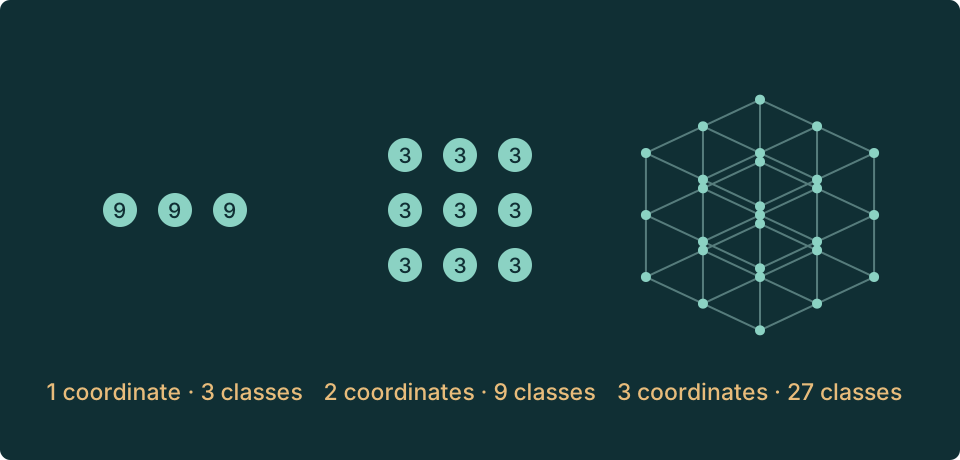
Select one, two, or three retained coordinates. The underlying 27 sites remain fixed; the readout groups them into 3, 9, or 27 visible coordinate classes. Numbers on a projected point count how many original sites it represents.
Explore · teaching model v1
Teal: generated values. Gold: highlighted readout or reference.
Enable JavaScript to explore this model. The figure, worked values, and equations explain the same construction.
With two coordinates retained, three sites collapse onto each displayed position. Those sites can still have different weights and neighbours in the full model. A projection changes the available description; it does not automatically supply an autonomous lower-dimensional dynamics.
Rank and discarded information
For the linear coordinate maps on the ambient real coordinate space, the ranks are 1, 2, and 3. On our finite site set, the image sizes are 3, 9, and 27. The first is a statement about independent linear directions; the second is a statement about distinct discrete outputs.
This schematic quaternionic readout removes the scalar component. The published argument requires more than writing four symbols: finite dimensionality, associativity, a positive multiplicative norm, suitable noncommuting circular phases, and the detector conditions matter. Changing a hypothesis can change the available classification or the interpretation. Read the theorem statements alongside the website guide. [P01] [B07]
What remains between rank and physical space
A local rank-three response does not by itself determine global topology, a distance scale, curvature, or a spacetime metric. Nor does it establish that every state of the carrier can be prepared or every direction measured. These are additional operational and geometric questions.
In this teaching model, adjacency and the Euclidean drawing convention were supplied separately. That makes the limitation constructive: you can change the graph while retaining the same coordinate rank, as the relations lab demonstrated. You can also change what is observed without changing the graph, as the projection lab shows. [B08]
The next chapter turns from where a record is represented to when it becomes available. Completion will use the full 27-site state, so no projected information is silently discarded. For a wider comparison of dimensions, see Space & dimensions.