
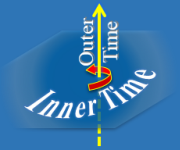

Open, explore, or download a diagram
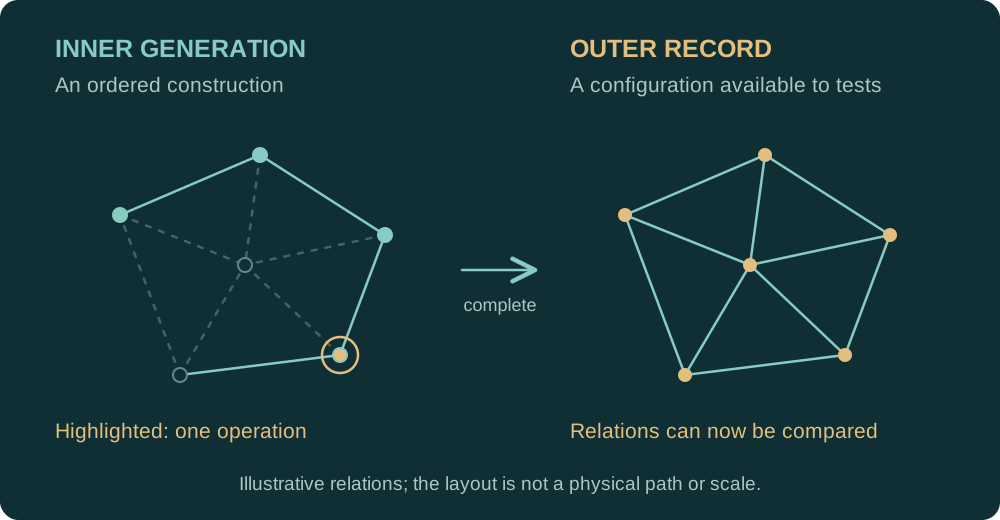
Generation and completion
The unfinished working state and the last available record are shown separately.
Explore the explanation → Download SVG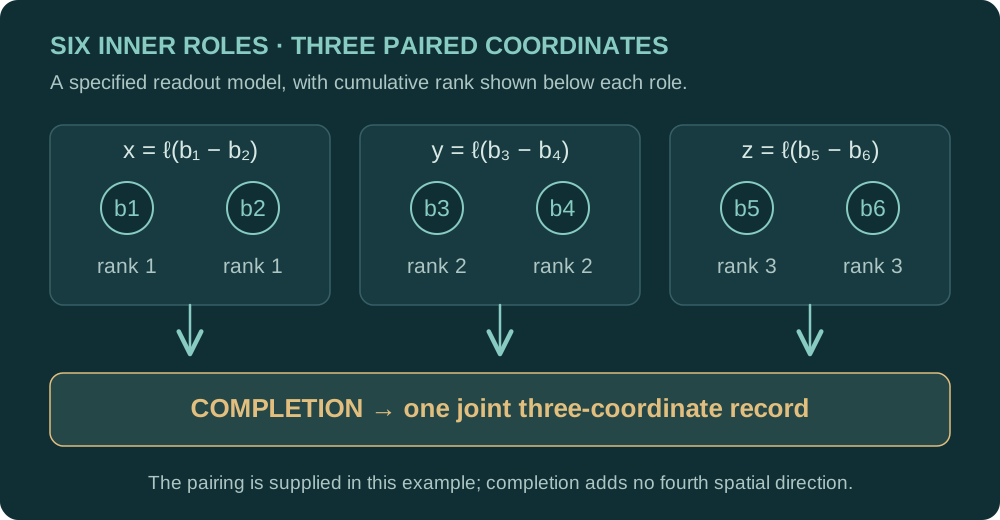
Six inner roles
Three paired contributions and an outer completion interface.
Explore the explanation → Download SVG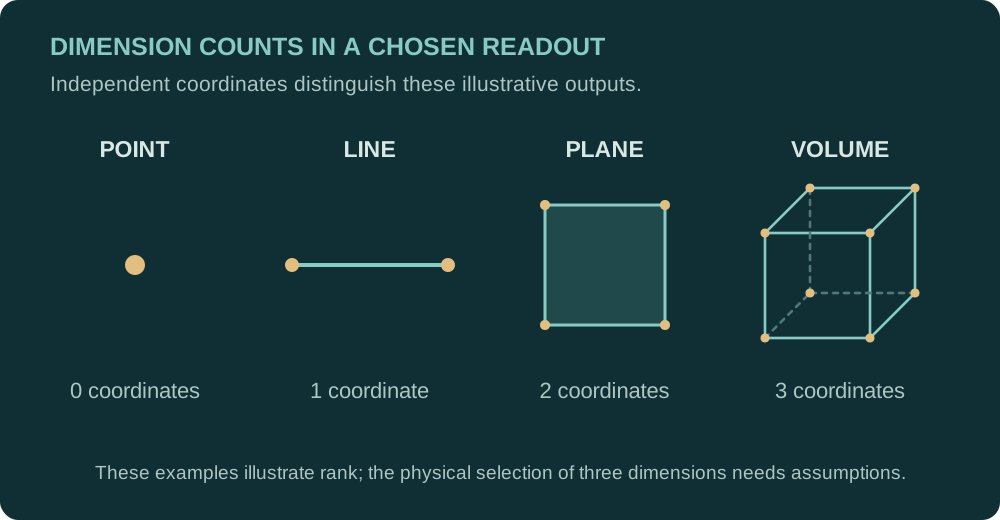
Spatial readout
Independent coordinates, then the further task of a physical geometry.
Explore the explanation → Download SVG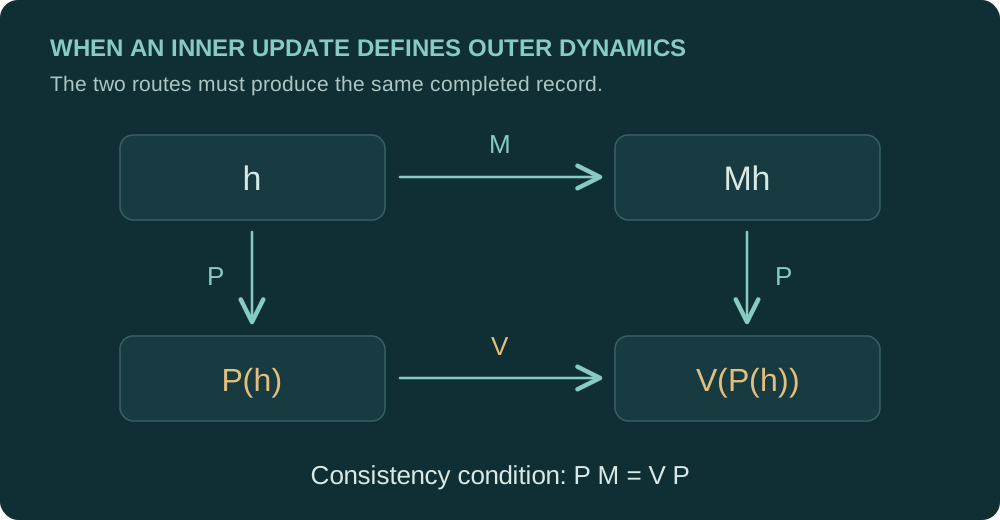
Predictive closure
Two routes must agree for an autonomous outer update to exist.
Explore the explanation → Download SVG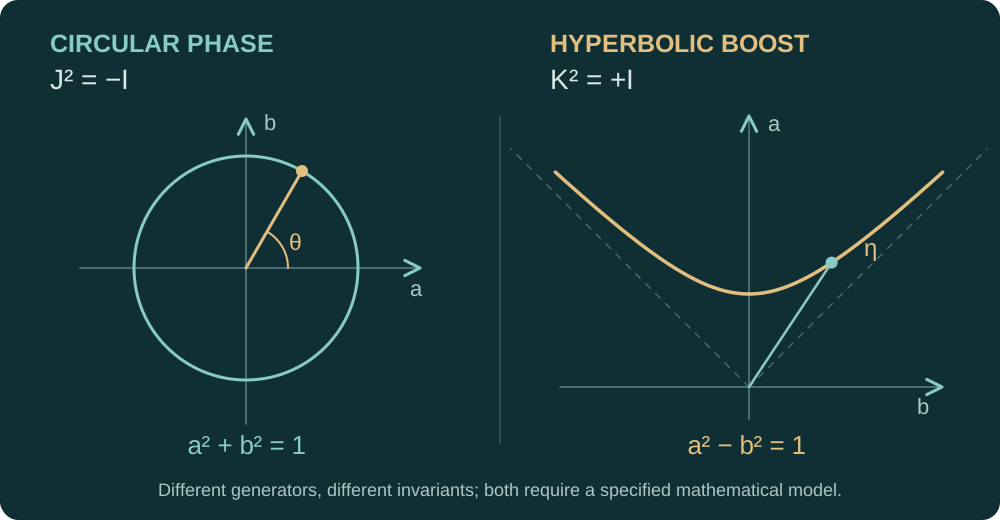
Two meanings of complex
Circular phase and hyperbolic pairing preserve different forms.
Explore the explanation → Download SVG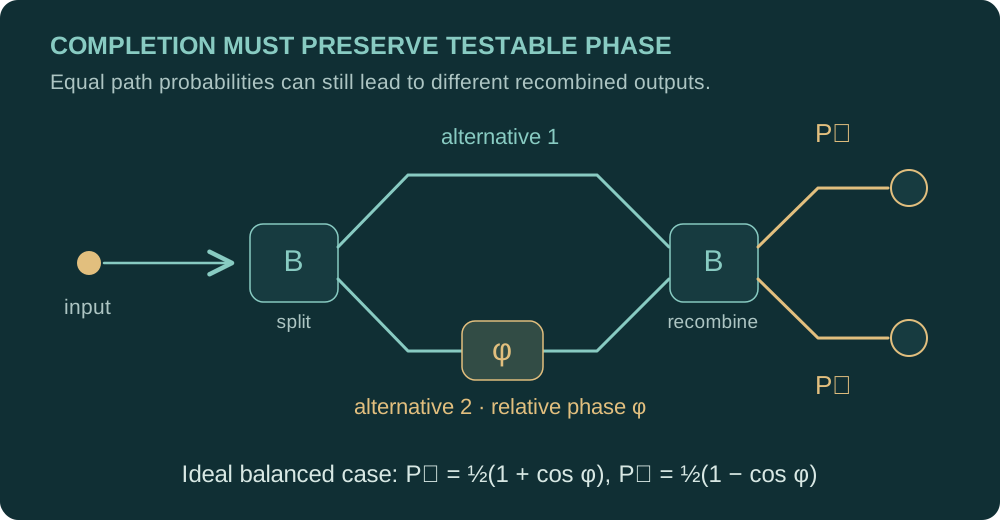
Phase-sensitive alternatives
A later recombination can reveal what an intensity-only display omits.
Explore the explanation → Download SVG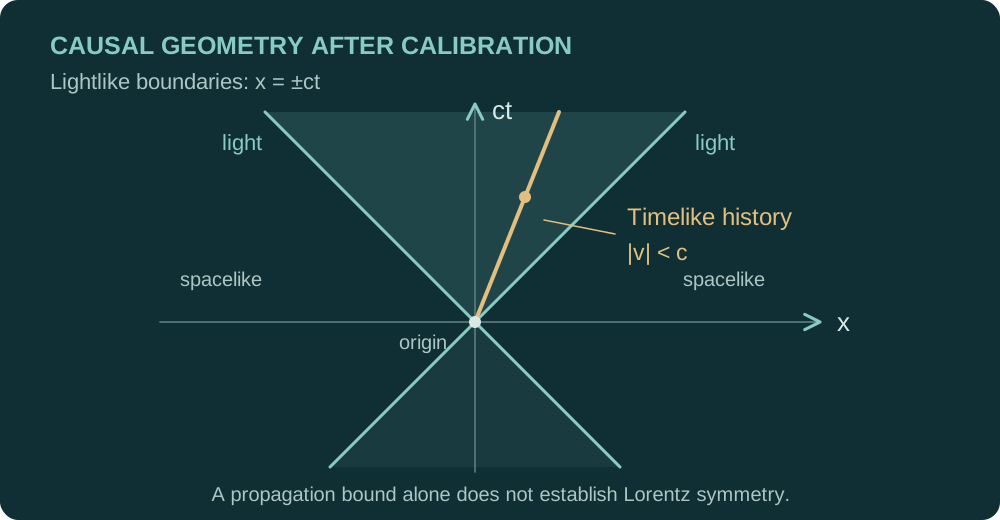
Calibrated propagation
A finite bound, an isotropic cone, and the further comparison of clocks.
Explore the explanation → Download SVG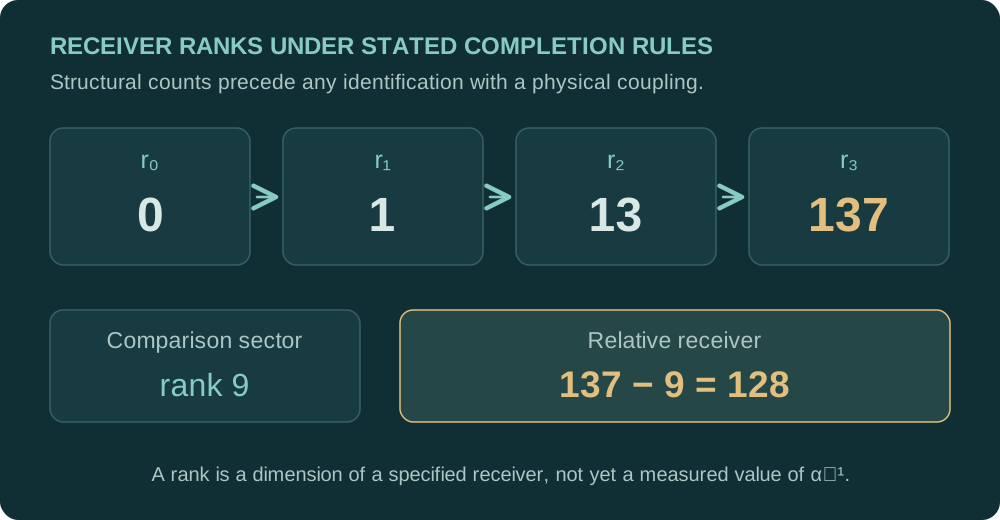
Receiver ranks
The recurrence 1,13,137 and the separately completed comparator 9.
Explore the explanation → Download SVGEight things to explore
- Generation and observation: play, pause, step, reset, and change the order of independent writes.
- Six-role geometry: vary the active roles and rotate the coordinate view.
- Predictive memory: vary the coupling from hidden information to the visible record.
- Circular and hyperbolic geometry: compare the two invariants.
- Interference: vary relative phase and coherence.
- Finite recorder: vary apparatus stages and capture phase across a full recurrence.
- Clock comparison: vary inertial speed and compare elapsed times.
- Receiver ranks: inspect each acquisition depth and the separate comparator.
How to read the animations
All dynamic examples identify their supplied rules. The network animation is an analogy for staged construction and completion. The six-role example and the leakage example implement exact finite rules. Interference and proper-time comparisons are familiar benchmark formulas. The recorder and rank examples illustrate specific published constructions.
Controls change the demonstration locally in your browser. No parameters are sent to a server. The pages remain readable with JavaScript disabled, and the static diagrams provide a printable companion to the interactions. Auto-motion is disabled when the device requests reduced motion; you can still choose to play an exploration.
Original SVG diagrams were prepared for this section. The original book illustration retains its attribution and is available in the inner-time chapter. [A06] [B15]