
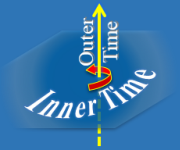

Generation, availability, and reading
Three events should be distinguished. A source process generates a configuration. A completion rule makes a record available. A subsequent interaction reads or uses that record. These can be connected physically, but they need not be the same event. A detector can register a result that a person reads much later; the later reading does not have to create the earlier correlation. [B02] [A05]
“Observation” in the outer-time description refers to physical accessibility: a distinction can affect an admitted test or another retained record. An observer belongs to the physical system and uses its own memory and apparatus. This avoids placing consciousness outside the generated world as an unexplained mechanism that switches reality on.
The outer sequence is therefore a sequence of completed distinctions, often written r₀, r₁, r₂, …. Their index orders records. To turn that order into a measured interval, a model must say what counts as a reproducible clock cycle and how it is calibrated against other processes.
What makes a record complete?
Completion is relative to the allowed operations and tests. A record that suffices for one question may be too coarse for another. Consider two quantum preparations with equal intensities in two paths but opposite relative phase. A detector that examines the paths separately cannot distinguish them; a later recombination can. Treating their equal current intensities as a complete predictive state would lose the difference that the later experiment needs. [B05] [P02]
Here P is the retention map and M is one complete inner update. If the implication holds, a well-defined outer update V can be assigned by V(P(h)) = P(Mh). Its output depends on the retained state, not on which hidden representative happened to produce it. If the implication fails, the same visible starting point has more than one possible future under the same stated operation.
For stochastic models, “equal” means equality of the relevant outcome distributions rather than necessarily one deterministic output. Future-test equivalence must include the interventions the model promises to predict. The stronger the test language, the more distinctions may need to be retained.
Make hidden information visible
Can the visible record predict its own future?
Two preparations share the same visible x = 1, but have hidden values y = +1 and y = −1. Change the coupling b in x′ = x + by.
Both preparations begin with visible coordinate x = 1. Their hidden coordinates are +1 and −1. The update x′ = x + by gives visible outputs 1 + b and 1 − b. At b = 0, the discarded coordinate cannot influence the next observation. For nonzero b, the current x alone is insufficient.
This is a small exact model of the autonomy condition proved in the published reconstruction. A nonzero hidden-to-visible block tells us how discarded information re-enters the observable record. The remedy may be to retain the hidden coordinate, restrict the allowed operation, or use a history-dependent effective description. Calling the old record “complete” does not remove the dependence. [P01]
A complete cycle can behave differently from one inner step
Suppose an inner phase takes three successive values. The visible counter n advances only when the phase completes its cycle. Starting with different hidden phases, a single step may or may not advance n. That step cannot be predicted from n alone. Three steps, however, advance n once whatever the initial phase. The full cycle has an autonomous action on the visible counter. [A05]
This illustrates why the correct unit of analysis may be the completed product of inner operations. Demanding every internal factor already act on the final record can be unnecessarily strong. Conversely, demonstrating closure for a full cycle does not license arbitrary intermediate observations; those require their own record description.
A recurrent phase also needs a valid capture or completion condition. Merely returning to an angle does not prove that all information has been registered. A physical construction must connect the return to the apparatus, the state, and the record that becomes accessible.
Memory connects successive completions
Memory is not an optional decorative addition to outer time. Comparing a current reading with an earlier one requires a surviving correlation. A clock counter, an apparatus register, or a physical trace supplies the relation through which change can be reported. Without retention, a succession of states would not automatically contain a record of succession. [B04]
Eliminating hidden variables can make the observable evolution depend on earlier observations. The temporal-asymmetry paper develops a specified dual-time model and a relation between internal coordinates and memory kernels. This is a different formal use of two temporal coordinates from the books’ nested-role interpretation. Both concern what a reduced description retains, but their assumptions should be read in their own formulations. [P04] [A04]
For a finite linear illustration, an unobserved mode y can store the effect of earlier x and later feed it back. Solving for y produces an integral over past x. The mathematical bridge works out that elimination explicitly. Memory in an observed equation can therefore arise from ordinary local evolution on a larger state space.
Three arrows that should be kept distinct
| Arrow | What is ordered? | Additional question |
|---|---|---|
| Generative | Dependencies in the formation of a configuration. | Which source operations are allowed and in what order? |
| Record availability | Which completed information can be used by later tests. | What retains records and permits comparison? |
| Thermodynamic | Entropy change in a stated physical description. | What dynamics, coarse description, and initial conditions produce it? |
A direction assigned to a generator is not already an entropy theorem. A reversible microscopic evolution can coexist with effective loss of accessible correlations. Likewise, a monotonically increasing display counter can be programmed without explaining the thermodynamic cost of its operation. DTT’s account of temporal orientation becomes stronger when these questions are related through a concrete physical model. [B12] [P04]