
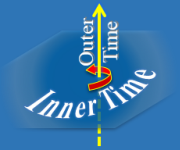

What the four published papers contribute
| Publication | Contribution relevant to duality | Further physical work |
|---|---|---|
| OMS · 10.30538/oms2026.0350 | A conditional finite reconstruction joining quaternionic readout, recorder dynamics, receiver completion, autonomous records, phase actions, and response. | Select and normalize a concrete microscopic realization; derive compatible matter and clock dynamics. |
| OMS · 10.30538/oms2026.0328 | Completion and future tests, real Hilbert representations, compatible phases, and conditional geometric structures. | Supply compatible physical dynamics, composition, calibration, and observables. |
| Physics Letters A · 10.1016/j.physleta.2026.132085 | Real-commutant phase selection and oriented polar phase on the dynamic sector. | Connect the representation and phase choice to an independently specified physical source and its measurements. |
| Mathematics · 10.3390/math14050853 | A dual-time topological model of temporal asymmetry and a realization of projected memory. | Identify discriminating observables and compare them with alternative memory models. |
These are complementary contributions with different hypotheses. Their publication is a record of mathematical and theoretical work, not evidence that every ontological interpretation or every possible physical identification has been experimentally established. [P01] [P02] [P03] [P04]
A map from claim to required evidence
| Claim | What is demonstrated here? | What would strengthen it? |
|---|---|---|
| Inner and outer time have distinct roles. | A coherent distinction between generation and accessible completion. | A source mechanism that constrains measurable relations. |
| A specified detector has rank three. | A conditional algebraic and covariance result. | A physical selection of its carrier and detector class. |
| A completed record predicts its future. | An exact fibre-preservation or projection criterion. | A stable realization for the actual allowed interventions. |
| A structural receiver has rank 137. | A count under a specified free-completion rule. | An independently normalized response and scale-dependent comparison with data. |
| A calibrated propagation bound is finite. | An inequality from displacement and delay budgets. | Isotropic sharpness and universal relativistic matter and clock behaviour. |
Design a discriminating experiment
A test begins with an observable, not with the number of time variables in an equation. Specify a preparation, a control sequence, a readout, and a comparison model. Then calculate what changes when one experimentally adjustable quantity is varied while the other assumptions remain fixed. [B16]
- Prepare: define states or histories the apparatus can reproducibly produce.
- Control: specify the operations, their order, and how duration is calibrated.
- Read: choose the retained signal and estimate its uncertainty.
- Compare: state the alternative model class and the parameters already fixed.
- Predict: calculate a withheld observation or a restricted range before fitting it.
For example, two preparations could have the same current visible record but different next-record distributions under the same intervention. That would refute a predictor using only the current record. It would not automatically refute every one-time model, because a larger state space with memory could represent the distinction.
Similarly, control-order dependence is familiar in noncommuting dynamics. A distinctive result would be a quantitatively derived relation between that dependence and another independently calibrated feature of the source architecture. The specific relation—not the mere appearance of a loop or a phase—is what makes a proposal testable.
The constructive priorities
1. Select the generative law
Specify the microscopic states, admissible operations, completion mechanism, and reasons for the selected carrier. A useful model should explain which ingredients are fixed and which remain adjustable.
2. Make geometry and matter emerge together
Derive neighbourhood relations and persistent excitations from compatible dynamics. Check isotropy, propagation, conserved quantities, and the limits in which familiar continuum equations are recovered.
3. Retain enough information
Test whether the completed record is predictive under the allowed interventions. If hidden differences reappear, enlarge the state or derive the resulting memory law explicitly.
4. Calibrate independently
Connect counts to duration, relational distances to rulers, and response coefficients to physical normalization. An observed constant used to set a scale cannot also be claimed as an independent prediction of that scale.
5. State a falsifiable relation
Find an observable relation that survives the allowed freedom in calibration. A prediction can be a constrained range or a correlation across experiments; it need not begin as one exact number.
Questions readers often ask
Does the observer create reality by looking?
That is not required by the operational description used here. Completion concerns physical record availability, including apparatus and environmental correlations. A person’s later reading is another physical event.
Does inner time mean a second clock beside ordinary time?
Not in the basic distinction. It names the generative order. A particular mathematical model may introduce extra coordinates, but their metric and observable interpretation must be specified separately.
Has the fundamental refresh rate been measured?
The animations do not display a measured microscopic rate. Their playback speed is a control for understanding the illustration. A physical rate would require a selected source law, calibration, and evidence.
Do the six levels prove that space must have three dimensions?
The paired-role example produces three coordinates because its pairing is supplied. The quaternionic reconstruction gives a separate conditional rank-three theorem using algebraic and detector assumptions. Neither should be presented as an assumption-free derivation.
Are 137 and 128 already electromagnetic couplings?
They are receiver ranks in the published completion scheme. Connecting them to measured inverse couplings requires response normalization, scale, and corrections. A structural count and a physical identification are different steps.
Does memory prove the existence of two fundamental times?
No. A hidden-state model with one evolution parameter can produce memory in its reduced observable equation. The distinguishing prediction must be more specific than the presence of a memory kernel.
Are these diagrams simulations of experimentally established microscopic physics?
They are explanatory constructions with their rules stated next to them. They demonstrate specified mathematical relationships and illustrate the SMM/DTT proposal.