
A specified receiver grammar yields 137 exactly. A coupling additionally depends on the response operator, source normalization, and identification with the matter interaction.
Read the earlier proposal through its dependencies
A Combinatorial–Geometric Derivation of the Fine-Structure Constant from Inner-Time Projection Dynamics in the Duality of Time Theory is a public preprint. Its abstract connects dimensional projection with an ideal inverse value of 137 and discusses corrections. This guide expands A212 while keeping the integer construction separate from its electromagnetic interpretation.
The ideal label α₀=1/137 is not automatically a bare coupling, a low-energy coupling, or a coupling at some high-energy scale. Such identifications need a specified physical theory, observable, and matching prescription.
Why a quadratic receiver has ten components
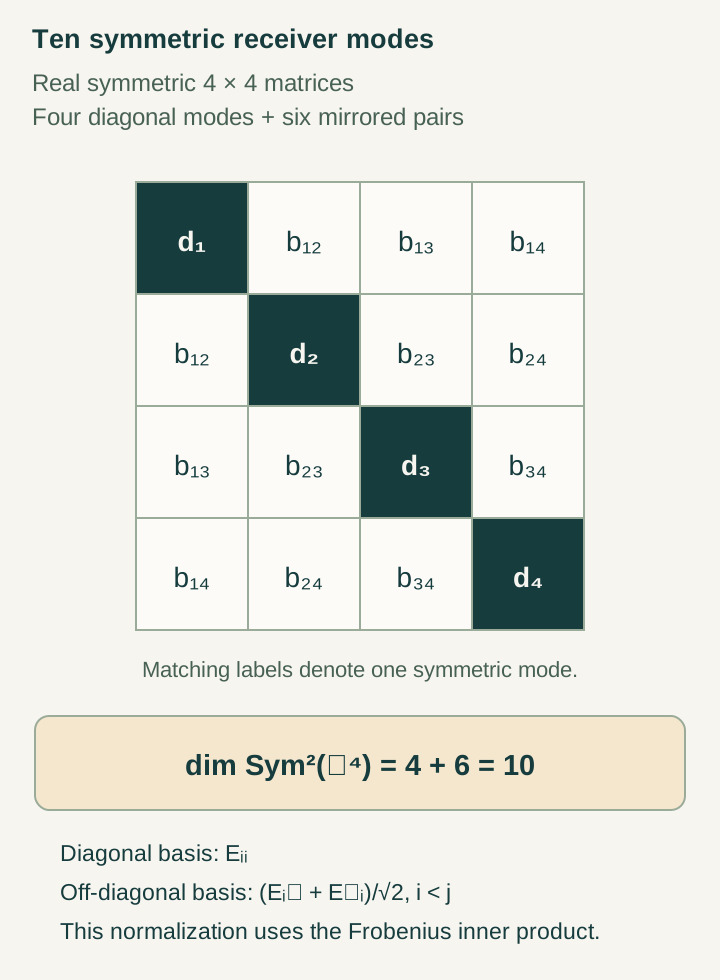
A four-dimensional input has four square terms and six unordered mixed pairs in its free symmetric quadratic receiver. Therefore dim Sym²(V)=4·5/2=10, over either the real or complex field when dimensions are counted consistently over that field.
This provides a structural origin for a factor of ten without appealing to decimal notation. It does not select the receiver automatically: why quadratic observables, why a four-component envelope, and which relations among the components are physically imposed? Those questions determine whether the free dimension is the relevant retained count.
Open the full-size diagram →
Calculate the retained count
The nonempty subsets of a d-element set number 2d−1. If a chosen record rule gives every old record ten extensions and adds one record for every new nonempty subset, the recurrence is Q₀=0 and Qd=10Qd−1+(2d−1).
The result is exact for that grammar. The rule for extending old records, admitting new branches, and stopping at depth three is substantive. A necessity argument must derive those rules from source operations and completion requirements rather than choose them after recognizing the target integer.
Count and capacity can vary independently
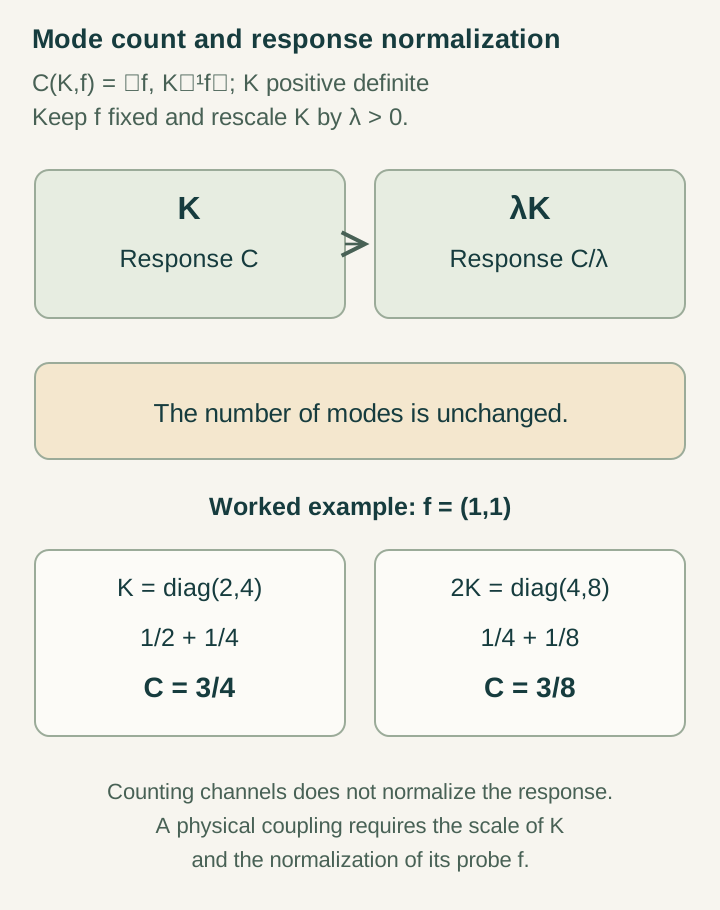
Let a positive receiver operator K respond to a source f with capacity C=⟨f,K−1f⟩. If K=sI and ||f||²=137, then C=137/s. The receiver dimension remains unchanged while its response varies with the positive stiffness s.
A physical derivation of α₀ would have to fix s and the source norm by the same construction, then prove the electromagnetic coupling is the appropriate inverse capacity. This is where the geometric count meets dynamics. A field redefinition cannot settle the issue unless the corresponding matter normalization is tracked as well.
Open the full-size diagram →
What the atom tells us once coupling is supplied
For the nonrelativistic Coulomb Hamiltonian with reduced mass μ and potential −αℏc/r, E₁=−μα²c²/2. The virial relation gives ⟨p²⟩/(2μ)=μα²c²/2, so the relative root-mean-square speed is sqrt(⟨p²⟩)/μ=αc.
In the center-of-mass frame, the electron speed is instead (μ/me)αc. Substituting α₀=1/137 yields the ideal model prediction after the coupling has been supplied. Binding exists for a continuous family of positive α values, so the existence of hydrogen-like binding does not by itself select 137.
Connect the structural and physical programs
Read A212 with A87–A90 and A96–A99. Then follow A171–A176 to see what is needed for attraction, a Coulomb law, and a normalizable atom. The strongest SMM/DTT objective is one source that fixes both the receiver and the matter probing it.
A useful next result would show that an allowed rescaling of K necessarily changes another already fixed observable, removing the free matching parameter. Only afterward should a fractional correction be calculated from a defined mechanism. Which response and atomic observations remain predictions after calibration? That question tests whether the integer has become a coupling explanation.
Continue with the articles
- The earlier combinatorial fine-structure proposal
The earlier 137 construction combines a ten-mode receiver with the branch counts 1, 3 and 7. A response-operator example and the Coulomb speed relation show which normalization and source-selection steps are still needed to identify a physical coupling.
- From three-dimensional readout to retained records
A quaternionic readout, ten-mode pair memory, and a selected stopping grammar produce 137 distinguishable records. The construction makes its retention assumptions explicit and leaves physical coupling as a separate problem.
- Why a record count is not yet a coupling
A receiver's static response depends on its source and inverse stiffness, as well as its size. Exact minimization shows why counting 137 records does not by itself determine an electromagnetic coupling.
- Trace-sector response and the Schur complement
Allowing hidden traceless modes to relax changes the stiffness seen by a trace source. The Schur complement gives the exact reduced capacity and exposes the normalization still needed for an inverse-rank coupling.
- The conditional ideal value one over 137
The ideal model value 1/137 requires a selected record count, a trace-response law, and an additional absolute normalization. A hydrogen-like calculation checks their consistency without deriving the measured fine-structure constant.
- Why the symmetric receiver has ten modes
The symmetric square of a four-component envelope contains four diagonal and six off-diagonal pair modes. Retaining all ten requires genuine pair memory, beyond the information in a quaternionic product.
- Alternating branches and the ranks one, three, seven
Positive-degree exterior combinations give branch ranks 1, 3, and 7. Combining them with ten-mode continuation memory yields 137 records under a free-retention rule whose losses can be calculated explicitly.
- A normalizable hydrogen-like ground state
Square completion gives the exact normalized ground state of the supplied nonrelativistic Coulomb Hamiltonian. Its spectrum and relative root-mean-square speed provide precise atomic benchmarks without selecting the coupling itself.
- Why binding does not fix the coupling
Dilation shows that every positive Coulomb coupling admits binding and the same type of ground-state filter. A source derivation of a particular coupling must therefore fix field, matter, action and clock normalization beyond the existence of an atom.
Sources and reading
Read the original source for its exact formulation and edition. The examples on this page are explanatory reconstructions.