


A supplied family of independent commuting operations can generate a spatial address system. Its dimensional rank, metric, local transport, and retained completion are distinct achievements.
The public spatial-formation proposal
The Dynamic Formation of Spatial Dimensions in the Inner Levels of Time has a public preprint version linked below. Its stated theme is formation of spatial structure through nested temporal activity. This page reads that theme through explicit finite constructions and the later article A213, without treating every broad claim in the abstract as a completed reconstruction.
The essential question is whether source relations determine space or whether an already spatial arrangement has simply been given a temporal interpretation. Both can be useful models, but they answer different explanatory questions.
What six inner roles mean
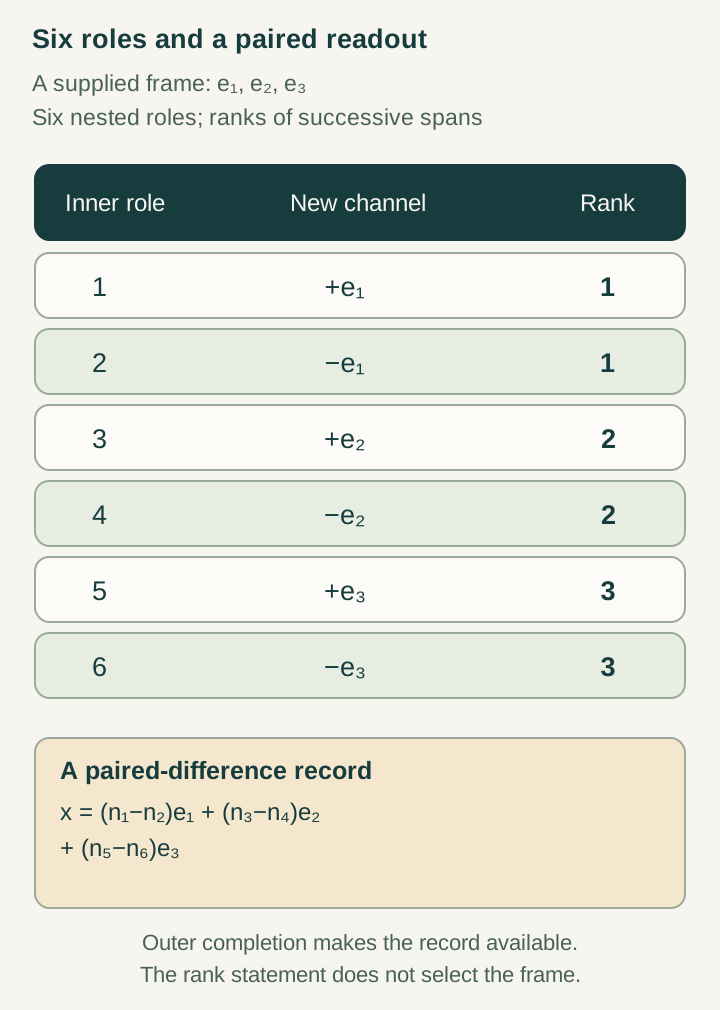
The six inner roles are nested dependencies associated in pairs with three stages of readout. A candidate rank sequence is 1,1,2,2,3,3. A repeated rank can indicate that one operation resolves distinctions within an already opened direction rather than adding another independent direction.
The outer role makes the completed result available. It is not a seventh spatial axis or an additional independent measured clock. To assess a particular construction, identify what is retained from lower roles, what the next role changes, and how successful completion is certified by the source itself.
Open the full-size diagram →
Generate a small relational grid
Take labels (m,n) with m modulo 3 and n modulo 4. Let P increment m and Q increment n. Then P³=Q⁴=I and PQ=QP. Starting at (0,0), the twelve expressions PmQn(0,0) produce twelve distinct records.
This gives a finite two-directional address system. If Q is instead set equal to P on three labels, the two named operations generate only three records and one independent cycle. The example demonstrates why distinct operation names do not prove independent spatial directions: their relations and action on records must be checked.
Add costs and compare paths
Declare P and Q moves, including their inverses, to cost one unit. The shortest-path distance between (0,0) and (1,2) is three. If Q moves cost two, that distance becomes five. The label set and number of directions are unchanged.
Thus addressing does not determine a metric scale or isotropy. A physical source law must justify the costs or derive an operational comparison that fixes them. Likewise, a later update that jumps freely between labels can violate local transport even though the address geometry remains intact.
Make the generated geometry persist
Suppose the observer sees a record only after all required P and Q relations have passed compatibility checks. That is a completion interface. To be autonomous, the model must include the checking degrees of freedom, the flag that signals success, and the memory that preserves the result.
SMM motivates deriving all these functions from one source rather than invoking an external organizer. DTT provides the distinction between internal construction and completed availability. A finite algorithm can demonstrate consistency, while a physical selection principle must additionally explain why the source realizes that algorithm and maintains its resources.
Follow the formation chain
Read A213 with A126 for nested roles, A127 for local transport, A128 for discarded information, and A117–A121 for autonomous records. Then compare A123–A125 on why local structures may need a preparation mechanism.
The next strong result would link the same update to a rank-three readout, a stable neighborhood structure, and a material clock used by propagation. Can the source enforce their agreement across a nontrivial family of settings? Such a joint result would explain more than a programmed grid and would make spatial formation a constraint of the theory rather than one possible implementation.
Continue with the articles
- Dynamic spatial formation: a paper guide
Dynamic spatial formation requires generated relations, observable distances and persistent local transport. A permutation example clarifies those separate tasks while the six inner levels remain nested generative roles followed by outer completion.
- Six inner stages and one publication interface
A six-digit nested counter with paired signed readout realizes ranks 1, 1, 2, 2, 3, 3 before one completion interface. Its exact counts reveal sampling bias and the restricted assumptions behind the six-channel bound.
- Generating a neighborhood and preserving local transport
A generated graph predicts local influence only when later operations respect its edges and retained ports. Guarded transport supplies a finite-update support bound while exposing runtime and controller-memory requirements.
- What spatial readout forgets
Different inner states can share one spatial readout and still have different successors. A concrete counterexample and a kernel-preservation criterion identify the memory needed for autonomous completed evolution.
- A record that carries its own completion certificate
An autonomous history Hamiltonian can generate both a data record and a flag tied to its completed write. The exact construction retains incomplete outcomes, coherent intermediate stages, and finite observation windows.
- Keeping an observed label stable
A transported record can preserve an already observed label under a declared class of later readings. Exact projector identities and channel-error bounds distinguish genuine retention from unchanged one-time statistics.
- Why local geometry can be statistically rare
Lattice-like signed operation tables are rare in the stated permutation ensemble, with an entropy penalty of order N log N. Bounded selection costs cannot overcome that asymptotic disadvantage under the theorem's assumptions.
- Programmed geometry and spontaneous selection
A programmed serial source can prepare a periodic lattice and reproduce its local neighborhoods exactly. This establishes feasibility while leaving spontaneous selection, dimension choice, and persistent growth as separate tasks.
Sources and reading
Read the original source for its exact formulation and edition. The examples on this page are explanatory reconstructions.