A transported record can preserve an already observed label under a declared class of later readings. Exact projector identities and channel-error bounds distinguish genuine retention from unchanged one-time statistics.
01A stable distribution is weaker than a stable observed label
A pointer can have the same probability distribution at two times while individual repeated readings disagree. Retention must therefore be formulated using the actual sequence of measurement instruments, including their backaction. The draft asks whether a label already observed remains the same under later admitted readings.
This is the operational version of persistence needed by SMM/DTT. An outer record should be available later as the same record, not merely recreated with the same one-time statistics. The distinction becomes especially important when the generating field continues to evolve.
02Write locally, then transport the file away
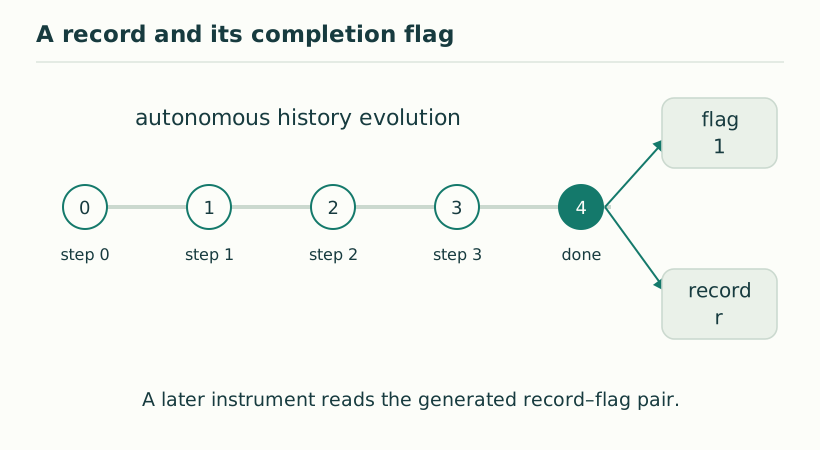
Consider a chain of finite cells, each with data and a completion flag. A fixed write unitary acts only at cell zero. A completed cycle combines field evolution, the local write, and a shift that carries records outward. Incoming cells are prepared blank.
After the first cycle, the first file is at cell one. Subsequent cycles move it farther from the writer, so it is never overwritten in the infinite outgoing-chain idealization. The field can be interacting or nonstationary; retention follows from the transport and pointer-sector structure, not from stationarity of the field state.
Figure 1. A record and its completion flag. A prescribed autonomous history dynamics can place a retained result and a flag in the same state. A later readout checks the flag and the result; assigning a flag by hand is not a dynamical construction. View full size ↗
03The exact transported-projector identity
Let P_j,r project onto label r in cell j and β be the completed Heisenberg action. For the first outgoing file, βⁿ(P_n+1,r)=P_1,r. The same identity holds for its flag. Thus every later measurement of the moving file pulls back to the same projector at the first completed slice.
For Lüders readings, multiplying those projectors makes any unequal-label history vanish by orthogonality. If all labels agree, idempotence leaves the original label probability. This explicitly includes selective measurement backaction rather than assuming a hidden undisturbed trajectory.
βⁿ(P_n+1,r)=P_1,r
Pr(r₀,…,rℓ)=1[r₀=⋯=rℓ] ω(P_1,r₀)
04Which interventions are allowed?
The ideal theorem permits readouts whose Kraus operators preserve the pointer-label sectors and whose reported outcomes agree with those labels. Such operations can disturb other degrees of freedom without changing the stored data. An intervention deliberately overwriting the file is outside the retention class.
This restriction is physical rather than semantic. A claim of durability must say what handling and reading operations the memory tolerates. No memory can be required to preserve its data under every possible unitary, including one explicitly designed to flip the stored bit.
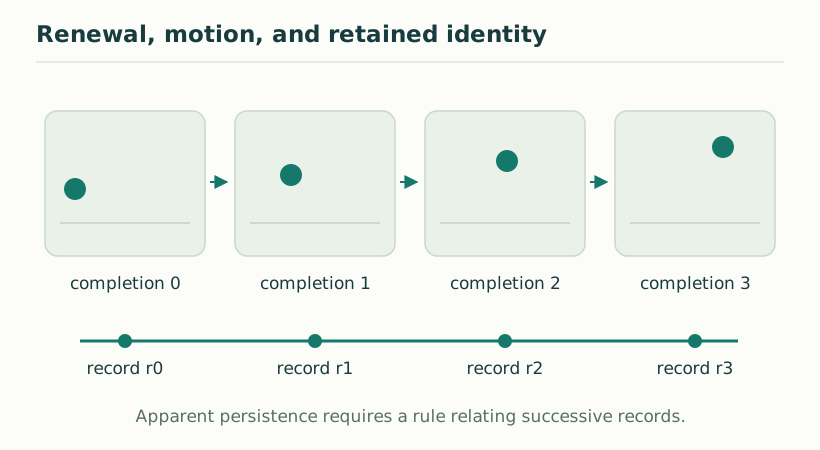
Figure 2. Renewal, motion, and retained identity. A film-frame analogy clarifies successive creation and apparent motion. It does not itself provide an update law, a conserved identity, or a continuum limit. View full size ↗
05Finite memory gives a finite horizon
An infinite blank chain is a memory reservoir. A finite ring of M cells obeys the same argument only until the file revisits the writer, giving at most M−1 additional protected cycles in the stated arrangement. An open line needs a boundary channel and a declared access procedure.
A one-way shift is also not automatically the finite-time evolution of a local bounded-below Hamiltonian. The draft discusses a balanced two-layer SWAP realization with a counterflow channel. That implementation makes the additional transport capacity visible rather than assuming an uncharged one-way conveyor.
06Noise produces an accumulated error budget
Suppose each actual transport channel differs from its ideal counterpart by half-diamond distance δ_j and each reading instrument by κ_l. Starting from the same state conditioned on the first observed label, the probability that a later reading differs is bounded by the sum of those errors, capped at one.
The proof retains the complete outcome history, replaces actual operations one at a time, and uses trace-distance contraction. No inverse probability of the first label appears because the two comparisons start from the same conditional state. Error in preparing that state must be accounted for separately.
Pr(any later mismatch|r₀)≤min{1,Σjδ_j+Σlκ_l}
07What this establishes for SMM/DTT
The model separates the source’s ongoing generation from later access to an exported file. It gives a precise law of persistent record identity under a declared class of operations. A record arrow arises from preparation, writing, isolation, and transport; the microscopic operation can remain reversible.
The result is not cost-free eternal memory. Capacity, blanks, transport, access to the moving cell, noise control, and finite revisit time matter. A fundamental dual-time theory would need to explain why its physical records realize such protected channels. The construction supplies a rigorous witness and a measurable error criterion for that requirement.
KEEP THE CONNECTION
Key ideas
Sequential retention concerns the same observed label, including measurement backaction.
Outgoing transport gives an exact projector identity before the file meets a writer again.
Finite capacity and channel noise determine the useful retention horizon.
Scope of the argument. Exact ideal retention within a declared transport/readout class, with finite-horizon resource and noise limits.
Sources & further reading
SMM_DTT_Autonomous_Records_Free_Field_Limits_v10(6).pdfWorking draft, pp. 43–46
Source editions and catalogue entries
Working manuscript
Autonomous records and free-field limits — working draft v10
Working manuscript. Article-level references identify the consulted sections and the scope of the interpretation. No public URL was supplied for this exact manuscript version.