A smooth threshold converts a continuous pointer into a certified binary memory. Its error can be bounded, while sharper thresholds increase the registration energy in the specified free-field model.
A probe can carry a real-valued pointer distribution, but an archive often needs a finite label. Converting that pointer into a bit is a physical interaction. The draft treats it explicitly rather than replacing the pointer by an ideal threshold without checking energy or error.
The SMM/DTT connection is direct: outer records are finite accessible distinctions produced by inner operations. Their value, their completion status, and their accuracy relative to an ideal decision rule are separate properties.
02Choose a smooth threshold
Let b₀ be the calibrated threshold and δ>0 its transition width. Define χδ(b)=(π/4)[1+tanh((b−b₀)/δ)] and qδ(b)=sin²χδ(b). A blank memory qubit is rotated by exp[−iχδ(B)Y_R], controlled by the pointer observable B.
For a pointer value b, the probability of writing one is qδ(b). Far below threshold it approaches zero and far above it approaches one. Near the threshold the record is deliberately unsharp. The bounded spectral function defines a unitary for every pointer state in the supplied Hilbert space.
χδ(b)=(π/4)[1+tanh((b−b₀)/δ)]
qδ(b)=sin²χδ(b)
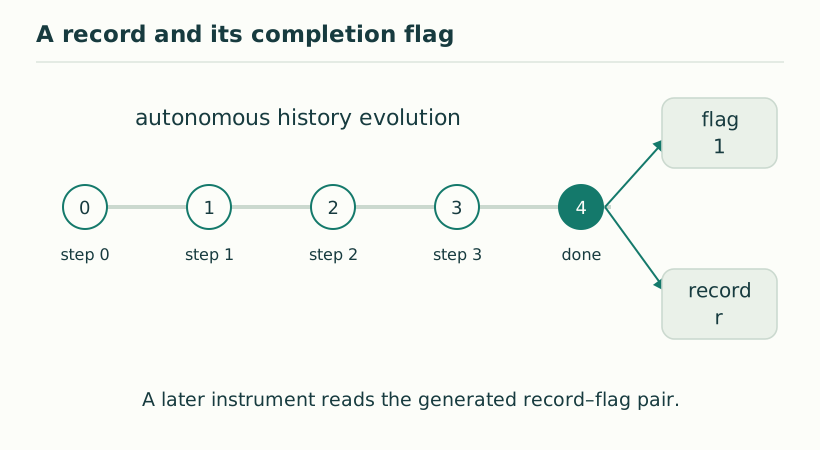
Figure 1. A record and its completion flag. A prescribed autonomous history dynamics can place a retained result and a flag in the same state. A later readout checks the flag and the result; assigning a flag by hand is not a dynamical construction. View full size ↗
03The resulting system effect
If the preceding field–probe write induces pointer measurement E(db), the memory-one effect on the system is Eδ,+=∫qδ(b)E(db). The complementary effect is I−Eδ,+. These probabilities include probe noise and threshold smoothing.
A separate flag flips after the registration operation. A zero memory value does not mean the write failed, because zero can be a valid completed result. Reading both data and flag distinguishes incomplete memory from a completed negative-threshold outcome.
Eδ,+=∫qδ(b)E(db)
Eδ,−=I−Eδ,+
04Bound the threshold approximation error
Let p(b) be the post-write pointer density and suppose it is bounded by M. The integrated mismatch between qδ and the sharp step at b₀ is at most π²Mδ/8, capped at one. The same bound controls the absolute error in the binary outcome probability.
For the Gaussian pointer, a bound on M follows from its variance. The estimate shows explicitly that sharper registration improves agreement with the ideal threshold linearly in δ under the stated density bound. It is not a claim of pointwise agreement at the threshold itself.
∫p(b)|qδ(b)−1[b≥b₀]|db≤min{1,π²Mδ/8}
05The energy cost increases as the threshold sharpens
The registration energy is controlled by the derivative of χδ. In the draft’s free-field model, ΔEreg=(ℏ²/2)‖g‖²⟨[χδ′(B)]²⟩. A general bound grows as 1/δ²; with a bounded pointer density it improves to a 1/δ bound.
For the Gaussian vacuum-shear output, δΔEreg tends to a positive constant proportional to the density at b₀. Thus the sharp limit has diverging energy cost in this model. The approximation error can be made smaller at finite cost for each fixed δ, but a perfect discontinuous threshold is not obtained for free.
χδ′(b)=π sech²((b−b₀)/δ)/(4δ)
ΔEreg≤ℏ²π²‖g‖²M/(24δ)
06A useful tradeoff rather than a defect
If a target probability error is ε and M is known, the sufficient condition δ≤8ε/(π²M) sets a required resolution scale. The associated energy estimate then exposes how demanding that target is. These are conservative bounds, not a claim of optimal detector design.
The chosen threshold location also matters. A pointer density small near b₀ can reduce the actual energy coefficient and mismatch, while a threshold through a dense part of the distribution is more costly. A physical application should select the decision rule before evaluating its performance on the relevant input class.
07Accuracy and durability are different questions
The smooth bit may occasionally differ from the ideal sharp-threshold answer. Once the actual bit is written and certified, a separate transport and retention mechanism can preserve that actual label exactly in an ideal model. Improving retention does not retroactively improve the threshold decision.
This distinction is useful for SMM/DTT: completion, fidelity to an intended observable, and later persistence need separate proofs. The finite-energy registration supplies the first two ingredients with a controlled approximation. The outgoing-memory construction supplies durability under its declared transport and readout assumptions.
KEEP THE CONNECTION
Key ideas
A smooth pointer-controlled rotation writes a finite binary label.
Threshold error decreases with δ while registration energy grows as resolution sharpens.
Preserving the actual stored label is separate from matching an ideal sharp threshold.
Scope of the argument. Fixed-resolution free-field registration with explicit approximation and energy bounds; no zero-cost sharp measurement is claimed.
Sources & further reading
SMM_DTT_Autonomous_Records_Free_Field_Limits_v10(6).pdfWorking draft, pp. 40–45
Source editions and catalogue entries
Working manuscript
Autonomous records and free-field limits — working draft v10
Working manuscript. Article-level references identify the consulted sections and the scope of the interpretation. No public URL was supplied for this exact manuscript version.