Specified scalar and spinor regulator families yield controlled free-field correlation limits compatible with explicit record apparatus. These results retain their locality, state, calibration, and particle-sector assumptions.
01A continuum field limit is a substantial but bounded result
The autonomous-record draft includes explicit scalar and spinor families whose smeared correlation functions converge to familiar free relativistic fields. These are genuine field-theoretic witnesses, stronger than merely expanding one particle’s dispersion relation. They show that the record architecture can coexist with controlled free-field limits.
They do not establish a complete interacting theory, select a unique microscopic source, or derive all locality assumptions from SMM ontology. The supplied transport rules, quantum kinematics, states, and calibration remain visible in the construction.
02The scalar lattice and its dispersion
Choose a calibrated cubic lattice with spacing a, canonical oscillator fields, and a positive nearest-neighbor quadratic Hamiltonian. Its mode frequency obeys Ω_a(k)²=μ²+(4c²/a²)Σ_i sin²(ak_i/2). Here μ is a supplied frequency parameter and the corresponding continuum mass is ℏμ/c².
For fixed momentum and a→0, sin(ak_i/2)≈ak_i/2, giving Ω(k)²=μ²+c²|k|². Smooth compactly supported test functions control high-momentum contributions, allowing convergence of vacuum Weyl correlations and their time evolution, not only pointwise convergence of the frequency.
Ω_a(k)²=μ²+(4c²/a²)Σ_i sin²(ak_i/2)
Ω_a(k)→√(μ²+c²|k|²)
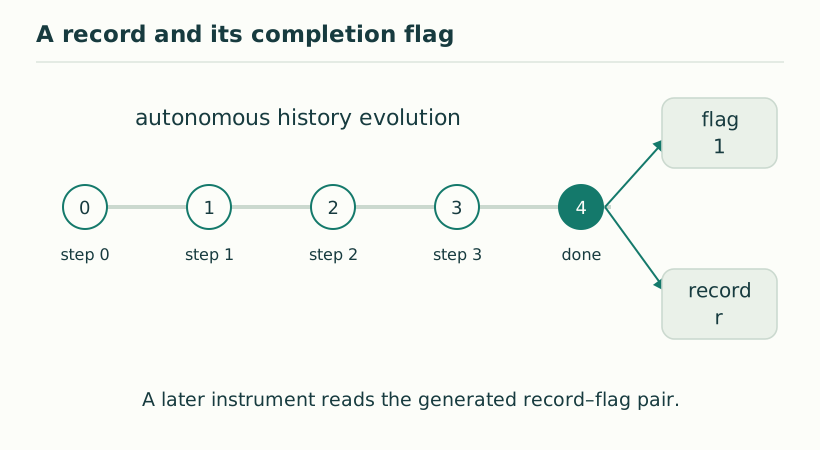
Figure 1. A record and its completion flag. A prescribed autonomous history dynamics can place a retained result and a flag in the same state. A later readout checks the flag and the result; assigning a flag by hand is not a dynamical construction. View full size ↗
03Graph distance and spectral geometry are different
The cubic graph’s shortest-path distance tends to the ℓ¹ norm under spatial calibration. Its quadratic Dirichlet energy, however, tends to one half the integral of |∇f|², whose principal tensor is Euclidean. The round metric relevant to the wave equation therefore comes from the isotropic quadratic form, not directly from graph adjacency.
At finite spacing, a group-velocity bound does not imply exact relativistic microcausality; lattice propagators can have tails. Exact spacelike commutation is established for the limiting free field through the support of its continuum causal propagator. These different geometric statements should not be merged.
04The spinor cycle and the Dirac sector
The spinor construction chooses Clifford matrices and a palindromic finite-range phase cycle. Its eigenphases satisfy cos ε=cos θ∏_i cos q_i, with q_i=ak_i. Under the scaling τ=a/c and θ=ντ, the low-momentum update approaches the Dirac generator ℏ(cα·k+νB).
A specified negative-band quasifree CAR state supplies the vacuum covariance. Convergence of smeared two-point functions, together with the fermionic Wick rule, yields convergence of finite correlation words. The limiting even observable algebra has ordinary spacelike commutation; odd fields obey graded locality.
cos ε=cos θ∏_i cos q_i
h_D(k)=ℏ(cα·k+νB); m=ℏν/c²
05Additional lattice branches cannot be discarded silently
The finite spinor update has other Brillouin-zone corners and eigenphase branches. Smooth tests centered at finite physical momentum select the sector near zero, but oscillating tests can access other valleys. The limit theorem does not remove those degrees of freedom from the microscopic algebra or solve the particle-content problem.
Likewise, six phase factors in a chosen palindrome are not the same statement as six nested SMM/DTT inner dependencies. The ordering is an added dynamical choice. A source derivation must explain that choice and account for every retained sector.
06Regulator removal is not a claim that nature changes its spacing
The mathematical family a→0 establishes a continuum universality sector. If a microscopic spacing and tick duration are physical constants, low-energy approximation instead means wavelengths and periods large compared with those fixed scales. Nature is not assumed to perform the limiting operation.
A physical finite-spacing theory would predict corrections, whose coefficients and particle content must be derived. The draft’s cubic directional correction ratio is shared by ordinary cubic lattice fields and is not a unique DTT signature. A distinctive test needs a restriction selected by the proposed source rather than generic lattice symmetry.
07The next step for the SMM/DTT program
The free-field results demonstrate compatibility among a supplied local update, positive-energy continuum sectors, and an explicit record apparatus. To become a fundamental interacting theory, the program needs controlled interactions and gauge constraints, a selected vacuum and particle spectrum, regulator-independent observables, and a common operational clock and matter dictionary.
These are concrete obligations, not reasons to discount the free limits. The limits identify a successful mathematical baseline and clarify exactly which inputs have not yet emerged. SMM/DTT advances when a deeper source law derives one of those inputs while preserving the established field and record results.
KEEP THE CONNECTION
Key ideas
The scalar and spinor constructions yield controlled free-field correlation limits.
Graph distance, spectral metric, and causal support are distinct.
Interactions, extra lattice species, and unique source selection remain open.
Scope of the argument. Free-field limit theorems for specified regulator families and states, not a complete interacting continuum theory or unique microscopic derivation.
Sources & further reading
SMM_DTT_Autonomous_Records_Free_Field_Limits_v10(6).pdfWorking draft, pp. 26–30, 35–40
Source editions and catalogue entries
Working manuscript
Autonomous records and free-field limits — working draft v10
Working manuscript. Article-level references identify the consulted sections and the scope of the interpretation. No public URL was supplied for this exact manuscript version.