
In this article
- Spatial formation as an ordered construction
- Six nested roles do not mean six spatial axes
- A small relational construction
- Addresses are not yet distances
- Completion makes the generated structure public
- The current research frontier
Dynamic spatial formation requires generated relations, observable distances and persistent local transport. A permutation example clarifies those separate tasks while the six inner levels remain nested generative roles followed by outer completion.
The dynamic-formation proposal asks how spatial extension could result from inner temporal activity rather than exist as a background in which that activity happens. A useful modern reading starts with admissible histories and records, then asks what relationships among records qualify as locations, directions, and neighborhoods.
The important shift is explanatory order. It is not enough to begin with a conventional spatial lattice and call its updates temporal creation. The construction should identify which source operations generate the lattice-like relations and why observers have access only to their completed form.
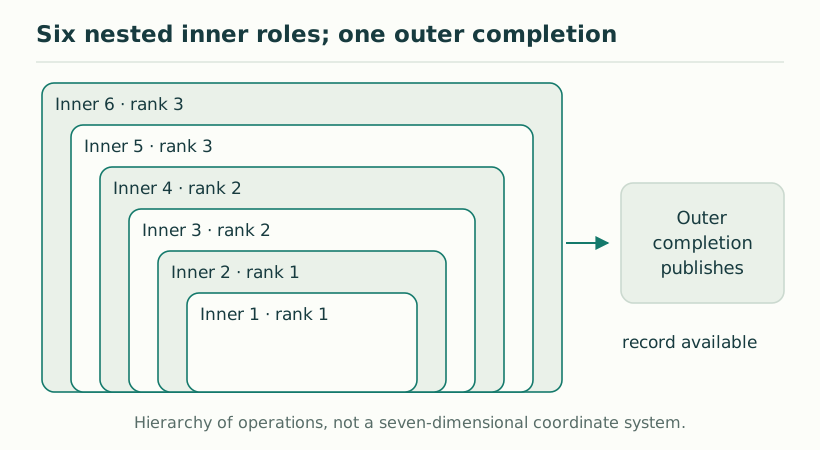
The six inner levels are organized in pairs associated with three progressively resolved directions. Later drafts express a possible rank hierarchy as 1,1,2,2,3,3, followed by an outer completion interface. Repeated ranks indicate distinct operations or roles at one dimensional stage rather than additional independent coordinates.
The nested-role diagram shows this hierarchy of dependencies. Seven perpendicular arrows would suggest seven coordinate axes and misrepresent the proposal. The outer role records the completed result of the hierarchy; it is not automatically a seventh independently measurable laboratory time variable.
Take a finite set of labels and two commuting permutations P and Q. Starting from a root label, repeated applications P^mQ^n can define a two-directional address system over the reachable set. Commutation means that taking the first operation and then the second reaches the same label as reversing their order.
If the permutations have suitable independent periodicities and no extra identifications, the resulting relations can form a discrete torus. But not every pair of permutations has this property. Their independence, commutation, and selected periods are precisely the assumptions that make the example geometric.
The labels in the example distinguish positions relationally. To measure a distance, one must assign costs to admissible steps and decide how paths are compared. To describe physical propagation, one must also supply a dynamics that respects those relations. An arbitrary permutation of labels can destroy local transport while leaving the number of labels unchanged.
This explains why dimensionality, metric structure, and locality are separate requirements. A source model could succeed in generating a rank-three readout yet fail to select a stable neighborhood structure. Conversely, a programmed local graph can exist without an explanation of why it is produced spontaneously.
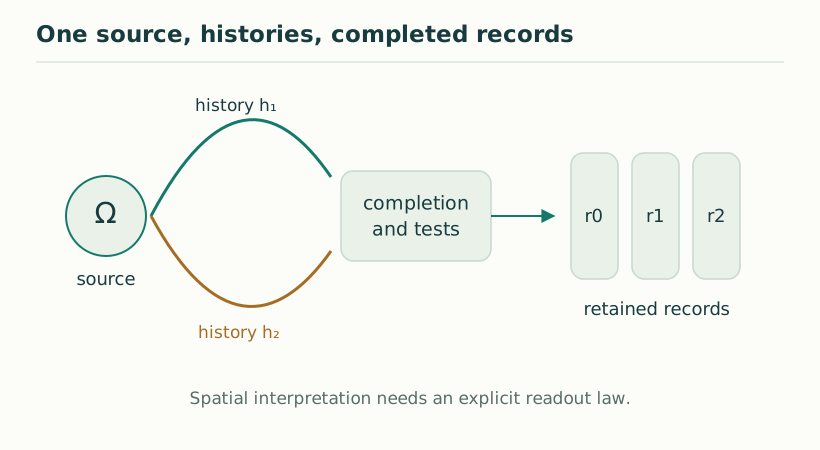
Suppose partially constructed relations are not yet available to an observer. A completion rule can publish a record only after required compatibility tests have succeeded. The observer then sees an apparently coherent spatial configuration, while the model retains a generative history of how it was assembled.
For this to be a physical account, the completion certificate and its retention must themselves arise from the stated dynamics. An external programmer who checks and freezes the lattice supplies resources that the model needs to acknowledge. The autonomous-record papers address this issue with explicit flags and storage processes.
SMM motivates the search for a common source of spatial multiplicity. DTT asks how nested generative operations become a completed spatial record. Together these principles turn spatial formation into a question about the constraints on one source: which relations it can construct, how it retains them, and when an observer may consistently treat them as a single geometry.
The strongest version of the program would derive the selection of local relations, their persistent storage, the physical clock, and the matter transport law from a single source dynamics. Independent recipes executed by one controller establish joint implementability but do not explain why nature chooses the matching recipes.
The public proposal motivates that goal. The newer locality, clock, causal-geometry, and record constructions divide it into tractable questions. Their exact counterexamples are useful: they identify what the source law must rule out if spatial generation is to become an unavoidable consequence rather than one available implementation.
KEEP THE CONNECTION
Scope of the argument. The permutation example is a supplied constructive model, not a proof that all source histories naturally form three-space.
The chronological formation proposal must supply operational positions, clocks and propagation rules before its physical conclusions can be assessed. The website’s relational-grid construction has specified generators and costs; it is an explanatory example, not a proof that all admissible sources generate three-dimensional physical space.
Source register →