
In this article
- The arithmetic that motivates the proposal
- Where ten can come from mathematically
- The branch recursion
- Why dimension is not response
- The hydrogen connection is conditional but concrete
- A stronger formulation of the research goal
The earlier 137 construction combines a ten-mode receiver with the branch counts 1, 3 and 7. A response-operator example and the Coulomb speed relation show which normalization and source-selection steps are still needed to identify a physical coupling.
The earlier combinatorial proposal emphasizes the identity 100+30+7=137. In a hierarchical description, the branch multiplicities 1, 3, and 7 are weighted by successive powers of ten. This is an exact integer calculation. The physical question is why those branches, that receiver, and that observation rule should govern electromagnetic response.
The cited ideal-coupling reconstruction, version 3, makes the bridge more explicit: a retained record count and a static response capacity are different objects. This article connects the older counting motivation with that newer distinction, rather than treating their shared integer as a complete physical derivation.
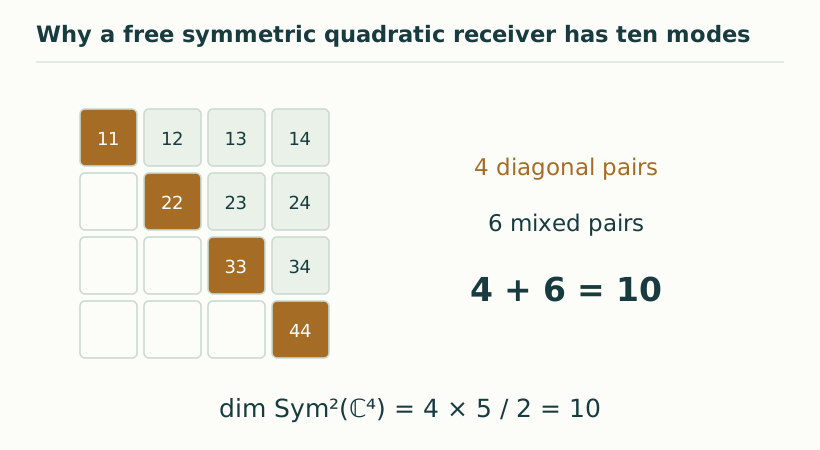
A complex vector space of dimension four has ten independent symmetric quadratic combinations: four squares and six mixed pairs. In general, the symmetric square of a d-dimensional space has dimension d(d+1)/2. For d=4 this gives ten.
This is stronger than selecting decimal weights merely because human notation uses base ten: it identifies a mathematical receiver with the desired dimension. It still requires explaining why a symmetric quadratic receiver is the physically relevant construction and why its four-component envelope is selected.
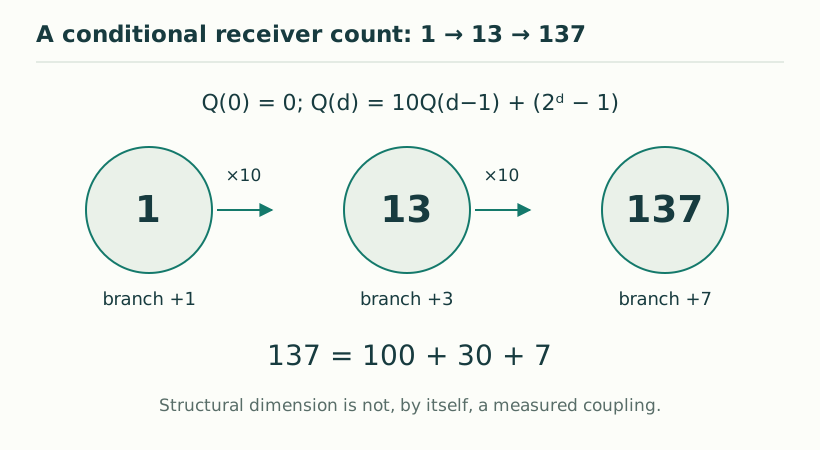
The positive-degree exterior sectors of a k-dimensional space have total dimension 2ᵏ-1. For k=1,2,3 this gives 1,3,7. A specified recursion N₀=0 and N_k=10N_(k-1)+(2ᵏ-1) then gives N₁=1, N₂=13, and N₃=137.
The proof is simply repeated substitution, but the recurrence is not forced by those separate dimension formulas alone. One must define how old records are propagated, how new branches are added, and why closure occurs at the selected depth. The newer reconstruction drafts supply explicit versions of these choices and study their obstructions.
Let A be a positive response operator and J a source vector. A typical static capacity is C=⟨J,A⁻¹J⟩. If A=sI and J has squared norm N in an N-dimensional receiver, then C=N/s. Changing s changes the capacity while leaving the record count N unchanged.
This elementary example isolates the missing physical information. The coupling may depend on an inverse capacity only after a field/matter dictionary is fixed. To obtain 1/137, one must also justify the stiffness normalization and the identification with electromagnetism. The cited alpha-zero reconstruction, version 3, states those extra requirements.
For a nonrelativistic Coulomb ground state with coupling α, reduced mass μ, and potential -αℏc/r, the binding energy is -μα²c²/2. The virial relation gives kinetic energy μα²c²/2 and therefore relative root-mean-square speed αc. Setting the ideal model coupling to 1/137 gives c/137 under these assumptions.
This provides a physical interpretation once the Coulomb model and coupling are supplied. It does not determine α from the existence of binding: a whole positive-coupling family binds. Nor is αc a universal speed of an electron in every state, atom, or relativistic regime.
In SMM, one generative source motivates a common origin for the receiver and the matter it influences. DTT adds a distinction between inner response and completed observation. Together they suggest a concrete objective: derive both sides of the interaction from one source law, so that the conversion from structural multiplicity to a measured response is fixed internally.
The next mathematical target is a source law that selects the receiver, its response operator, its source, and the common matter normalization together. Only then would the structural integer enter a coupling without independently adjustable matching. A count is a candidate ingredient, not an electromagnetic measurement by itself.
The small difference between 137 and the measured inverse fine-structure constant is a further question. The ideal α₀ label in the cited version 3 reconstruction is not automatically a bare or zero-momentum coupling in a specified renormalization scheme. Any correction needs a defined observable and independently derived dynamics rather than an added fraction chosen to match the target.
KEEP THE CONNECTION
Scope of the argument. Exact finite counting and conditional model relations are distinguished from an established empirical derivation of alpha.
The exact value of a combinatorial count must be distinguished from a physical electromagnetic coupling. A complete derivation needs justified carrier selection, a normalized response and independently constrained correction dynamics. The source labels its ontological foundation speculative; the guide does not treat the fractional correction as established.
Source register →