Square completion gives the exact normalized ground state of the supplied nonrelativistic Coulomb Hamiltonian. Its spectrum and relative root-mean-square speed provide precise atomic benchmarks without selecting the coupling itself.
Consider H=−DΔ−C/r with D,C>0 on three-dimensional space. The first term penalizes rapid spatial variation; the second rewards proximity to the positive source. A proper atomic state must be square integrable and lie below the dissociation threshold. The hydrogen note uses the lower-bounded Friedrichs realization of this operator, rather than treating its singular potential informally. Hardy-type estimates control the Coulomb term relative to the kinetic form. This provides a well-defined nonrelativistic model before any interpretation of the wavefunction as a completed temporal record is added.
02Finding the length scale
An exponential trial form ψ∝e^(−r/rB) is natural because a negative-energy bound state decays at large distance. Substituting it into the radial equation reveals that cancellation of the 1/r terms requires rB=2D/C. The remaining constant gives E₁=−C²/(4D). The result can be proved globally by completing a square in the quadratic form, so it is not merely a good variational guess. Every normalized state has energy at least E₁, and the exponential saturates the bound.
rB = 2D/C; E₁ = −C²/(4D).
⟨ψ,Hψ⟩ + D||ψ||²/rB² = D∫|∇ψ + r̂ψ/rB|²d³r ≥ 0.
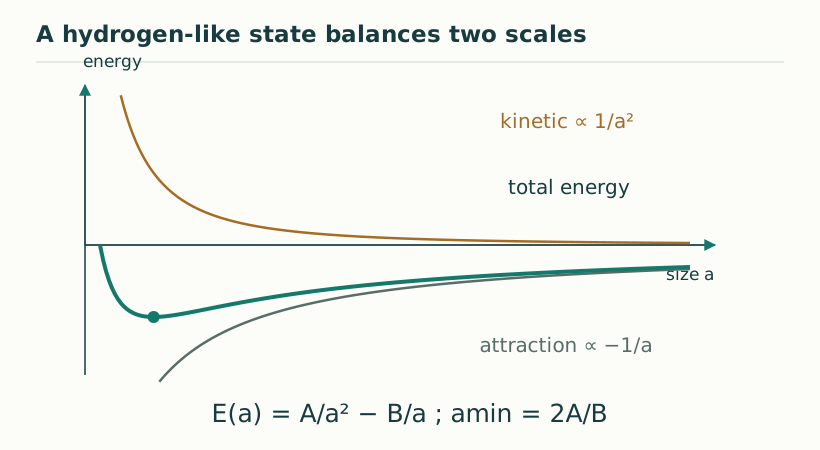
Figure 1. A hydrogen-like state balances two scales. The illustrative variational form E(a) = A/a² − B/a has a minimum at a = 2A/B for A,B > 0. Binding follows once kinetic and attractive terms are supplied; this calculation leaves B, and hence the coupling, free. View full size ↗
03Normalization and what the picture means
The normalized ground wavefunction is ψ₁=e^(−r/rB)/(πrB³)^(1/2). Multiplying its squared magnitude by 4πr² gives the probability for a spherical shell, P(r)=4r²e^(−2r/rB)/rB³. The shell probability peaks at rB, while the density per volume peaks at the origin. The mean separation is 3rB/2. These different quantities should be labeled separately in figures. The real stationary ground wavefunction carries zero probability current. The atom’s stability is a stationary distribution and phase evolution, not evidence for a little particle on a visible circular track.
04The bound spectrum and a scale-free check
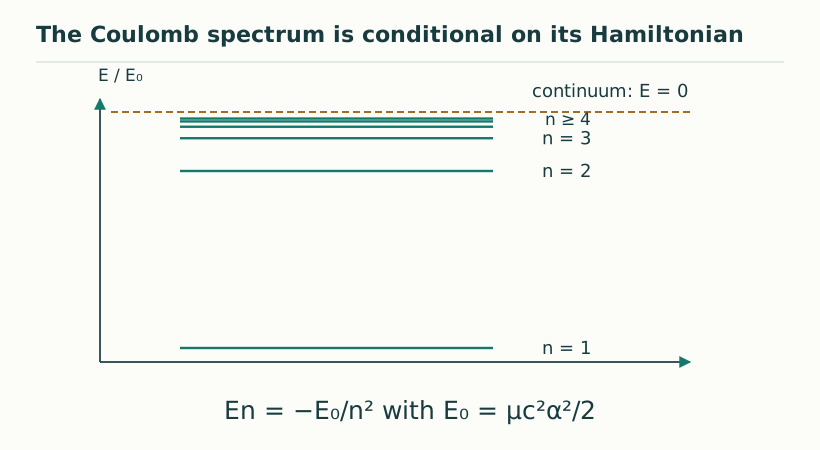
Separating angular variables gives a radial equation with a centrifugal term Dℓ(ℓ+1)/r². Normalizability of its hypergeometric solution requires n=nr+ℓ+1, producing En=E₁/n². Spin is omitted, so the level multiplicity is n² in this model. Energy ratios test the mathematical structure without fixing a dimensional scale. For example, the ratio of the 2→3 energy difference to the 1→2 difference is 5/27. This is not a prediction of line intensity or lifetime; those require a radiation coupling absent from the operator.
En = −C²/(4Dn²); (E₃−E₂)/(E₂−E₁) = 5/27.
Figure 2. The Coulomb spectrum is conditional on its Hamiltonian. For the nonrelativistic Coulomb Hamiltonian, bound levels follow En = −E₀/n² and approach the continuum threshold. The diagram uses dimensionless E/E₀ and does not derive the coupling or supply radiative corrections. View full size ↗
05Where the familiar atomic dictionary enters
Supply an action scale a and reduced mass μ, and set D=a²/(2μ). Write C=gac. Then rB=a/(μcg) and En=−μc²g²/(2n²). If a=ħ and electromagnetic matching identifies g=α, these become the usual leading hydrogen formulas. The virial theorem gives relative root-mean-square speed vrms/c=g/n. In the ground state it is g, while the mean velocity vector is zero. Neither this speed identity nor the spectrum determines g independently: both were derived from a Hamiltonian whose coefficient already contains g.
06Deriving the speed statistic without a circular orbit
For the Coulomb eigenstate, the virial relation is 2⟨T⟩=−⟨V⟩, so ⟨T⟩=−En=μc²g²/(2n²). With the supplied kinetic dictionary T=p²/(2μ), this gives √⟨p²⟩/μ=cg/n. It is the root-mean-square speed of the relative coordinate. The electron’s speed about the center of mass differs by the factor μ/me when nuclear motion is retained. In the infinitely heavy nucleus limit that factor approaches one. The stationary 1s state can therefore have nonzero momentum variance while its mean velocity vector and probability current vanish. This derivation makes the familiar ground-state connection to alpha precise without claiming a classical trajectory or using that connection to determine the coupling.
07The SMM/DTT meaning of a stable mode
The same Hamiltonian can generate outer phase evolution U(T)=e^(−iTH/a), making a bound eigenmode a persistent spatial readout with a changing phase. This is a precise sense of temporal resonance. Absolute phase recurrence depends on the chosen energy zero; measured transition beats depend on energy differences. The source-level challenge is to derive this effective operator and its clock normalization from the nested inner generation, rather than merely interpret its eigenstates afterwards. The minimal model provides exact benchmarks for that challenge: localization, lower bound, normalized shape, spectral ratios and transition consistency.
KEEP THE CONNECTION
Key ideas
An exact square completion proves the Coulomb ground state.
Stationary density and radial shell probability describe different quantities.
The physical coupling enters through an additional dictionary.
Scope of the argument. An exact solution of a conditional nonrelativistic Coulomb model, with spin, radiation and nuclear structure omitted.
Sources & further reading
A Minimal Neutral-Pair Hydrogen Model for SMM/DTT, working notesmm_dtt_minimal_hydrogen.pdf, complete note, pp.1–8
Working manuscript. Article-level references identify the consulted sections and the scope of the interpretation. No public URL was supplied for this exact manuscript version.