A normalized two-outcome energy filter approaches the ground state along accepted sequences when the initial overlap is nonzero. Its fidelity bound is distinct from preparation yield, radiative relaxation and an autonomous completion mechanism.
SMM/DTT uses completion to distinguish generative histories from persistent observer-level records. In the hydrogen note, that idea is made concrete by an explicitly declared selective instrument built from the same operator that binds the neutral pair. The instrument favors the ground state. This is a preparation model with outcomes and probabilities, not an assertion that isolated atoms continuously undergo a new universal collapse process. The distinction matters because standard unitary evolution preserves the populations of energy eigenstates; a filter changes those populations only by selection or coupling to a measurement apparatus.
02A bounded acceptance operator
Since H−E₁ is nonnegative, Kₛ=exp[−s(H−E₁)] is a contraction for s>0. Its ground-state eigenvalue is one and excited-state eigenvalues are smaller. Define the complementary rejection operator Rₛ=(I−Kₛ²)^(1/2). Then Kₛ†Kₛ+Rₛ†Rₛ=I, providing a normalized two-outcome quantum instrument. The parameter s has inverse-energy units. It should not be identified with an inner-time duration or a laboratory clock until an implementation and units dictionary have been supplied.
Kₛ = e^(−s(H−E₁)); Rₛ = (I−Kₛ²)^(1/2).
ρaccept = KₛρKₛ / tr(KₛρKₛ).
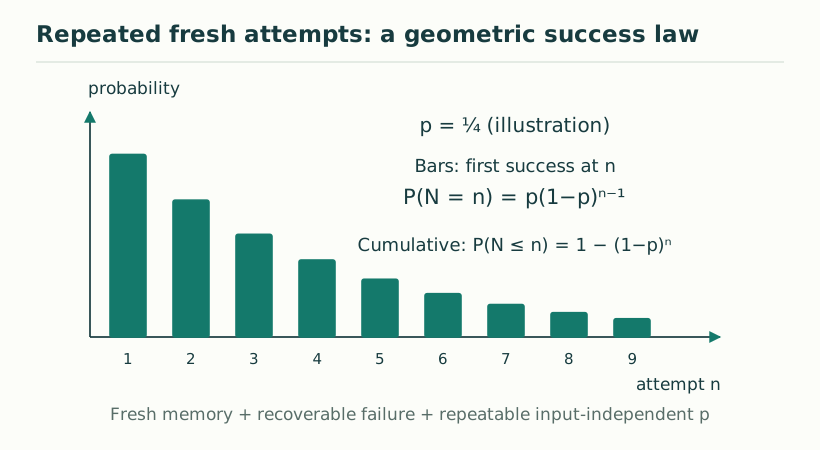
Figure 1. Repeated fresh attempts: a geometric success law. When a failed attempt restores the input and fresh attempts have the same independent success probability p, P(first success at n) = (1−p)ⁿ⁻¹p. The plotted example uses p = 0.25 and is not experimental data. View full size ↗
03Why successive acceptances improve fidelity
Write an initial pure state as c₁ψ₁+χ with χ orthogonal to the ground state. One acceptance leaves c₁ unchanged while shrinking χ. If the excited spectrum begins at E₂, m accepted applications reduce the excited norm by at most exp[−ms(E₂−E₁)]. After normalizing the accepted state, the ground fidelity approaches one whenever c₁ is nonzero. This is a spectral statement using the very same H that provided the bound-state energy. It links selection quality to an independently identifiable gap within the model.
1−Fₘ ≤ [(1−|c₁|²)/|c₁|²] e^(−2msΔ), with Δ=E₂−E₁.
04A worked success-versus-quality example
Take an initial ground probability of 1/4 and choose sΔ=1. After three consecutive accepted outcomes, the fidelity error is at most 3e^(−6), about 0.00744. The accepted state is therefore highly pure in the ground mode. However, the probability of the complete acceptance sequence approaches 1/4, not one. Excellent conditional fidelity is compatible with rejecting most trials. If the initial overlap is exactly zero, this filter never creates a ground component. Any claim of reliable atom preparation must state both the conditional quality and its success probability, along with what happens to rejected branches.
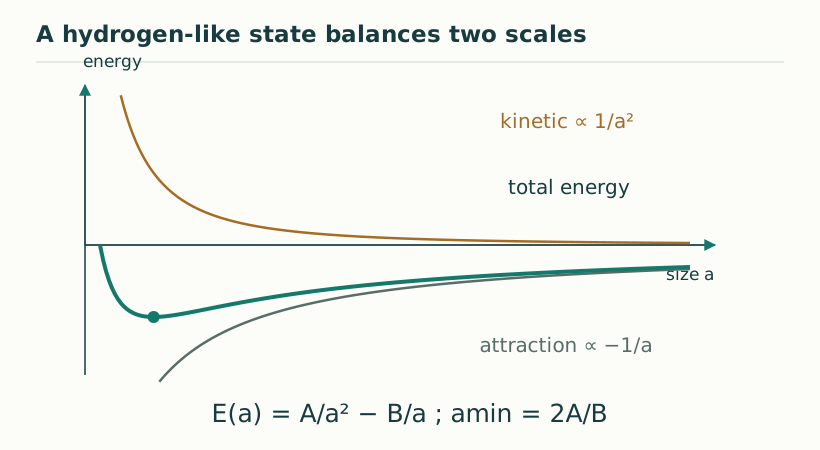
Figure 2. A hydrogen-like state balances two scales. The illustrative variational form E(a) = A/a² − B/a has a minimum at a = 2A/B for A,B > 0. Binding follows once kinetic and attractive terms are supplied; this calculation leaves B, and hence the coupling, free. View full size ↗
05Energy filtering is not radiative relaxation
Actual excited atoms can exchange energy and momentum with radiation. A complete physical relaxation model must include the emitted field and selection rules. The filter above instead suppresses excited amplitudes in an accepted outcome. Its implementation may require ancillary systems, control and postselection, and its resource cost is not fixed by the existence of the formula. Likewise, increasing s or the number of repetitions is not free. A local construction must explain how a finite apparatus approximates a function of the entire Hamiltonian without assuming inaccessible global operations.
06A normalized instrument has an abstract implementation
Introduce an outcome register with orthogonal labels accept and reject. The map ψ↦Kₛψ⊗|accept⟩+Rₛψ⊗|reject⟩ preserves inner products because Kₛ†Kₛ+Rₛ†Rₛ=I. It is therefore an isometry and supplies an abstract dilation of the instrument. Reading the register produces the stated conditional state and probabilities. This verifies that the filter is consistent with quantum measurement mathematics. It does not provide a local finite-time implementation of the spectral function of H. The register, control Hamiltonian, preparation cost and rejection handling remain physical resources. Distinguishing this abstract dilation from an autonomous source construction is especially useful when completion is proposed as an actual process rather than a notation for selecting successful histories.
07The completion problem that remains
The six nested inner levels can motivate a staged operation whose accepted outer record is stable, but the note does not derive those stages or the instrument from a Single Monad update. A useful next theorem would construct local operations, retained memory and a finite-budget acceptance rule that approximate Kₛ with an explicit error. It should preserve the nonzero-overlap condition, include rejection recovery and specify the public clock cost. That would convert an abstract existence proof into a source-compatible preparation mechanism. The present construction already supplies a precise target and separates three observables: ground fidelity, acceptance probability and duration/resource cost.
KEEP THE CONNECTION
Key ideas
The instrument is mathematically normalized and selects the ground state conditionally.
High accepted fidelity does not imply high preparation yield.
A physical completion mechanism must include local implementation and resources.
Scope of the argument. A declared selective instrument, not a derived universal law of atomic formation or spontaneous decay.
Sources & further reading
A Minimal Neutral-Pair Hydrogen Model for SMM/DTT, working notesmm_dtt_minimal_hydrogen.pdf, complete note, pp.1–8
Working manuscript. Article-level references identify the consulted sections and the scope of the interpretation. No public URL was supplied for this exact manuscript version.