
In this article
- The tempting but insufficient inference
- Dilation makes the freedom explicit
- A simple pair of models
- Why the speed identity does not close the argument
- Gauge symmetry also leaves normalization free
- The stronger source theorem
Dilation shows that every positive Coulomb coupling admits binding and the same type of ground-state filter. A source derivation of a particular coupling must therefore fix field, matter, action and clock normalization beyond the existence of an atom.
A model that produces a stable neutral atom has passed an important test. It is tempting to conclude that the existence of such an atom selects its coupling. The hydrogen note proves otherwise for the minimal Coulomb family. Every positive interaction coefficient C gives a normalizable ground state and admits the same type of completion instrument. The atom changes size and energy scale continuously with C. Therefore “there must be a bound completed record” does not by itself select a special value such as 1/137. A source-selection law must remove this remaining freedom.
Let rB=2D/C and write r=rBy. The spatial derivatives acquire a factor 1/rB² and the potential acquires 1/rB. After applying the normalization factor that makes the coordinate change unitary, the Hamiltonian becomes an overall energy coefficient multiplying a fixed dimensionless operator. Its normalized shape and energy ratios therefore cannot distinguish different positive couplings. The result is stronger than a numerical parameter scan: it is an exact equivalence across the whole positive family.
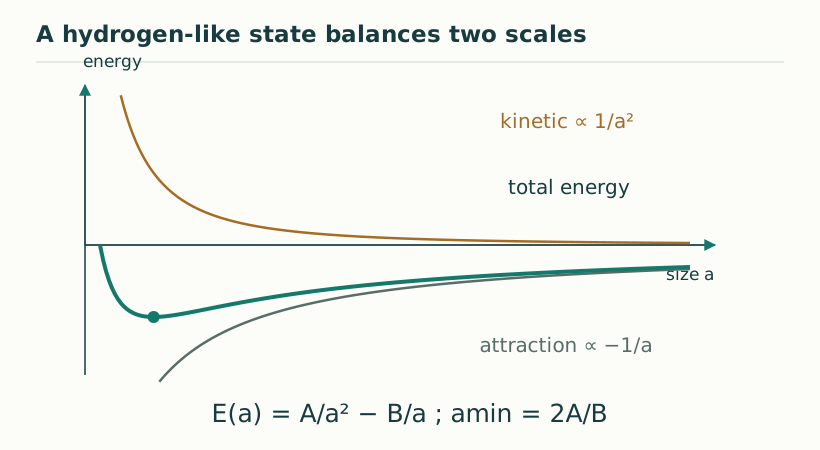
With D=1/2 and C=1, rB=1 and E₁=−1/2. With the same D and C=2, rB=1/2 and E₁=−2. Both have En/E₁=1/n² and the same probability curve when distance is plotted in units of their own rB. Both admit the ground-state filter. The second model is a smaller, more tightly bound atom, not an inconsistent one. If one chooses C by matching the observed radius or a transition, that is calibration. Such a calibration can support predictions for other quantities but cannot be relabeled as an independent derivation of C.
Using D=a²/(2μ) and C=gac gives the nonrelativistic relation vrms/c=g/n for relative motion. For the ground state, vrms/c=g. This connects a coupling to a speed statistic within the Coulomb model. It does not determine the statistic from the SMM/DTT source. In particular, assigning an electron delay of 137 ticks and then interpreting the resulting speed as c/137 requires a derivation of that delay and its relation to the same atomic Hamiltonian. A structural receiver rank, a tick count and an inverse coupling are different objects until a physical matching theorem connects them.
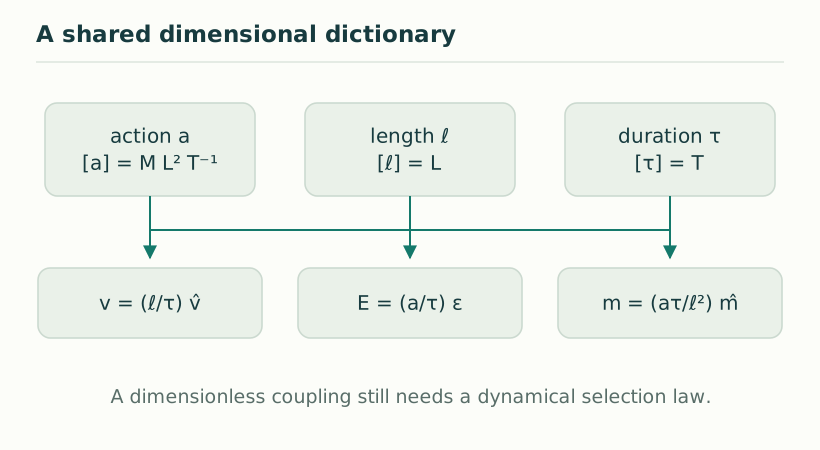
The same issue appears in a gauge formulation. Integer charge characters and gauge invariance can be preserved while the coefficient Z of the field-strength term is varied. Canonically normalizing the field changes the physical coupling to matter. In the note’s natural-unit convention the effective Coulomb strength is g=1/(4πZ). Charge topology can therefore quantize relative charge labels without selecting the absolute field stiffness. This gives a concrete diagnostic for proposed alpha derivations: ask which theorem fixes the field response relative to the action scale, clock calibration and unit matter charge.
A noncircular SMM/DTT derivation should specify one autonomous source with retained memory, six nested refinement stages and outer completion. From that update it should derive the spatial propagation coefficient D, the mediator coefficient C and the action/clock dictionary. It must then show that g=C/(ac) is fixed without using the target atomic radius, line frequencies or electromagnetic proxies to choose the input. A negative result identifying a surviving rescaling would be useful too: it would state exactly which additional physical principle is needed. The dilation theorem turns that missing step into a precise research question rather than an unexplained numerical discrepancy.
KEEP THE CONNECTION
Scope of the argument. The coupling remains free in the supplied effective model; this article does not claim a derivation of measured alpha.
Working manuscript. Article-level references identify the consulted sections and the scope of the interpretation. No public URL was supplied for this exact manuscript version.
Source register →