
In this article
- What the notation alpha-zero means here
- The three levels of the argument
- Where the missing normalization enters
- A hydrogen-like consistency calculation
- What the atom does and does not test
- The SMM/DTT research target
The ideal model value 1/137 requires a selected record count, a trace-response law, and an additional absolute normalization. A hydrogen-like calculation checks their consistency without deriving the measured fine-structure constant.
The draft uses α₀model for a proposed ideal-vacuum coupling. The subscript does not mean zero momentum, the measured low-energy fine-structure constant, or a bare parameter in a specified renormalization scheme. Keeping these meanings separate is necessary before comparing the exact integer 137 with laboratory electromagnetism.
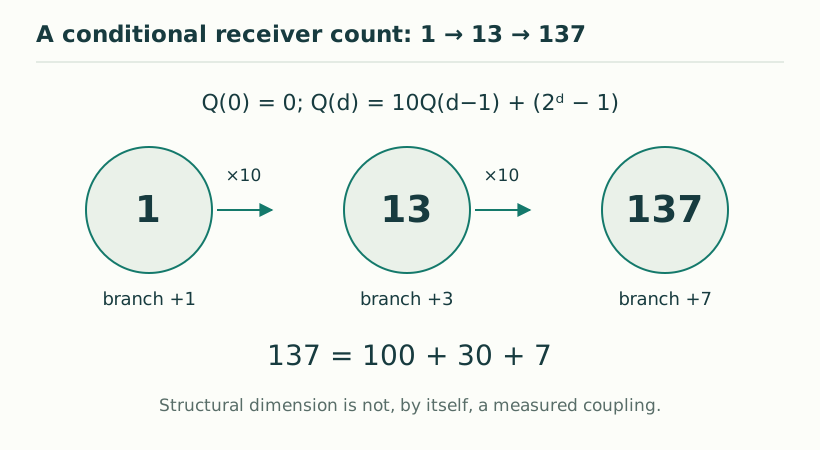
The construction deliberately studies the structural integer without fitting a fractional correction. Its strongest exact statement is conditional: a selected receiver and response class give an inverse-rank factor, and an additional absolute normalization turns that factor into a model coupling. A later physical matching must identify the model field and source with electromagnetism.
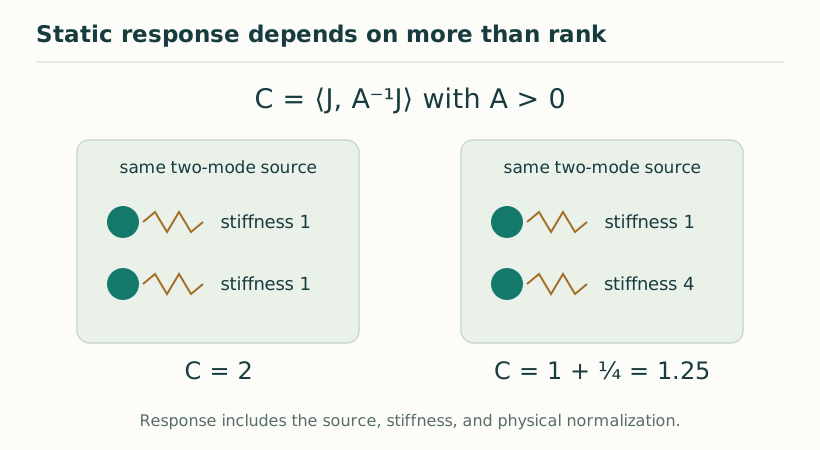
First, the retention grammar has N=137 distinguishable records. Second, the additive trace-response model distributes a fixed total source across those channels, producing a relative interaction coefficient S_N=C_N/C₁=1/N. Third, the coefficient must be compared with the matter action scale a and propagation speed c to form a dimensionless coupling.
The first two conclusions do not set the third. A ratio of rank-N to rank-one response cancels the primitive stiffness; an absolute physical coupling retains it. This is why a correct derivation of 1/137 as a relative suppression is meaningful but incomplete as a derivation of electromagnetism.
With continuum stiffness scont, the Coulomb coefficient is C_N=scont/(4πN). The factor 4π follows from the three-dimensional flux normalization of the Laplacian Green function. The ideal condition is scont=4πac, equivalently gprim=1.
Both scont and ac have units energy times length, so their ratio is dimensionless. Setting it to one is not a change of units. It is a physical relation that a source dynamics would have to establish. Rescaling units cannot turn an arbitrary value of this ratio into the desired one.
For reduced mass μ and potential −C_N/r, the nonrelativistic relative Hamiltonian is H=−a²∇²/(2μ)−C_N/r. Its ground state has radius r_B=a²/(μC_N) and binding energy E₁=−μC_N²/(2a²). The virial relation gives relative root-mean-square speed vrel,rms=C_N/a.
Consequently vrel,rms/c=g_N, and the ideal normalization gives c/137. This is the RMS speed derived from relative momentum in the specified ground state. The mean velocity vector vanishes; the result is not a classical circular orbit and is not a statement about the Dirac velocity operator.
The same model predicts r_B/[a/(μc)]=137 and |E₁|/(μc²)=1/[2×137²] in the normalized ideal sector. These relations check the use of one common action, mass, speed, and potential dictionary. They become physical tests only when those ingredients are independently defined.
Generic Coulomb ratios, such as ratios of gross spectral transitions after the overall energy scale is removed, test the Coulomb Hamiltonian rather than the specific integer. Likewise, fitting the potential coefficient to an observed line and then reporting the fitted speed ratio is calibration, not an independent derivation of α.
The conceptual proposal is that one source generates the spatial readout, retained receiver, field response, and matter dynamics. The conditional model shows how these components can fit together and identifies the normalization they must share. It does not yet demonstrate that the SMM/DTT principles uniquely force that common response.
A decisive upgrade would derive scont/(4πac) from a selected autonomous source law, establish electromagnetic source matching, and predict an additional observable without fitting it. Fractional corrections should then arise from a specified physical mechanism with its own observables. Treating the exact structural value and its matching obligations separately gives the program a clear path toward such a result.
KEEP THE CONNECTION
Scope of the argument. No unconditional derivation of the measured fine-structure constant is claimed.
Working manuscript. Article-level references identify the consulted sections and the scope of the interpretation. No public URL was supplied for this exact manuscript version.
Source register →