C433New research questions
The imaginal realm is philosophically richer than a hidden physical dimension or a synonym for private fantasy. Reading Ibn Arabi’s barzakh alongside SMM/DTT clarifies how a mediating form can distinguish and connect different modes of reality. A worked mirror example then identifies what a modern readout model captures and what it leaves open.
Research guide · 6 min read↗
C434New research questions
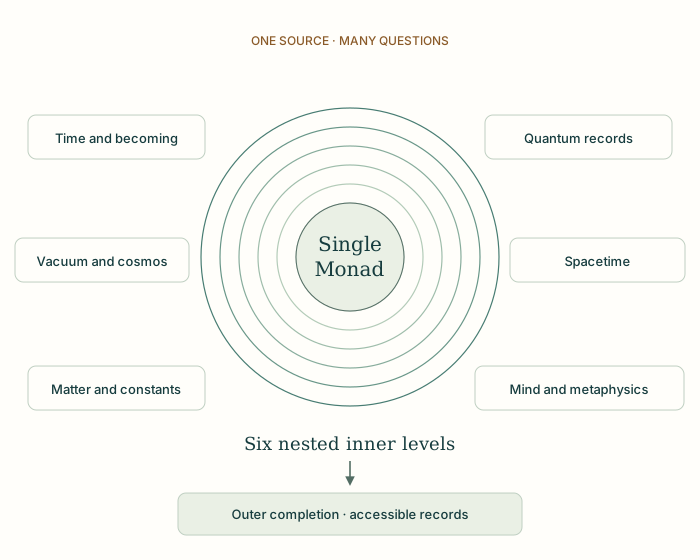
A melody is heard as an unfolding unity, not as disconnected acoustic instants. Husserl’s distinction between retention, current impression and protention gives SMM/DTT a precise phenomenological comparison for temporal completion. The relation becomes stronger when these intentional structures are distinguished from stored data, hidden physical clocks and the six nested levels of generation.
Research guide · 6 min read↗
C435New research questions
Dreams can reorganize narrative, memory and the feeling of duration. That makes them a useful comparison for SMM/DTT’s distinction between generated experience and publicly accessible records. Research on communication during lucid dreaming provides a concrete bridge, while careful timing definitions prevent vivid retrospective reports from being mistaken for evidence of an additional physical time dimension.
Research guide · 6 min read↗
C436New research questions
A common source can explain unity while leaving a difficult question: why are there distinct subjects with private experiences? Cosmopsychism makes that problem explicit. SMM/DTT contributes a language of generated boundaries, retained histories and differentiated access, allowing a sharper argument about what these structures explain and what additional principle would establish phenomenal subjecthood.
Research guide · 6 min read↗
C437New research questions
The 2025 COGITATE study directly tested contrasting predictions of two prominent consciousness theories. Its value for SMM/DTT is methodological: broad ideas became specific commitments about neural content, timing and connectivity. This essay explains the verified result, its limits and how a source-based consciousness proposal could become comparably concrete without claiming support by default.
Research guide · 6 min read↗
C438New research questions
The claim that space arises from time can express a causal mechanism, an ontological grounding relation or an effective description at a new scale. These are different achievements. This essay gives SMM/DTT a precise vocabulary for each, works through a coarse-graining example and identifies what a successful single-source explanation would establish.
Research guide · 6 min read↗
C439New research questions
A single controller can coordinate separately chosen clocks, matter rules and spatial readouts. The stronger SMM/DTT goal is to explain why those rules agree. An explicit six-stage counter model and a conserved-constraint example make the difference precise and identify what a shared dynamical explanation would accomplish.
Research guide · 5 min read↗
C440New research questions
A scaling dimension can be calculated exactly while a physical clock rate remains free. This guide works through a three-dimensional refinement example, exhibits the clock freedom explicitly, and explains what a common-source derivation of D = Δu/Δτ and c = Dv_g would need to establish.
Research guide · 5 min read↗
C441New research questions
A lasting sequence of completed records needs somewhere to retain its distinctions. Finite-state recurrence and a simple counting bound show what an autonomous SMM/DTT source can and cannot preserve. The comparison with information thermodynamics clarifies when storage, compression, overwriting and physical reset enter the account.
Research guide · 5 min read↗
C442New research questions
Three spatial readout directions can be assembled from three pairs of opposite channels. Under explicit restrictions this requires six primitive channels. The important next question is whether the channel bound also selects six nested generative levels. A worked rank calculation separates the valid theorem from that additional physical claim.
Research guide · 5 min read↗
C443New research questions
An accepted completion can change conditional correlations without changing a distant observer’s unconditioned data. A short operator calculation proves this for local trace-preserving quantum operations. The result provides a sharp compatibility test for SMM/DTT accounts of hidden inner activity, completion, temporal entanglement and observable communication.
Research guide · 5 min read↗
C444New research questions
A three-dimensional local carrier is a promising building block for spatial emergence. It does not yet determine how separate records are near or far from one another. This guide constructs a graph metric, compares independent notions of dimension, and identifies the additional relationships a SMM/DTT source must generate.
Research guide · 5 min read↗
C445New research questions
Two frameworks can use the language of two times while assigning it very different mathematical meanings. Bars’s constrained higher-dimensional formulation and DTT’s generation–completion distinction provide a useful example. Comparing their state spaces, gauge constraints and observables clarifies what a substantive correspondence would require.
Research guide · 5 min read↗
C446New research questions
A spatial distance can be defined from a round-trip signal and one physical clock. This makes radar ranging a useful benchmark for SMM/DTT’s temporal account of geometry. A worked example shows exactly what the clock readings determine and which assumptions about signals, receivers and causal structure remain necessary.
Research guide · 5 min read↗
C447New research questions
A static gravitational field links thermal equilibrium to clock redshift. The Tolman–Ehrenfest relation is therefore a useful benchmark for a theory that connects temporal structure with gravity. A short two-height calculation shows how a SMM/DTT clock proposal could meet a concrete thermodynamic consistency condition.
Research guide · 5 min read↗
C448New research questions
A cyclic internal phase and a compact physical time coordinate can have radically different causal consequences. An explicit circle example explains why SMM/DTT must identify which kind of compactification it uses. The comparison preserves inner recurrence while making the physical requirements for causality and clock evolution clear.
Research guide · 5 min read↗
C449New research questions
A quantum system cannot pass between distinguishable states arbitrarily quickly at fixed dynamical resources. This supplies a quantitative test for language about inner ticks or cosmic refresh rates. A two-level calculation shows what a quantum speed limit constrains and why it does not by itself determine the speed of light.
Research guide · 5 min read↗
C450New research questions
A recurring source process, an ordinary oscillator and a time crystal are not interchangeable. Time-crystal research supplies precise criteria for temporal order and robustness. Comparing an elementary period-doubled system with DTT’s inner cycles shows how recurring behavior can become a measurable physical claim without being mistaken for the creation of time itself.
Research guide · 5 min read↗
C451New research questions
A finite number of inner records suggests a capacity bound, while gravitational holography relates entropy to area. The two ideas become comparable only after the records, region and entropy are defined. A worked 137-state example shows how a temporal information model could meet an area bound without deriving that bound from counting alone.
Research guide · 5 min read↗
C452New research questions
Eliminating unobserved inner variables changes the effective law seen by a receiver. A Gaussian calculation makes this exact and connects temporal coarse graining with renormalization. The comparison also shows why nesting depth, physical elapsed time and renormalization scale cannot be identified without an additional source-derived relation.
Research guide · 5 min read↗
C453New research questions
A receiver with 137 states supports a precise record-count result. Turning that count into an inverse coupling requires more structure. A family of density matrices and a two-channel susceptibility calculation show exactly where preparation, symmetry, coupling and physical calibration enter the proposed SMM/DTT bridge.
Research guide · 5 min read↗
C454New research questions
The number ten can arise as a genuine dimension of pair memory rather than an arbitrary numeral base. That improves the structural interpretation of 137, but it does not prove that nature writes numbers in decimal. A symmetric-square calculation and an explicit stopping grammar make the distinction clear.
Research guide · 5 min read↗
C455New research questions
Quantized winding or a selected gauge group is only part of a particle theory. Its chiral charge assignments must also preserve quantum gauge consistency. A one-generation Standard Model calculation shows how anomaly cancellation creates a demanding but constructive test for SMM/DTT accounts of temporal phase, charge and matter.
Research guide · 5 min read↗
C456New research questions
A spinor changes sign under a two-pi rotation and returns after four pi. This is an exact representation-theoretic fact with a natural temporal-winding interpretation. Deriving fermionic exchange statistics requires additional structure. A rotation calculation and a two-particle example show what a SMM/DTT spin model must connect.
Research guide · 5 min read↗