


What SMM/DTT brings to the comparison
The Single Monad Model places a common generative foundation before observable multiplicity. Duality of Time distinguishes the inner activity through which configurations are generated from outer completion, through which records become available to observation. This changes the explanatory target: geometry, matter, clocks and observers should ultimately be accounted for within one source process.
The six inner levels are nested functional levels. The seventh role is outer completion. A six-stage illustration is a schematic of dependence and completion, not a claim that six independently measurable time coordinates have been detected. A concrete model must specify what each level does and how its organization is selected. The postulate guide and the six-stage construction give the website’s operational account.
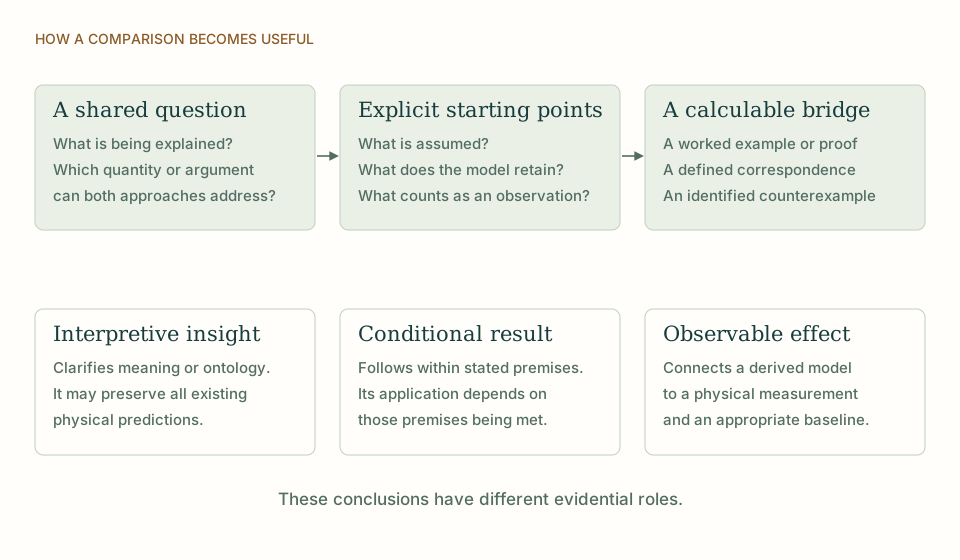
Five different kinds of conclusion
| Statement | Meaning | What supports it |
|---|---|---|
| Framework premise | A starting commitment, such as a common source or generative temporal order. | A stated ontology or axiom and the restrictions it imposes. |
| Interpretive connection | Two approaches illuminate a shared question through different concepts. | An explicit argument and faithful treatment of the sources. |
| Result within a model | A conclusion follows from a defined state space, dynamics and readout. | A proof or reproducible calculation under named assumptions. |
| Physical correspondence | The model’s quantities match defined observables in another physical theory. | A map preserving the required probabilities, symmetries, units and limiting behavior. |
| Discriminating prediction | A quantitative result can differ from an appropriate baseline. | A derived parameter dependence, independent calibration and an applicable measurement. |
Publication of a mathematical construction supports its stated theorems. It does not by itself establish every physical interpretation proposed for it. The same discipline applies to the comparator: an active quantum-gravity programme is described as a programme, and an interpretation of quantum mechanics is distinguished from a modified dynamical theory.
Read the worked example at its stated scale
Worked calculations show what can actually be established with explicit inputs. A finite graph may have a calculable spectral dimension while still assuming its links. An autonomous counter can generate ordered records while leaving calibration in seconds undetermined. A 137-dimensional receiver can distinguish 137 messages while leaving their probabilities and physical response free. These are useful results because they identify the next missing law precisely.
Each example separates the mathematical result from its possible SMM/DTT interpretation. When the conclusion depends on an interface, a choice of memory, or a response operator, that choice is part of the model. A counterexample that changes the conclusion while preserving the stated premises identifies a freedom the next construction must remove.
Time, complex phase and mathematical notation
Inner and outer time describe two temporal roles in this collection. Their notation is not a license to equate incompatible algebras: ordinary complex phase uses i² = −1; split-complex geometry uses j² = +1. Analytic continuation, a Lorentz boost, a conditional clock reading and an ontological account of generation are different constructions. Their relationship must be demonstrated in a particular model. See the notation guide to split-complex time and quantum phase.
Physical, psychical and metaphysical inquiry
“Psychical” is used here for questions concerning experience, subjectivity and the philosophical relation of mind to world. When an article discusses an imaginal realm, spiritual eternity or metaphysical renewal, it explains the relevant tradition and argument. Such a discussion does not assign those notions an experimentally measured location or extra metric dimension.
Empirical consciousness research concerns operational tasks, reports, neural measurements and specified theories. A proposed link from a metaphysical account to these measurements needs its own bridge law. Respecting that distinction allows the philosophical content to remain substantial while keeping physical claims assessable. Readers can begin with the unseen-world guide, philosophy of time and creation, and the mind-and-metaphysics reading path.
How sources are used
Primary theory papers and original research support technical comparisons. Philosophical arguments refer to original texts or identified translations where available. Numbered references sit beside the relevant discussion; each bibliography explains the role of its sources. Links to SMONAD’s individual articles and research chapters help readers follow the framework’s own definitions.
This edition was prepared on 17 October 2026. A dated study is cited for what that study reports; the collection does not treat a suggestive result as an established discovery or as independent confirmation of SMM/DTT. The source register collects the external and primary-source references used throughout.
Use a comparison to ask the next productive question
Start by identifying the observable, argument or construction that both approaches address. Then ask which additional structure SMM/DTT explains, which choices remain independent, and what would change if a key premise were removed. A valuable next result may be a smaller theorem, a robust null prediction, a resource bound, or a new common dynamics. The aim is a clearer chain from source principles to consequences.
For the broader website policy, read Editorial standards and the meaning of research claims. To start reading, choose a comparison path.