The geometry–clock–cone relation: a constructive test of SMM/DTT
A scaling dimension can be calculated exactly while a physical clock rate remains free. This guide works through a three-dimensional refinement example, exhibits the clock freedom explicitly, and explains what a common-source derivation of D = Δu/Δτ and c = Dv_g would need to establish.
01Three quantities that must be read independently
A geometric dimension describes how distinguishable spatial structure scales. A clock reading describes duration according to a physical device. A propagation speed compares a displacement with that device’s elapsed reading. Their definitions are related in familiar spacetime models, but none is simply another word for the others.
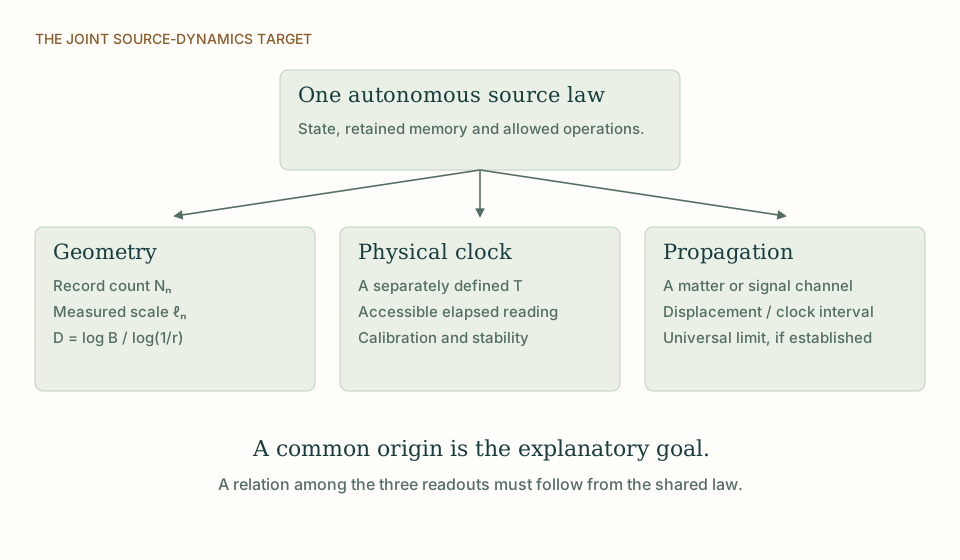
SMM/DTT asks whether these quantities can be generated jointly. The question becomes assessable when the model supplies three independent readouts of one source trajectory. If the same variable is renamed dimension, clock ratio and speed, equality is automatic but explanatory content is absent. Independent definitions let a relation become a prediction of the shared dynamics. [1]
02An exact refinement calculation
Let each record cell have B children and let its characteristic scale contract by r, with B greater than one and 0 < r < 1. After n refinements there are Bⁿ cells at scale Lrⁿ. Eliminating n gives a scaling exponent D = log B / log(1/r). For B = 8 and r = 1/2 the exponent is three; after four refinements there are 4096 cells of scale L/16.
The arithmetic fixes a counting exponent. Identifying it with Hausdorff dimension requires an appropriate self-similar metric construction and separation assumptions. Identifying it with a spectral dimension requires a diffusion operator and a separate calculation. None of these refinements makes n a laboratory clock reading.
Nₙ = Bⁿ, ℓₙ = Lrⁿ
D = log Nₙ / log(L/ℓₙ) = log B / log(1/r)
B = 8, r = 1/2, n = 4 ⇒ N₄ = 4096, ℓ₄ = L/16, D = 3
Geometry, clocks and propagation as independent readouts. A single source model should explain the relation between separately defined measurements. Sharing a diagram does not impose that relation. View full size ↗
03Why logarithmic encoders give the desired ratio
Suppose a source transducer assigns an activity increment Δu = t⋆ log B and a clock increment Δτ = t⋆ log(1/r), using the same positive scale t⋆. Both quantities then have units of time, and their ratio is D. If a matter band is parameterized by u with velocity v_g = Δx/Δu, its speed against τ is Dv_g.
This is a correct conditional derivation. Its substantive premise is the physical encoder law with common calibration. The formula for dimension does not force a material clock to measure the contraction logarithm. Nor does it ensure that every matter species evolves against the same activity variable. Those are exactly the links a stronger source dynamics must supply.
The clock and activity are physical only after their transducers and calibration are independently specified.
04A counterexample that locates the missing premise
Keep the same source geometry and matter evolution but let an admissible clock report T = u + τ. Its ratio becomes Δu/ΔT = D/(D+1). In the B = 8 example the original factor is 3, whereas the new factor is 3/4. The corresponding speed is 3v_g/4. Nothing in the cell counts or contraction data rules this clock out.
The comparison is meaningful only when the two candidate devices are physically specified in a common calibration. A change in notation is not a falsification. The example instead shows why an allowed-clock class must be selected and protected. This same point appears in the website’s conditional geometry–clock discussion: geometric scaling by itself leaves operational clock freedom. [1]
05A stable bound is a further result
For each completed operation, suppose a displacement d and positive delay Θ obey ‖d‖ ≤ c⋆Θ. Concatenation preserves the bound by the triangle inequality. This yields a composition-stable causal cone once lengths, delays and admissible operations have been defined.
A cone bound, a band group velocity and an experimentally universal limiting speed can differ. A lattice can have a velocity bound without exact Lorentz symmetry; different species can share a bound but approach it differently. The phrase quantum relativity therefore names a programme of physical reconstruction, not a consequence of dimensional arithmetic alone.
‖d₁+d₂‖ ≤ ‖d₁‖+‖d₂‖ ≤ c⋆(Θ₁+Θ₂)
06A practical way to compare candidate source laws
A useful comparison fixes the measuring devices before changing the source parameters. For example, one can specify a record-counting procedure, a clock built from a retained two-state cycle, and a signal defined by transfer between neighboring records. Each has its own readout rule. The same family of autonomous source updates then supplies the records from which all three outputs are computed. A relation that survives those changes has more content than one obtained by redefining the clock after every run.
This procedure also separates two kinds of failure. A clock may stop working because its oscillation loses stability, or it may remain a good clock while its ratio to propagation changes. The first limits the device’s operating regime. The second tests the proposed universal relation. Reporting both outcomes makes a finite SMM/DTT construction informative even before a continuum limit is available.
07What would make the comparison decisive
A common-source theorem would allow B and r to vary through a nonempty family while the physical transducer is held fixed, and would derive the endpoint logarithms rather than retune a clock for every case. It would also identify the controls under which the clock remains protected, and show that the relevant signals share the resulting cone.
This is a focused standard of progress. The valid scaling law and the valid conditional speed conversion can be retained, while the next construction targets the independent freedom exposed above. Such a result would connect the generative and observational roles through measurable structure rather than through a chosen relabelling of internal steps.
THE SAME QUESTION, DIFFERENT STARTING POINTS
The comparison at a glance
Question
SMM/DTT
Self-similar scaling and operational clocks
Scaling
Nested records may generate a calculable counting exponent.
B and r determine D under the stated construction.
Clock ratio
The source should select and protect the physical readout.
A logarithmic encoder yields D only when its law is supplied.
Propagation
A common clock and matter law could constrain the causal limit.
A band speed or cone bound alone is not universal Lorentzian relativity.
KEEP THE CONNECTION
Key ideas
The B = 8, r = 1/2 refinement has counting exponent three.
The equality between dimension and a clock ratio requires a physical transducer law.
A composition-stable cone still needs a universal physical interpretation.
Read the wider relativity and physical-clock programme.
Sources and further reading
References support the comparator and the specific mathematical or interpretive claims indicated. SMM/DTT connections are developed in the analysis above.