Radar distance: a concrete target for temporal spatial emergence
A spatial distance can be defined from a round-trip signal and one physical clock. This makes radar ranging a useful benchmark for SMM/DTT’s temporal account of geometry. A worked example shows exactly what the clock readings determine and which assumptions about signals, receivers and causal structure remain necessary.
In radar ranging, an observer sends a signal, receives its reflection and records both events with the same clock. The interval between emission and reception supplies a two-way travel time. This operational idea has a natural connection to DTT: relations described as spatial can be accessed through a sequence of temporal records.
That connection is substantive but limited. The ranging procedure presupposes a functioning signal channel, a reflector, an observer worldline and a calibrated clock. A fundamental temporal theory seeks to generate those ingredients together. Radar distance offers a sharply defined output for that programme rather than an automatic derivation of space from time alone. [1]
02The flat-spacetime calculation
For an inertial observer in flat spacetime, let τ₋ be the emission reading and τ₊ the reception reading. Assign the reflection event the radar time (τ₊+τ₋)/2 and radar distance c(τ₊−τ₋)/2. The midpoint convention agrees with the observer’s inertial coordinates when light propagation is isotropic in that frame.
If the round trip takes ten nanoseconds, the one-way radar distance is approximately 1.50 metres. This is a metrological calculation using the fixed SI conversion between seconds and metres through c. It does not predict the value of c or discover a new physical constant. It defines a reproducible relation among clock records, signal propagation and an operational distance.
Flat spacetime, inertial observer, negligible instrumental delay; c = 299792458 m/s in SI.
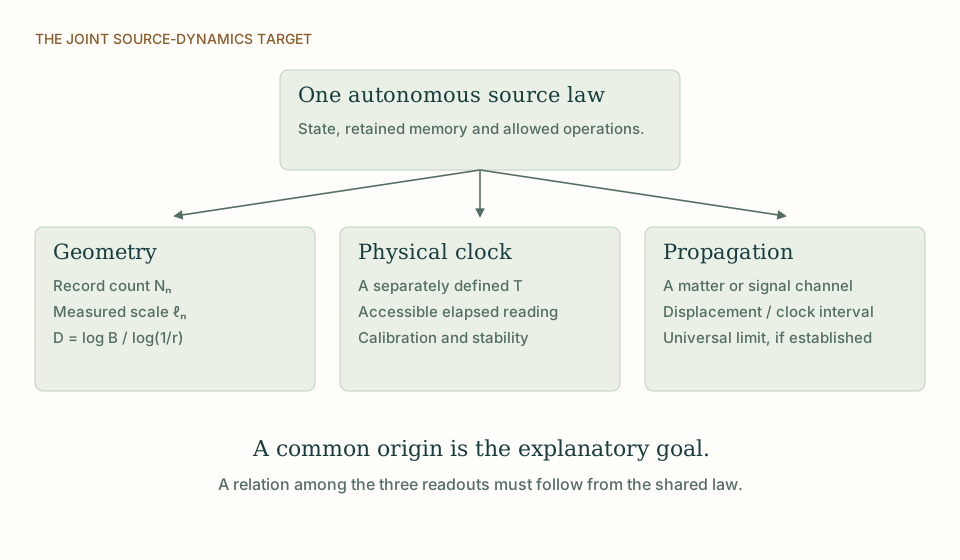
Geometry, clocks and propagation as independent readouts. A single source model should explain the relation between separately defined measurements. Sharing a diagram does not impose that relation. View full size ↗
03Why completion delays matter
Suppose a reflecting device waits a known interval δ before returning the signal. In the simple common-rest-frame calibration, the measured round trip contains propagation time plus that delay. The geometric estimate then uses c[(τ₊−τ₋)−δ]/2. An unmodelled processing delay would be misread as extra distance.
This is directly relevant to temporal-completion models. A source may require inner work before a record or reply is available. If that work affects a laboratory signal, it belongs in the detector or transducer model. One cannot assume that every additional source operation changes spatial length, or conversely that every operational delay changes the invariant vacuum speed.
R = (c/2)[Δτround trip − δ]
The subtraction assumes a delay calibrated in the same rest-frame timing model; relativistic moving devices require a complete worldline calculation.
04What one observer can and cannot reconstruct
Repeated radar experiments can establish distances to reflectors and compare their change over time. A network of observers can add consistency conditions by exchanging signals and clock records. To infer a three-dimensional metric geometry, the resulting distances must satisfy the relevant relations and be embedded in an appropriate spatial model.
A list of delays alone need not be symmetric or obey a spatial triangle inequality. Directed communication networks can have asymmetric latencies; waiting rules can depend on memory and congestion. A source-based geometry must identify which latency component is metric, which is device response, and which reflects curvature or nontrivial causal structure. This turns the language of temporal distance into a reconstruction problem.
05Curved spacetime and accelerated observers
In a general setting, radar coordinates remain tied to an observer’s worldline and causal access. They need not provide one global coordinate chart. Horizons may exclude events from round-trip communication, and different observers can assign different operational distances while agreeing on invariant physical relations.
The SMM/DTT comparison therefore concerns operational covariance. If outer completion defines a record order, the model must explain how different physical receivers reconcile their readings without assuming an observable universal simultaneity. An inner generative order may be part of the model’s ontology, but its physical interpretation depends on whether it imposes detectable preferred-frame effects.
06Separating a turnaround delay from distance
Suppose the elapsed time between emission and reception is twelve nanoseconds, but the remote receiver waits two nanoseconds before returning the signal. Under the same stationary, reciprocal propagation assumptions as the radar formula, the propagation interval is ten nanoseconds. The inferred one-way distance is therefore approximately 1.50 metres. Ignoring the receiver delay would assign approximately 1.80 metres to the same path.
This elementary correction matters for a theory in which completion itself can require internal operations. A retained record of a return event may include transit time, detector response and processing delay. A source model should identify which contributions define geometry and which belong to the measuring apparatus. Varying the receiver protocol while holding the path fixed provides an operational separation. If the proposed geometry changes with every adjustable detector delay, it has not yet become an apparatus-independent spatial relation.
07A constructive benchmark for a source model
A finite model could specify source states for an emitter, reflector, receiver and clock, derive the distribution of round-trip completion intervals, and compare its inferred distance with an independently generated adjacency metric. Agreement would be a real joint result because the two measurements have different definitions.
The strongest extension would show that the agreement survives different source refinements, moving receivers and allowed device perturbations with the same calibration rules. This illustrates how a modest operational calculation can advance the larger SMM/DTT aim: temporal generation would account not just for an abstract coordinate but for the physical procedure by which a world becomes measurable.
THE SAME QUESTION, DIFFERENT STARTING POINTS
The comparison at a glance
Question
SMM/DTT
Radar coordinates in relativity
Access to space
Spatial relations should become measurable through completed interactions.
Radar distance is defined from round-trip clock records.
Needed inputs
Generate clocks, signals and response delays together.
The basic formula assumes a calibrated propagation and device model.
Covariance
Explain compatible records for different observers.
Radar coordinates depend on a worldline and its causal access.
KEEP THE CONNECTION
Key ideas
Radar ranging provides an independently measurable target for temporal geometry.
Processing or completion delays must be separated from propagation in the model.
A global spatial metric requires more structure than a list of signal latencies.
Compare operational ranging with metric reconstruction.
Sources and further reading
References support the comparator and the specific mathematical or interpretive claims indicated. SMM/DTT connections are developed in the analysis above.