Thermal clocks and the Tolman–Ehrenfest equilibrium law
A static gravitational field links thermal equilibrium to clock redshift. The Tolman–Ehrenfest relation is therefore a useful benchmark for a theory that connects temporal structure with gravity. A short two-height calculation shows how a SMM/DTT clock proposal could meet a concrete thermodynamic consistency condition.
A static observer measures both a proper time interval and a local temperature. These are different measurements: one concerns a clock along a worldline, the other concerns equilibrium statistical behavior of local matter. General relativity relates their spatial variation through the static metric. This provides a stronger comparison than merely saying that gravity affects time.
SMM/DTT’s common-source goal is to connect physical clocks with the same generative structure that supports matter and geometry. A model that recovers the right redshift but assigns inconsistent equilibrium temperatures would not yet achieve that connection. Thermal equilibrium tests whether its clock, energy and statistical dictionaries fit together. [1]
02The static metric convention
Use the static line element ds² = −N(x)²c²dt² + hᵢⱼdxⁱdxʲ, with positive lapse N in the region considered. An observer at fixed spatial coordinates has proper time dτ = Ndt. The Tolman–Ehrenfest condition says that local equilibrium temperature satisfies T(x)N(x) = constant.
Thus different local temperatures can coexist in one global equilibrium. The temperature gradient compensates for gravitational redshift in comparing energy exchanges. The result is not a claim that heat spontaneously flows from a cooler place to a hotter one in contradiction with local thermodynamics; the equilibrium comparison includes the gravitational energy accounting. [2]
dτ = N(x)dt
Teq(x)N(x) = T∞
Static spacetime with observers following the timelike static flow; T∞ is a normalization constant for that flow.
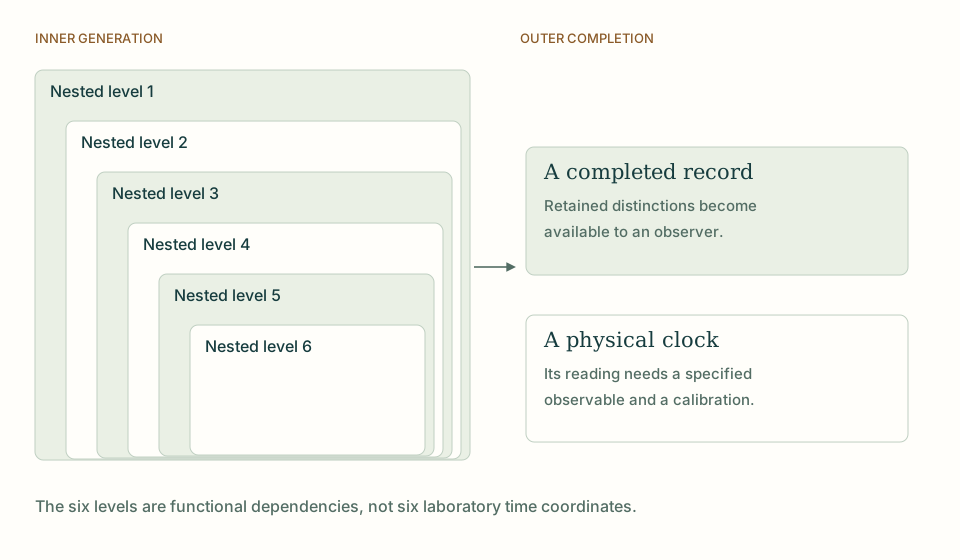
Six nested inner levels and outer completion. The nesting indicates functional dependence in the SMM/DTT proposal. Outer completion makes a retained result available; it does not turn the six levels into six independently measured clocks. View full size ↗
03A two-location calculation
Let the lapse values at two static locations be N₁ and N₂. Equal global equilibrium implies T₂/T₁ = N₁/N₂. Meanwhile the ratio of proper clock increments for the same coordinate increment is dτ₂/dτ₁ = N₂/N₁. The temperature and proper-time factors are inverse to one another.
For the illustrative values N₁ = 1 and N₂ = 1.01, the second location has T₂ ≈ 0.9901T₁ in this equilibrium normalization, while its clock advances 1.01 times as much proper time per coordinate interval. The chosen one-percent lapse difference is a transparent toy input, not an estimate for an ordinary laboratory height.
When N is approximately 1 + Φ/c² in a weak static field, a small potential change gives ΔT/T approximately −ΔΦ/c² at equilibrium. The clock redshift has the opposite fractional sign in the same coordinate comparison. The approximation requires a small potential difference and a consistent choice of static observers.
This is a relation among already operational quantities. A temporal theory cannot establish it by defining temperature as the inverse of its clock parameter and then declaring agreement. It must connect actual equilibrium energy populations or an equivalent thermometer to the source law that also generates the clock readout.
Inner generation could supply transitions and phase accumulation, while outer completion makes clock ticks and thermometer records available. The natural task is to derive their joint dependence on the same stationary source configuration. A common constraint on local energy and clock calibration would be more informative than separately fitting both readouts to a prescribed metric.
The six nested levels organize the proposed source dependence, but their count alone fixes neither a lapse nor a thermal state. The finite model must identify stationary states, the matter energy observable, the relevant equilibrium ensemble and the observer’s clock. The Tolman relation then becomes a benchmark those independently defined quantities can satisfy or fail. [1]
06Two local thermometers in one equilibrium state
For a numerical illustration, let the static lapse at an upper station be one and at a lower station be 0.999. If the upper local temperature is 300 kelvin, the Tolman condition gives a lower local temperature of 300/0.999 kelvin, approximately 300.3003 kelvin. The two readings differ even though the combined system is in the stated static thermal equilibrium. Equality applies to lapse times local temperature.
A generative account could aim to reproduce this relation by deriving the redshift of the local energy standards and the corresponding equilibrium weights from one source interaction. Merely assigning faster inner activity to a hotter region does not accomplish that calculation. The relevant temperature is defined by local equilibrium response, and the relevant lapse relates proper-time readings to the same stationary time convention. This small example gives the proposed thermal-clock bridge a numerical and operational target without requiring an unexplained universal identification of temperature with a fundamental time rate.
07What remains different from thermal time
The thermal-time programme and the Tolman–Ehrenfest law are related questions but not identical statements. One investigates a flow associated with an algebra and state; the other concerns equilibrium in a specified static gravitational geometry. A model can reproduce the second without proving the first, and neither automatically selects a unique cosmological time or a fundamental creation process.
For SMM/DTT the value of the comparison is its precision. It identifies a joint clock–matter result that a temporal gravity model should recover. A successful derivation with fixed source parameters would strengthen the physical bridge from generative order to thermodynamic and relativistic observations.
THE SAME QUESTION, DIFFERENT STARTING POINTS
The comparison at a glance
Question
SMM/DTT
Tolman–Ehrenfest relation
Clock
A physical outer reading must arise from a source-coupled device.
Static proper time satisfies dτ = Ndt.
Temperature
An independent source-derived thermometer should be compatible with that clock.
Equilibrium requires TN to be constant.
Research target
Derive both responses from one stationary source mechanism.
The geometric benchmark already fixes their inverse spatial variation.
KEEP THE CONNECTION
Key ideas
Local equilibrium temperatures can vary in a static gravitational field.
The Tolman factor and static clock-redshift factor are inverse.
A common-source theory should derive the joint relation without redefining a thermometer as a clock.
References support the comparator and the specific mathematical or interpretive claims indicated. SMM/DTT connections are developed in the analysis above.