Source-generated charge must also cancel gauge anomalies
Quantized winding or a selected gauge group is only part of a particle theory. Its chiral charge assignments must also preserve quantum gauge consistency. A one-generation Standard Model calculation shows how anomaly cancellation creates a demanding but constructive test for SMM/DTT accounts of temporal phase, charge and matter.
A compact phase can support integer winding labels. A representation can organize states under a gauge group. Neither fact alone gives a consistent chiral quantum field theory. The interaction must remain compatible with the quantum constraints that remove unphysical gauge degrees of freedom.
For SMM/DTT, a temporal origin of charge becomes stronger when it constrains the complete matter representation content rather than producing a sequence of isolated integers. Gauge anomalies provide one such constraint. They test the joint pattern of species and charges and therefore connect the common-source idea with a real consistency requirement on the generated particle spectrum. [2]
02What a gauge anomaly tests
A classical gauge symmetry can fail to survive quantization when the chiral matter content produces an uncancelled anomaly. In the ordinary four-dimensional Standard Model framework, the relevant anomaly sums cancel among the fermions in each generation. The result depends on their representations and hypercharges.
This is different from spontaneous symmetry breaking. An anomaly is not a small correction to be ignored because the classical equations look symmetric. A proposed source-derived gauge sector needs the appropriate cancellation or another explicitly consistent mechanism. Vectorlike spectra can cancel anomalies while still failing to reproduce the observed chiral interaction pattern, so cancellation is necessary but not sufficient. [2]
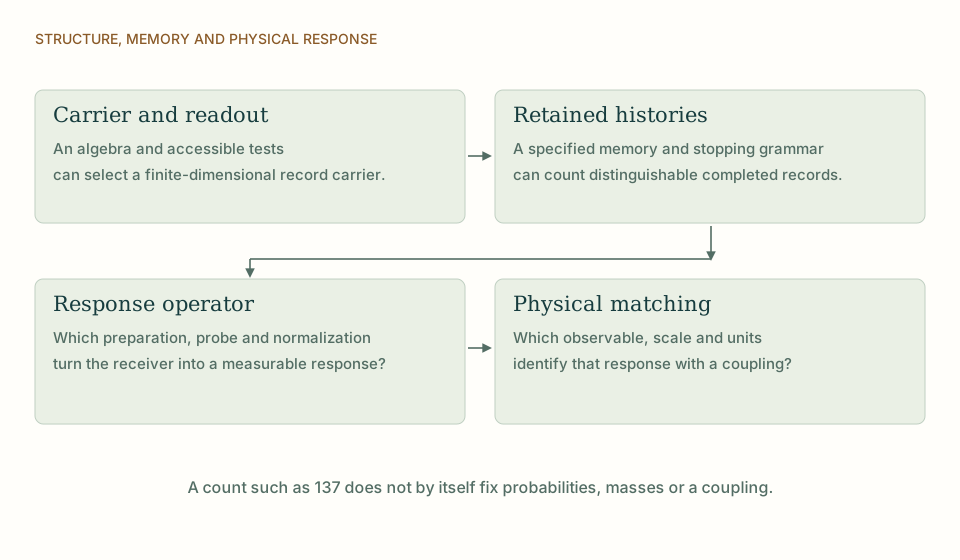
From carrier structure to a measurable response. Representation dimension, a chosen retention grammar, a response operator and physical calibration are separate stages of the constants programme. View full size ↗
03A hypercharge calculation with explicit conventions
Write all fermions as left-handed Weyl fields and use the convention Q = T₃ + Y. One generation has multiplicities and hypercharges: six quark-doublet components with Y = 1/6; three conjugate up-quark components with Y = −2/3; three conjugate down-quark components with Y = 1/3; two lepton-doublet components with Y = −1/2; and one conjugate charged-lepton component with Y = 1.
The cubic hypercharge sum is therefore 6(1/6)³ + 3(−2/3)³ + 3(1/3)³ + 2(−1/2)³ + 1. Bringing the terms to denominator 36 gives 1−32+4−9+36 = 0. The cancellation involves the full pattern, not just the integrality of a charge unit. [2]
All fields are left-handed; conjugate right-handed fields have the displayed opposite hypercharge.
04Two further checks
The mixed gravitational–hypercharge sum also vanishes: 6(1/6)+3(−2/3)+3(1/3)+2(−1/2)+1 = 0. For the mixed SU(2)²U(1) anomaly, common representation factors leave the combination 3(1/6)+(−1/2), again zero. The factor of three counts quark colours.
These examples show how the various sectors constrain one another. Changing a single hypercharge while leaving the rest fixed generally spoils a cancellation. A source rule that produces the correct correlated assignments would have more explanatory force than a rule that independently labels each species and then adjusts charges to repair the sums.
ΣY = 1−2+1−1+1 = 0
SU(2)²U(1): 3(1/6)−1/2 = 0
05The temporal source question
A possible SMM/DTT construction might use winding, holonomy or a representation of source operations to label charges. It must then state which labels correspond to left- and right-handed matter, how colour and weak representations arise, and why the normalized charge ratios follow. The six nested generative levels do not answer these questions merely by being six in number.
The strongest bridge would derive correlated representation content from a single allowed-operation algebra or a common completion constraint. Anomaly cancellation could then follow from that structure. If the cancellation conditions are imposed separately as restrictions on an otherwise free spectrum, the model should identify them as additional physical inputs rather than a derived consequence of temporal ontology. [1]
06Why a list of charges is already a restrictive test
Consider a proposed spectrum consisting of one left-handed Weyl fermion with a nonzero U(1) charge q. Its contribution to the cubic gauge-anomaly coefficient is proportional to q³, so that coefficient does not vanish. Adding a left-handed field of charge −q cancels this cubic sum and the corresponding charge sum in this simple example. The cancellation follows from the complete chiral spectrum, not from the existence of the U(1) phase symmetry alone.
This illustrates a productive test for source-generated matter. The programme can specify which retained modes behave as left- and right-handed excitations, calculate their charges in one normalization, and evaluate the anomaly coefficients before attempting a mass fit. A paired spectrum may pass these elementary checks while remaining physically different from the observed chiral matter content. A proposed mechanism must therefore explain both consistency and selection. These checks sharply constrain a candidate source representation without presupposing that its full continuum field theory has already been constructed.
07A concrete criterion of progress
A useful new source model could generate one chiral family and verify every local and relevant global gauge-consistency condition before adding masses or coupling predictions. It should distinguish a proof of consistency from a unique selection of the Standard Model, since many alternative spectra can satisfy anomaly constraints.
This comparison gives the research programme a tractable intermediate target. Temporal phase could provide a representation-theoretic origin for charge while completion constraints explain why the species fit together. Reproducing the cancellation pattern with fewer independently chosen assignments would be a meaningful constructive gain, even before claiming full interaction unification.
THE SAME QUESTION, DIFFERENT STARTING POINTS
The comparison at a glance
Question
SMM/DTT
Chiral anomaly cancellation
Charge labels
Winding or holonomy may motivate a charge construction.
A viable chiral gauge theory constrains the combined representation content.
Consistency
Derive correlated species and charges from source operations.
Cubic and mixed anomaly sums must satisfy the relevant cancellations.
Strength of result
Reducing independently assigned charge data would be constructive progress.
Cancellation alone does not uniquely select the observed particle theory.
KEEP THE CONNECTION
Key ideas
Integer winding is not sufficient for quantum gauge consistency.
Standard Model anomaly cancellation links quark and lepton assignments.
A source derivation should explain correlated chiral content, not repair each anomaly after choosing the spectrum.
Follow the common-source reconstruction programme.
Sources and further reading
References support the comparator and the specific mathematical or interpretive claims indicated. SMM/DTT connections are developed in the analysis above.