Can inner completion change a distant record? A no-signalling calculation
An accepted completion can change conditional correlations without changing a distant observer’s unconditioned data. A short operator calculation proves this for local trace-preserving quantum operations. The result provides a sharp compatibility test for SMM/DTT accounts of hidden inner activity, completion, temporal entanglement and observable communication.
Suppose two laboratories share a state ρAB and are spacelike separated according to the physical spacetime being tested. Laboratory A performs an inner process and records one of several completion outcomes. Can its choice change the statistics already available at B without an ordinary message?
The standard quantum answer is no for a local trace-preserving operation. Correlations conditioned on a particular outcome can change, but B needs information about that outcome to sort its data into the relevant subensemble. SMM/DTT can interpret the production of these records through a common source while preserving the same operational distinction. A claim of actual faster-than-light communication would require a different, fully specified prediction.
02The complete local instrument
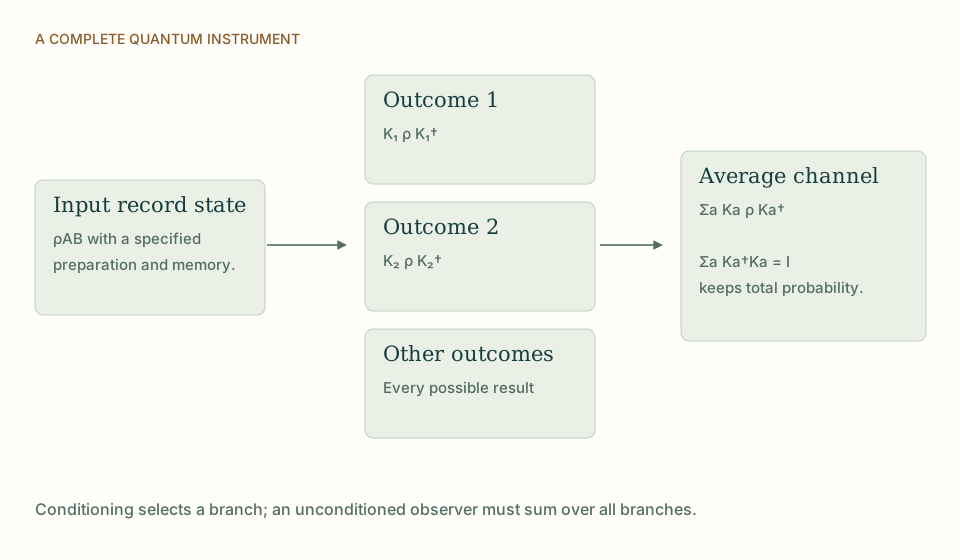
Use a Kraus-refined description of A’s outcomes, with one operator Kₐ per refined branch and completeness condition ΣₐKₐ†Kₐ = I. A recorded outcome may group several such branches. The unnormalized joint state in branch a is (Kₐ⊗I)ρAB(Kₐ†⊗I). Its trace is the probability of that outcome. The sum of all branches is the physically relevant state for someone who does not receive the outcome label.
The calculation must include failed or unaccepted completions. Dropping them changes a trace-preserving map into a trace-decreasing branch map. Renormalizing the surviving branch is legitimate when discussing a selected ensemble, but it cannot be substituted for the statistics of all trials. This is the mathematical place where apparent signalling claims often change the task being described. [2]
Σₐ Kₐ†Kₐ = IA
ρ′AB = Σₐ (Kₐ⊗IB) ρAB (Kₐ†⊗IB)
From a source process to a complete record instrument. Outcome probabilities, retained conditional states, and the outcome-averaged channel belong to the same instrument. Keeping every outcome prevents postselection from being mistaken for a signal. View full size ↗
03A direct proof of unchanged distant statistics
Let B measure an effect E, where 0 ≤ E ≤ I. Its probability after the averaged operation is the trace of (I⊗E)ρ′AB. Moving the A operators through the trace and using completeness reduces the sum to tr[(I⊗E)ρAB]. This holds for every effect E, so B’s entire reduced state is unchanged.
The proof is independent of the choice of ρAB and allows entangled inputs. Its assumptions are decisive: a bipartite observable structure, an operation localized on A, and a complete trace-preserving instrument. The theorem is not a derivation of spatial locality from a nonspatial source. It tells a source reconstruction what it must recover if these laboratories are to behave as ordinary quantum subsystems.
Use the state (|00⟩+|11⟩)/√2. Before receiving any message, B obtains zero or one with equal probability in a computational-basis measurement. If A measures and keeps only trials with outcome zero, the corresponding conditional B state is |0⟩. Trials with A outcome one have conditional B state |1⟩.
The full average remains one half of each. A has not chosen which random outcome occurs and cannot communicate a desired bit by selecting a label after the fact. Even when accepted completions are rare, B’s unsorted list contains both accepted and unaccepted events. A transmitted acceptance certificate is needed to identify the special subset.
In DTT language, a completion rule can certify when a retained record becomes available. Its physical formulation should give the instrument, the outcome probability, the record carrier and the cost of retaining or communicating the certificate. Inner activity may affect the conditional state and correlations while remaining invisible to an observer who lacks that record.
This is a substantive distinction between generative and accessible descriptions. It permits a richer source history than appears in one receiver’s state without sacrificing quantum no-signalling. What must still be explained is why the source’s allowed controls yield local instruments and why the relevant subsystem structure emerges in the first place. [1]
06A two-outcome example that keeps every record
Take the shared state (|00⟩+|11⟩)/√2 and let A measure in the computational basis. Outcome zero prepares B conditionally in |0⟩, while outcome one prepares it conditionally in |1⟩. Each occurs with probability one half. The state available to B without the outcome label is therefore the equal mixture of these two states, exactly its reduced state before the measurement.
If A instead measures in the plus/minus basis, B’s conditional states are |+⟩ and |−⟩. Their equal mixture is again the same reduced state. The two completion procedures generate different labelled ensembles while leaving the unlabelled records at B identical. This is a concrete way for SMM/DTT to describe different inner organizations behind the same accessible statistics. The interpretive freedom becomes experimentally consequential only if a proposed dynamics changes a fully specified, unconditioned observable.
07How the result can guide a new model
For a proposed completion dynamics, the first operational comparison is between B’s full output distributions under two choices at A. A difference in a postselected subset does not answer that question. If the complete map is nonlinear, nonlocal or not trace preserving when all outcomes are included, the model departs from the assumptions and must state its replacement probability law.
Conversely, if the calculation above applies, the model predicts no signal through this channel. That null result is a useful physical restriction. It makes the claimed hidden inner dynamics compatible with accessible quantum records and focuses novelty on other consequences, such as memory structure, contextual completion or a derivation of the admitted operations.
THE SAME QUESTION, DIFFERENT STARTING POINTS
The comparison at a glance
Question
SMM/DTT
Completely positive quantum instruments
Completion
A record becomes accessible through a specified source operation.
An instrument specifies outcomes, probabilities and conditional states.
Conditioning
Inner histories may distinguish accepted records.
Postselected changes do not alter unsorted remote statistics.
Physical test
Recover locality and complete probability accounting from source dynamics.
A local trace-preserving map leaves the remote reduced state unchanged.
KEEP THE CONNECTION
Key ideas
No-signalling follows directly from local trace preservation, even with entangled inputs.
Accepted completions must be accompanied by the rest of the outcome space.
A communicated completion certificate is an ordinary information resource.
Compare the framework’s temporal-entanglement interpretation.
Sources and further reading
References support the comparator and the specific mathematical or interpretive claims indicated. SMM/DTT connections are developed in the analysis above.