A receiver with 137 states supports a precise record-count result. Turning that count into an inverse coupling requires more structure. A family of density matrices and a two-channel susceptibility calculation show exactly where preparation, symmetry, coupling and physical calibration enter the proposed SMM/DTT bridge.
A selected history grammar can yield 137 distinct completed records. If a single error-free measurement must distinguish all of them, the receiver needs at least 137 orthogonal states, and a free record space of that size attains the bound. This is a useful conditional result about a task and its retained information.
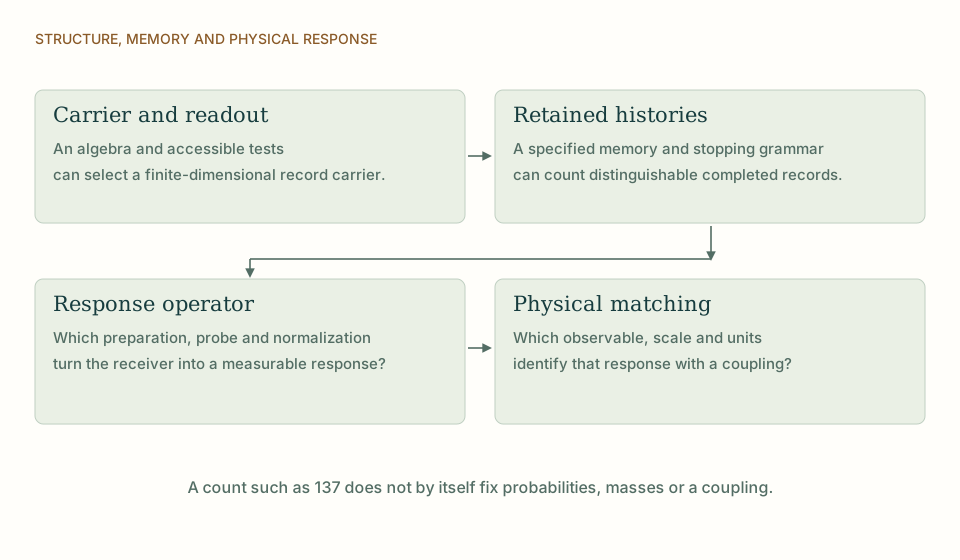
The next step is different: which state is prepared on that receiver, which operator represents a physical probe, and how is the response normalized? These are mathematical questions before they become experimental ones. A count can constrain possible responses while still leaving their actual value undetermined. [2][3]
02When one over the dimension appears
For a D-dimensional receiver in the maximally mixed state ρ = I/D, any rank-one projector P has expectation tr(ρP) = 1/D. For D = 137 this gives 1/137. The result is exact because both the state and the probe were specified.
It does not follow from D alone. If the physical preparation is required to be invariant under every unitary acting on the receiver, then a normalized density matrix must be I/D. That is a strong symmetry condition on the admitted operations and state preparation. A smaller physical symmetry group may leave several invariant sectors with independent weights. [3]
ρ = I/D, rank(P)=1 ⇒ tr(ρP)=1/D
The normalization follows from a specified state and rank-one probe, not merely from the size of the Hilbert space.
From carrier structure to a measurable response. Representation dimension, a chosen retention grammar, a response operator and physical calibration are separate stages of the constants programme. View full size ↗
03The same dimension supports other probabilities
Let 0 ≤ p ≤ 1 and define ρp = pP + [(1−p)/(D−1)](I−P). This is a valid normalized density matrix on exactly the same D-dimensional space. Its expectation of P is p. Thus the same 137-state receiver admits every probability between zero and one for this probe through different preparations.
This is not a defect in the counting result. It identifies the selection problem: a source law must pick the relevant preparation and physical measurement. Equating a generic probability with the electromagnetic coupling would add another independent identification. A physical response can involve amplitudes, spectral denominators and interaction normalizations that are absent from this counting example.
04A response that depends on hidden-channel coupling
Consider a positive two-channel quadratic response operator K with entries a, b, b, d. If a probe couples only to the first channel, its static susceptibility is the first diagonal entry of K⁻¹: 1/(a−b²/d). The answer depends on the hidden-channel coupling b and stiffness d as well as on the visible coefficient a.
Keeping the number of channels fixed while changing b changes the susceptibility. In a larger receiver, the same structure appears through a block Schur complement. This provides a precise route from retained states to response, but it makes clear why receiver dimension does not choose the interaction matrix or its physical normalization.
K = [[a,b],[b,d]], d>0, ad>b²
χ = (K⁻¹)11 = 1/(a−b²/d)
A static linear-response toy model with positive quadratic form; the displayed coefficients are supplied inputs.
05Structural vacuum values and measured couplings
The structural numbers discussed in the SMM/DTT programme should be kept in their stated vacuum or receiver role. They are not automatically low- and high-energy values of a running coupling. A comparison with measured electromagnetism must identify a renormalized observable and its scale, then calculate any mass, holonomy or radiative contributions using independently fixed parameters.
Calling a small difference a holonomy correction is a proposal for a mechanism, not its calculation. The mechanism becomes predictive when its operator, state and physical matching determine the correction without using the measured answer to set them. This is how the structural construction can retain its originality while acquiring a stronger physical interpretation. [3]
06The freedom can be tested without a numerical fit
One can organize a constructive test around a symmetry class instead of a desired decimal value. First specify the transformations the receiver preparation must respect and determine all density matrices invariant under them. Next specify the probe class and the allowed response operators. If several independent sector weights remain, a proposed universal response must explain why they are fixed or why the measurement is insensitive to them.
This procedure can produce a useful positive result even when it does not yield a unique coupling. For example, a symmetry may force equal probabilities within each irreducible sector while leaving the total weights of different sectors free. The source theory has then explained part of the response and isolated the remaining choice. A subsequent dynamical selection principle can address that choice directly. This sequence is stronger than adjusting an unspecified correction because each stage has an independently checkable mathematical conclusion.
07The positive research target
A strong next result would show that one source dynamics selects the 137-record grammar, the relevant invariant preparation, the probe and the response matrix together. If symmetry protects a normalized value, the proof should specify the full admitted operation set and the perturbations under which that value remains fixed.
The density-matrix and susceptibility examples make the outstanding freedoms visible. They also show that the needed bridge is mathematical and constructive, not merely a demand for new experiments. Deriving that bridge would turn an exact structural count into a restricted family of physical responses that could then be compared with electromagnetism.
THE SAME QUESTION, DIFFERENT STARTING POINTS
The comparison at a glance
Question
SMM/DTT
Quantum state normalization and susceptibility
Count
A retention grammar can produce 137 distinguishable completed records.
Dimension determines capacity, not every state or expectation.
One over 137
Requires a selected preparation and a specified observable.
A rank-one projector in I/137 has expectation 1/137.
Coupling
Derive the source response and physical matching without fitting the result.
Static response depends on the full interaction operator and its normalization.
KEEP THE CONNECTION
Key ideas
The same 137-state space supports many different probabilities and responses.
A symmetry-selected maximally mixed state explains one over the dimension for a specified projector.
A physical coupling requires a source-selected operator and an independent calibration.
Compare receiver counting and response in the live interactive workbench.
Sources and further reading
References support the comparator and the specific mathematical or interpretive claims indicated. SMM/DTT connections are developed in the analysis above.