
An update label, a recurring phase, and a material clock reading are different objects. Their agreement is a property to construct and test.
A clock makes a comparison
Watch a pendulum while an event takes place. Counting its swings compares that event with a repeated process. To use the result as duration, you also need a counting convention, stable operating conditions, and a calibration. A pendulum that changes its period unpredictably still moves, but it provides a different quality of reference.
The conceptual question in Time Chest becomes sharper when the clock is included in the world being explained. SMM seeks a common source for the clock and the measured event. DTT asks how a completed clock record relates to the inner activity that produces it. Calling the source’s update number time does not by itself construct that relationship.
A pointer needs a count of completed turns
Consider an ideal dial with four positions labelled zero through three. Each step advances the pointer by one. After four steps it returns to zero, so the visible position alone cannot distinguish zero steps from four, eight, or twelve steps.
Add a turn counter k. If q is the pointer position, the total step count is N=4k+q, assuming the initial reading was zero and the counter has not overflowed. With each step calibrated to one quarter second, the reading is τ=N/4 seconds. The phase and counter do different jobs: the phase identifies a location within the cycle, while the counter retains how many cycles have passed. Reliable timekeeping needs both within its declared operating range.
See where a single scale enters
Suppose every completed return is counted by a nonnegative integer n. An additive clock assigns a reading θ(n), with θ(n+m)=θ(n)+θ(m). Set θ(1)=δ. Repeated addition then gives θ(n)=nδ for all nonnegative n. For δ positive, two different counts give different readings.
Any second clock obeying these premises differs by one positive conversion factor. The conclusion follows from the chosen count structure and additivity; it does not show that every material instrument obeys those premises. Nor does it determine the absolute value of δ in seconds.
Make inner activity invisible to one readout
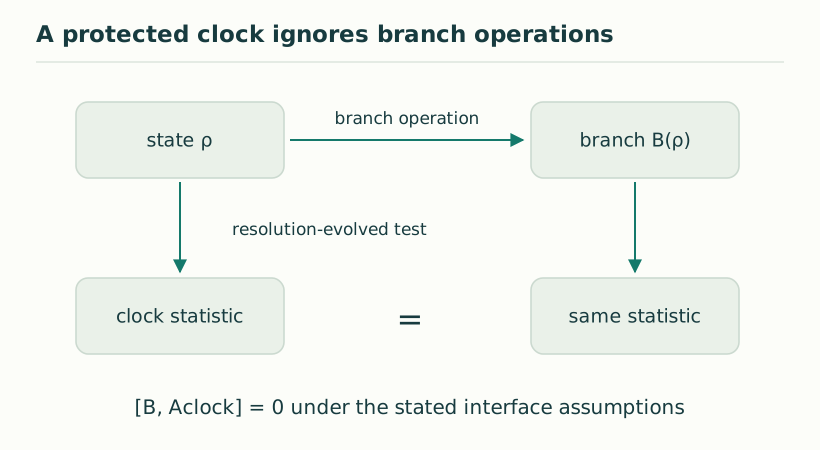
A simple model has a working bit g and a clock counter q. Let a branch operation flip g while leaving q unchanged. Let a resolution operation advance q while leaving g unchanged. An observer reading only q detects the resolution operations and is insensitive to the branch operations, even though internal work continues.
A related quantum construction protects a readable clock sector through its interaction algebra. In that setting, the relevant branch generator commutes with the clock observables carried through resolution evolution. The diagram presents this scoped criterion. The elementary bit model illustrates the idea; the quantum criterion specifies when the same statistical insensitivity holds for the admitted state and operation interface.
Compare two legitimate responses
Count u branch operations and r resolution operations. The protected counter above reads r units. An ungated counter that advances during both kinds reads u+r units. If u=6 and r=2, the two readings are two and eight. For u=2 and r=2, they are two and four.
A single fixed change of units cannot reconcile both comparisons, because the ratio changes with the operation mix. The clocks measure different aspects of the process. This is an exact counterexample to inferring universal clock behavior merely because devices share a generator. A fundamental source theory must explain which couplings physical clock-bearing matter realizes and why that choice remains stable under allowed disturbances.
Give the nested hierarchy a clock interface
The six inner DTT roles are nested dependencies in forming a record. Outer completion is the seventh role that makes the result available. Neither the number six nor the naming of an outer event fixes how a material oscillator accumulates phase during the process.
A satisfactory construction therefore specifies the clock preparation, its coupling to each operation, the readable quantity, and any phase-unwrapping or counting memory. It also states whether writing, transport, and later reading consume duration according to that same clock. When geometry and matter propagation are introduced, their conversion to clock units must be derived using this defined response. Independent calibration prevents a desired relation from being inserted through the measurement convention.
Test a clock by changing the process
Try the branch-and-resolution example with several pairs (u,r). Keep the resolution count fixed while changing branch activity, and predict both clock readings before calculating them. This separates a protected response from a response that merely happened to agree on one run.
Read A86 for additive clock uniqueness, A108 for a protected material example, and A110 for the universality question. The useful SMM/DTT target is a shared physical law that relates source activity, clock records, and measured motion. A dial, a counter, and a named temporal variable become a clock theory only when their operational relationships are stated.
Continue with the articles
- What is Time?
A definition of time must distinguish succession, duration and observation. Simple record models show why an ordered series of events does not yet provide a physical clock or a complete predictive state.
- The Three Hypotheses of the Single Monad Model
The three SMM hypotheses concern a common source, lawful renewal and the relation between generative order and observed time. Their combined physical content depends on a shared dynamics that constrains geometry, clocks and propagation together.
- When an additive clock is unique
An ordered rank-one return structure permits a faithful additive scalar clock only up to positive rescaling. Independent return directions and path-dependent delays show where that uniqueness stops.
- A protected material clock
An encoded two-qubit clock can ignore branch activity while responding to resolution. A controlled coupling mismatch produces a calculable failure, making both the protection and its assumptions testable.
- Why one clock model does not prove universality
Protected and ungated clocks can coexist with the same record geometry while assigning different readings to it. This countermodel shows why constructing one desired clock does not establish a universal material-clock law.
- Six inner stages and one publication interface
A six-digit nested counter with paired signed readout realizes ranks 1, 1, 2, 2, 3, 3 before one completion interface. Its exact counts reveal sampling bias and the restricted assumptions behind the six-channel bound.
- Reading Volume IV: Time Chest
Time Chest offers a conceptual route into particle–wave questions and temporal confinement. An ideal interferometer connects its themes with retained phase, localized records and the operational baseline a DTT account must reproduce.