
An event order admits many compatible numerical clocks. A physical clock law requires a stable observable, calibration, and a reason independently prepared clocks agree.
A relation can have objective consequences
The ordering of letters changes the meaning of a word, even though order is not an additional letter. Temporal relations can likewise organize events without being pictured as a substance flowing past them. Calling time relational does not imply that its comparisons are arbitrary or merely subjective.
The useful questions are concrete: which events are compared, what establishes precedence, and how are intervals measured? A clock is itself a physical process whose states can be compared with other processes. A theory of emergent time must therefore include the clock’s preparation, coupling, and memory among the structures it explains.
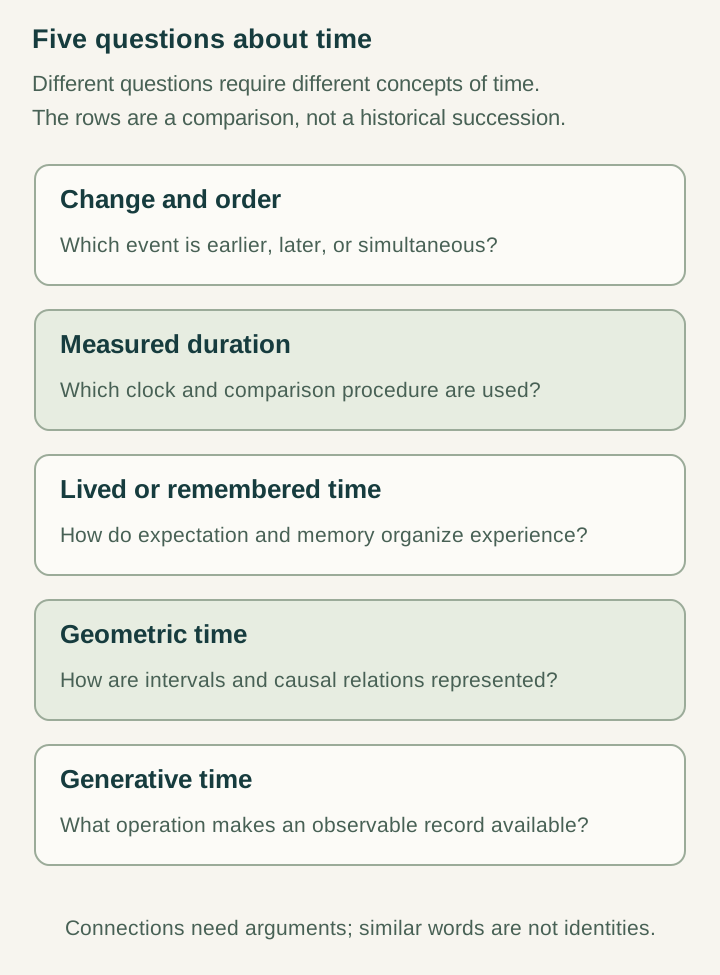
Open the full-size diagram →
One order permits different duration assignments
Let A precede B and B precede C. Readings 0,1,2 assign equal successive intervals; readings 0,1,5 assign unequal intervals. Both preserve the same order. An increasing transformation can keep precedence intact while changing all acceleration and frequency statements expressed through the transformed variable.
τ(B)−τ(A) relative to τ(C)−τ(B).
Multiplying every duration by one positive constant is a unit change. A nonlinear relabeling can instead alter which process appears uniform. A model must specify whether such a transformation is a harmless change of description accompanied by transformed equations or a different physical clock response.
A cycle is not yet an elapsed-time record
A pointer rotating on a circle returns to the same phase after one revolution. A receiver seeing phase alone cannot distinguish one revolution from several. Add a counter k, and the state becomes (phase,k). It now retains information about completed returns.
This example separates recurrence from memory. To measure duration, the cycle must also remain reproducible under the relevant environmental conditions. To compare two clocks, the model must specify their interaction or shared events. A universal claim cannot be obtained merely by using the same integer label for both counters; it concerns their actual observable relation under repeated preparation and measurement.
What makes an additive clock useful?
Suppose every allowed transition carries a positive delay d, and concatenating transitions adds their delays. Then a history’s duration is the sum of its transition delays. If two different paths join the same pair of events, a single-valued event clock exists only when their summed delays agree.
For a triangle A→B→C and A→C, delays 2,3,5 are consistent. Replacing the direct delay by 6 prevents those assignments from being differences of one global event function. The mismatch could represent path-dependent proper duration or an inconsistent proposed global clock, depending on what the paths physically mean. The interpretation must identify which quantity is intended.
The inner label and the material clock
In DTT, an inner update index orders generative operations, while an outer record supplies what an observer can read. The six nested roles need not each advance a material clock. But clock insensitivity to an operation must follow from the coupling and remain valid for subsequent readouts.
For example, a branch operation may leave a clock’s immediate pointer unchanged yet alter its later frequency. It is then not invisible to the clock experiment as a whole. The source model should define the clock observable independently, calculate its response, and explain any protection from internal generation. This is where the relational idea becomes a concrete dynamical problem.
From a philosophical position to a measurable relation
Read A5, A11, and A14 for order and measurement; A85–A86 for additive clocks; and A105–A110 for material clock selection. These routes distinguish the origin of an ordering relation from the selection of a particular reliable duration measure.
The strongest SMM/DTT target is one dynamics that generates spatial comparisons and clock behavior together. Ask whether their relation is fixed across a family of source settings, whether different material clocks agree, and which transformations preserve all observable comparisons. A relational account then explains shared temporal structure without needing to claim that every question about experienced time or metaphysical becoming has the same answer.
Continue with the articles
- Time in Philosophy and Science, Introduction
Temporal order, measured duration and experienced passage answer different questions about time. Their distinction clarifies how SMM/DTT connects generative activity with completed events and accessible records.
- What is Time?
A definition of time must distinguish succession, duration and observation. Simple record models show why an ordered series of events does not yet provide a physical clock or a complete predictive state.
- The Origin of Time
Explaining the origin of time requires distinguishable events, stable records and compatible clock readings. A featureless rotating sphere and a simple completion model show why change alone does not supply measurable duration.
- From available records to a temporal arrow
Completed returns that preserve or increase accessible records form a positive monoid. Under additional separation and clock conditions, this supplies an effective forward order without proving thermodynamic irreversibility.
- When an additive clock is unique
An ordered rank-one return structure permits a faithful additive scalar clock only up to positive rescaling. Independent return directions and path-dependent delays show where that uniqueness stops.
- What makes a clock insensitive to branching?
A material clock ignores branching exactly when the branch generator commutes with its full delayed-observation algebra. Immediate readouts alone can miss hidden motion that later resolution exposes.
- A protected material clock
An encoded two-qubit clock can ignore branch activity while responding to resolution. A controlled coupling mismatch produces a calculable failure, making both the protection and its assumptions testable.
- Why one clock model does not prove universality
Protected and ungated clocks can coexist with the same record geometry while assigning different readings to it. This countermodel shows why constructing one desired clock does not establish a universal material-clock law.